Everton FC Origins: How St. Domingo's Church Saved Liverpool's Youth (Part 1)
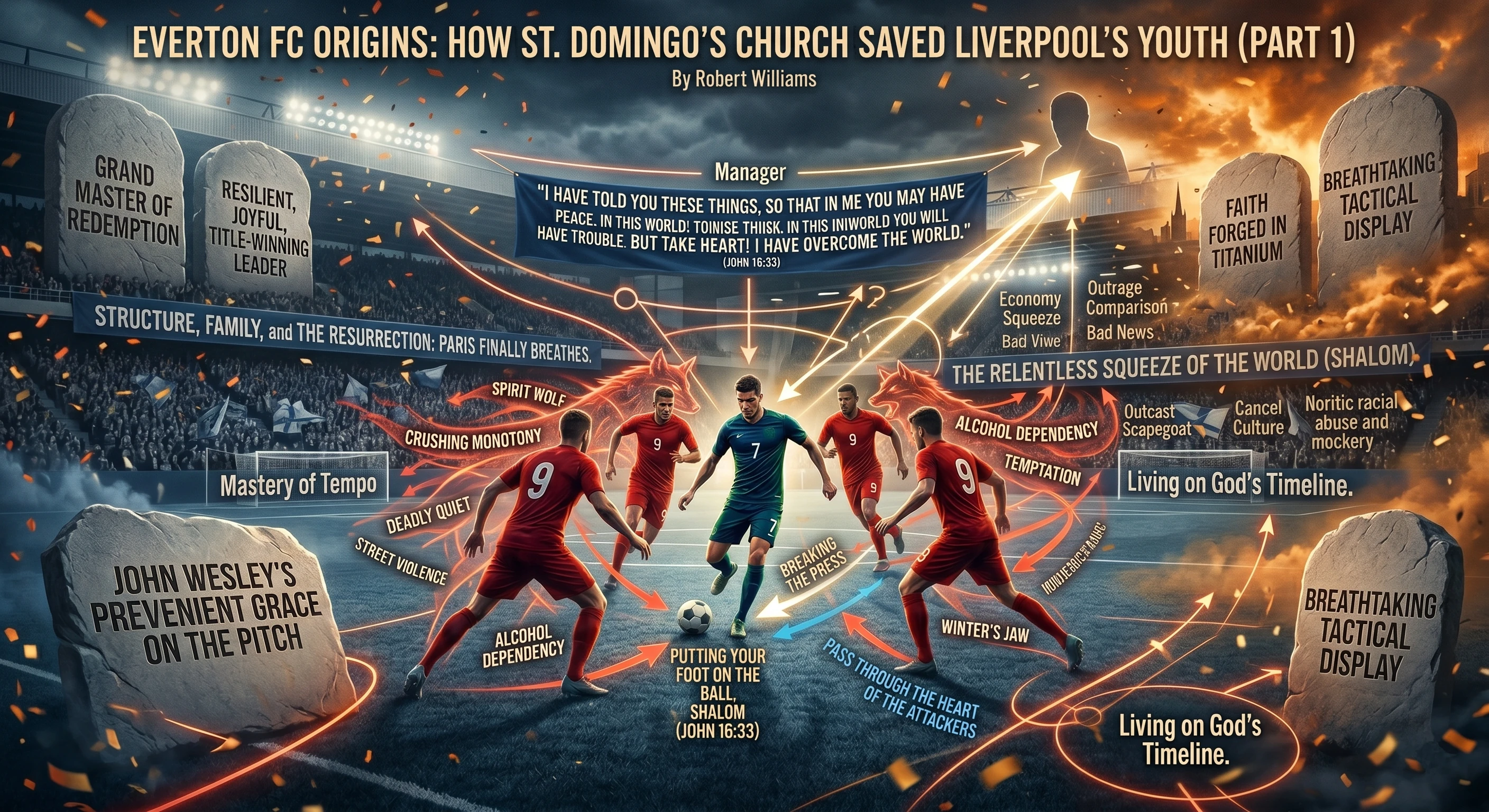
Welcome back to the 'Root & Legacy' series on The 91st Minute. In our previous global features, we witnessed how faith can build an ark for the displaced. Today, we return to the rough, rain-soaked streets of 19th-century England to explore an era where the Church did not merely stay inside its sanctuaries, but stepped directly onto the mud of the football pitch to fight for the souls of the next generation. This is the remarkably rich, untold story of Everton FC—a club known today as a Premier League staple, but born in 1878 out of a Methodist pastor’s radical determination to protect his youth from the freezing jaws of winter and temptation.
The Deadly Quiet of the Liverpool Winter
To understand the birth of Everton Football Club, one must understand the crushing monotony of winter in a Victorian industrial port. In the late 1870s, Liverpool was expanding at a breakneck pace. It was a city of soaring economic wealth, but beneath the surface lay thousands of working-class families crammed into bleak, smog-choked neighborhoods.
For the young men of the district, life was defined by grueling labor and an agonizing lack of clean recreation. During the beautiful, light-filled months of summer, the young men of the St. Domingo Methodist New Connexion Chapel had a healthy outlet: they played cricket. The church cricket team kept them active, focused, and deeply connected to a supportive community.
But in England, summer is notoriously fleeting.
When November arrived, the cricket pitches turned to freezing mud, the sun set at four in the afternoon, and a deadly quiet settled over the youth. With no sports to play, the young men were left entirely to their own devices. In 19th-century Liverpool, an idle youth on a dark winter evening was a recipe for tragedy. The street corners were ruled by territorial gangs, and the only warm, lit buildings welcoming working-class lads were the local public houses.
The winter was a spiritual graveyard, dragging the next generation into a cycle of alcohol dependency, street violence, and hopelessness.
The Birth of St. Domingo’s FC
The leadership of St. Domingo Methodist Church looked at this seasonal pattern and refused to accept it. They recognized that the church could not simply preach holiness on Sunday morning while abandoning their youth to the wolves of the streets on Tuesday night.
In 1878, spearheaded by the church’s visionary minister, Rev. Ben Swift Chambers, and the Sunday School leadership, the church made a historic tactical adjustment. If summer had cricket, winter needed a game that could be played in the freezing rain, a game that required intense physical exertion and absolute discipline.
They chose association football.
They formed St. Domingo’s Football Club. The boys cleared a piece of land in Stanley Park, fixed makeshift goals, and began to play. The response was overwhelming. The young men who had been drifting toward the pubs were suddenly running, tackling, and sweating under the banner of the church. Just one year later, as the team grew so large that players from outside the parish clamored to join, the club officially changed its name to reflect the wider district.
St. Domingo’s FC became Everton FC. The foundations of a football giant were poured using the holy concrete of pastoral concern.
John Wesley’s Prevenient Grace on the Pitch
When we analyze the creation of Everton FC through a theological lens, it stands as a flawless, practical manifestation of a core Methodist doctrine pioneered by John Wesley: Prevenient Grace.
Prevenient grace is the beautiful truth that God's love is active in a human life long before that person is even aware of Him. It is the grace that goes before us, constructing an invisible shield, surrounding us with mercy, and drawing us toward the Father before we ever take a step toward repentance.
The world’s approach to morality is almost always reactive. It waits for a young person to commit a crime, fall into addiction, or ruin their life, and then it steps in to punish, judge, or attempt rehabilitation.
But Rev. Chambers and the St. Domingo leadership utilized the tactical blueprint of prevenient grace. They did not wait for their Sunday School boys to get arrested in the slums of Liverpool before trying to save them. They moved first. By creating a football club, they built a holy barrier of prevention. They gave the youth a clean alternative, capturing their energy, time, and hearts before the dark temptations of the city could corrupt them.
The football pitch became an instrument of God's preventing mercy.
The Heart of the True Shepherd
This proactive, aggressive pursuit of the next generation perfectly mirrors the heart of the True Shepherd described by the prophet Ezekiel. God fiercely condemned spiritual leaders who sat comfortably in their temples while the flock was scattered and destroyed by the environment:
"You have not strengthened the weak or healed the sick or bound up the injured. You have not brought back the strays or searched for the lost... So they were scattered because there was no shepherd, and when they were scattered they became food for all the wild animals." (Ezekiel 34:4-5, NIV)
St. Domingo Methodist Church refused to let their boys become "food for the wild animals" of Liverpool's underworld. They understood that pastoral care is not passive. It requires putting on boots, walking into the cold wind of Stanley Park, and blowing a whistle to gather the strays.
As we watch the multi-billion-dollar spectacle of modern football today, we must never forget that clubs like Everton were not founded by businessmen looking for profit, but by shepherds looking for their sheep.
(In Part 2, we will look at how this small church team transitioned into the professional era, the spiritual value of physical discipline, and the urgent challenge Everton’s roots pose to the modern, screen-saturated Church.)