Forest Bathing: Letting God's Creation Slow Your Racing Mind
Living in a city means spending most of your day in an artificial environment.
You check your phone the moment you wake up, spend the day surrounded by traffic noise and work notifications, and often end up staring at a screen again before bed.
Your body might look like it's just sitting in a chair, but your brain and nervous system are constantly processing information. Add in work problems, family responsibilities, financial worries, and relational tension, and body and mind end up staying tense without you even realizing it.
But step into a forest and walk slowly, and something different happens.
Watching sunlight filter through leaves, listening to branches sway in the wind, breathing in the scent of soil and trees — the tangled thoughts in your head start to settle, little by little.
Why is that?
Forest bathing — a practice that's been drawing growing attention in the health world — focuses on exactly this kind of experience in nature.
From a Christian perspective, there's one more layer worth thinking about here. The nature we encounter in a forest isn't just scenery — it's the world God created.
"And God saw every thing that he had made, and, behold, it was very good." (Genesis 1:31, KJV)
Time spent walking through a forest can be a moment that releases physical tension, while also slowing down the pace of our lives inside the world God made.
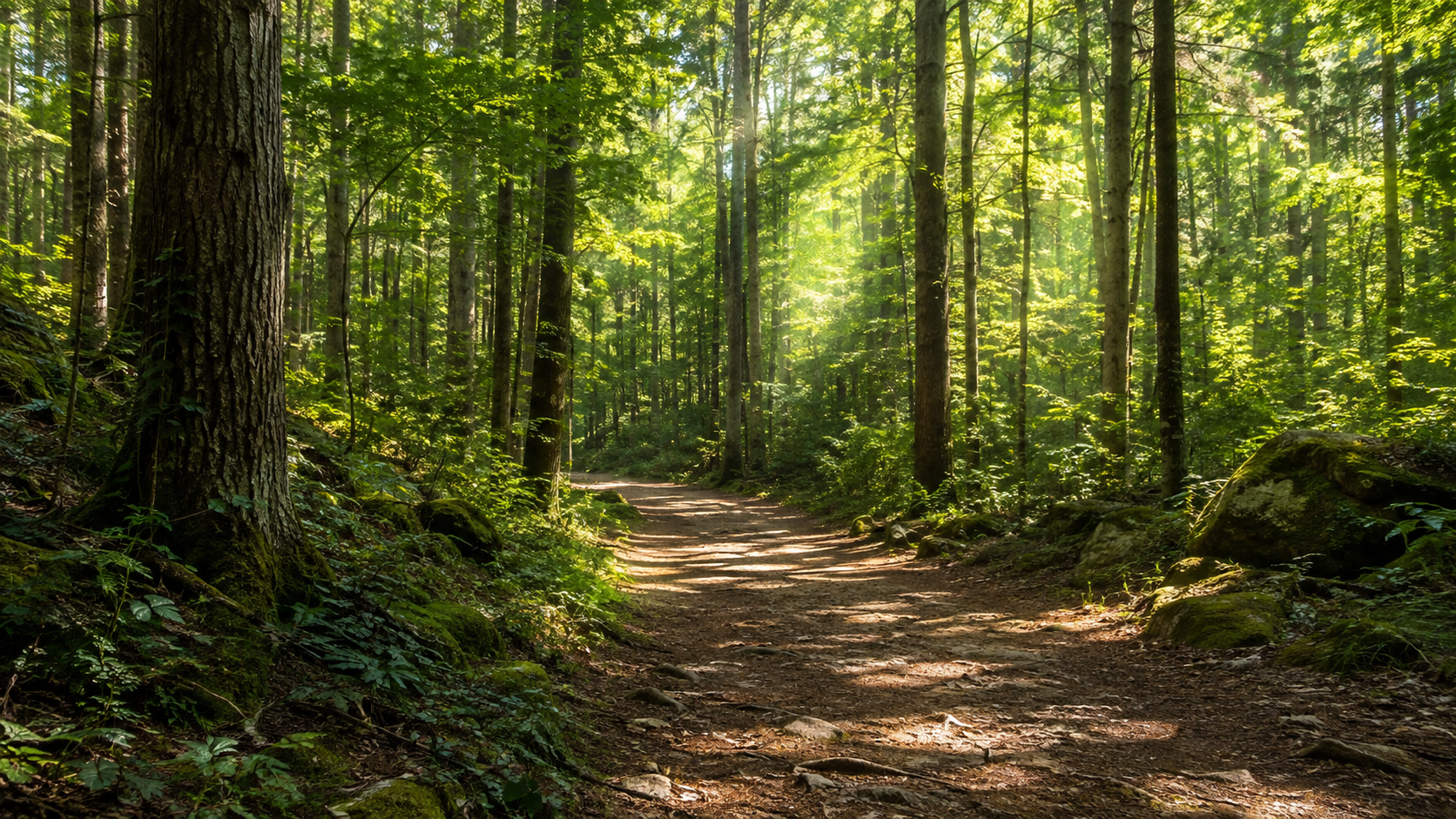 A quiet forest path glows under soft, dappled sunlight as tall trees and rich greenery surround the trail. The image captures the calm, restorative atmosphere often associated with forest bathing and time spent in nature.
Forest Bathing Isn't Simply Exercise in the Woods
Forest bathing is a concept developed in Japan, commonly known as shinrin-yoku (森林浴).
Translated literally, it means something close to "immersing yourself in the atmosphere of the forest."
It doesn't require a special exercise program or a complicated meditation technique. The core of it is simply spending time in a forest or natural setting, slowly opening your senses — sight, hearing, smell, touch — to what's around you.
So how fast you walked, or how many steps you took, isn't really the point.
Simply pausing to look at a tree, listen to birdsong, and feel the wind is enough.
When we think about managing our health, we usually start by asking "what more should I be doing?" More exercise, stricter dietary control, more information to learn.
But sometimes, simply stopping is itself an important choice for your health.
Why Forests May Affect Stress
Our bodies naturally shift into a tense state under stress.
Heart rate can climb, blood pressure can rise, and various stress-related physiological responses show up.
These responses are a normal part of dealing with danger. The problem is when that tense state lasts too long.
Chronic stress is linked to sleep and mood, and also to blood pressure and cardiovascular health, among other things.
That's exactly why spending time in nature has drawn so much interest. A number of studies have observed that people's stress levels and certain physiological markers shift in a positive direction after time spent in forests or green spaces. A 2019 systematic review pooling 22 studies found that cortisol levels — a key stress biomarker — were significantly lower after forest exposure in nearly every study reviewed, and a separate meta-analysis of 20 trials involving over 700 participants found that both systolic and diastolic blood pressure were significantly lower in forest environments compared to non-forest settings.
To be clear, this doesn't mean forest bathing is a medical treatment for high blood pressure, heart disease, or depression.
Diagnosis and treatment of illness should always involve a doctor's care.
But time spent in nature can genuinely be used as one healthy lifestyle habit for managing everyday stress.
What Matters More Than Walking Might Be Your Senses
Even in a forest, we often can't quite let go of our phones.
We photograph the scenery, check messages, and walk while listening to music through earbuds.
If you'd like to experience forest bathing a bit more fully, though, it's worth putting your phone in your pocket for a while.
Look up at the trees.
Notice the shape of the leaves close by, and the outline of the forest stretching into the distance.
Listen closely, and you'll hear sounds you usually miss — birds calling, wind moving through leaves, dirt and fallen leaves crunching underfoot.
Notice the scent of soil, bark, grass, and leaves.
Feel the temperature of the wind on your skin, and the sunlight filtering through the trees.
In that moment, you might realize just how much time you usually spend trapped inside a screen and your own thoughts.
Forest bathing isn't just exercise with nature as a backdrop — it can also be understood as a time to experience the world God made with your whole body.
Scripture Shows Us God's Hand Through Nature Too
Scripture doesn't teach us to worship nature itself.
Instead, it points us through nature toward the God who made it.
The psalmist writes:
"The heavens declare the glory of God; and the firmament sheweth his handywork." (Psalm 19:1, KJV)
Jesus Himself often used nature to explain God's care for us.
He told people to consider the birds of the air, and to think about how the lilies of the field grow.
That's a genuinely meaningful word for those of us living busy lives. We don't need some special environment to think about God — sometimes it can start with simply looking again at the small creatures we usually walk right past.
A single tree, an unnamed flower, clouds drifting across the sky — these can all turn our eyes back toward the Creator.
Do You Really Need to Go Deep Into the Mountains?
You don't.
When people think of forest bathing, they usually picture a dense national park or deep mountain trail — but there's no need to travel far.
A park near your home, an arboretum, or a tree-lined walking path can be a perfectly good starting point.
What matters isn't the size of the place, but how fully you're actually present to nature during that time.
A slow 20- to 30-minute walk through a tree-filled park on your lunch break works just fine. On weekends, you might take a bit more time to visit a forest trail or nature retreat center.
In both health and faith, small habits you can actually repeat tend to last longer than grand plans.
After 40 or 50, "Time to Recover" Is Also Health Management
In midlife, checking blood pressure, blood sugar, and cholesterol numbers on a health screening becomes a familiar routine.
When we think of health management, diet and exercise naturally come to mind first.
Of course, a balanced diet, regular exercise, weight management, and enough sleep are all genuinely important.
But it's worth adding one more question to that list: how will you help a body and mind worn down by stress actually recover?
Fully eliminating stress from life isn't realistic. Work and family responsibilities exist, and unexpected problems keep showing up.
So a more realistic approach isn't building a stress-free life — it's intentionally setting aside time for a tense body and mind to recover.
For a Christian, this kind of rest can carry more meaning than simple relaxation.
Jesus said to His disciples:
"Come ye yourselves apart into a desert place, and rest a while." (Mark 6:31, KJV)
We don't only need time to work.
We need time to rest.
We need time to pray.
And we need time within God's creation to settle our hearts again.
You Can Turn a Forest Path Into a Path of Prayer
If you're a Christian, you can connect forest bathing time with quiet prayer.
It doesn't need to be elaborate.
As you walk slowly along a tree-lined path, simply bring to mind one thing you're grateful for at a time.
Lord, thank You for giving me life again today.
Thank You for letting me see this beautiful creation.
I hand over to You this problem I've been worrying about.
A prayer this short is genuinely enough.
Walking in silence is fine too. Drawing close to God was never about saying a lot of words.
Listening to the wind, looking at the sky, and sitting quietly for a moment can also be a time that turns your heart toward God.
Don't Overthink Forest Bathing
If you're starting out, 20 minutes is plenty.
Put your phone in your pocket and walk slowly along a tree-lined path.
As you walk, try being mindful of five things:
1. Look at the trees and the sky.
2. Listen closely to the sounds of nature around you.
3. Notice the scent of soil, grass, and trees.
4. Feel the wind and sunlight on your skin.
5. Walk slowly, rather than rushing toward a destination.
And if you're a Christian, you can add one more thing:
Bring to mind one thing you're grateful to God for today.
There's no need to track your activity level or obsess over your step count.
Today, try valuing "how slowly did I look and listen" more than "how many steps did I take."
If comfortable, well-fitted shoes make it easier to actually get out the door for that walk, [a lightweight trail shoe like this Merrell Moab hiking shoe] is a solid, comfortable choice for an easy park or forest path (affiliate link — I may earn a small commission at no extra cost to you).
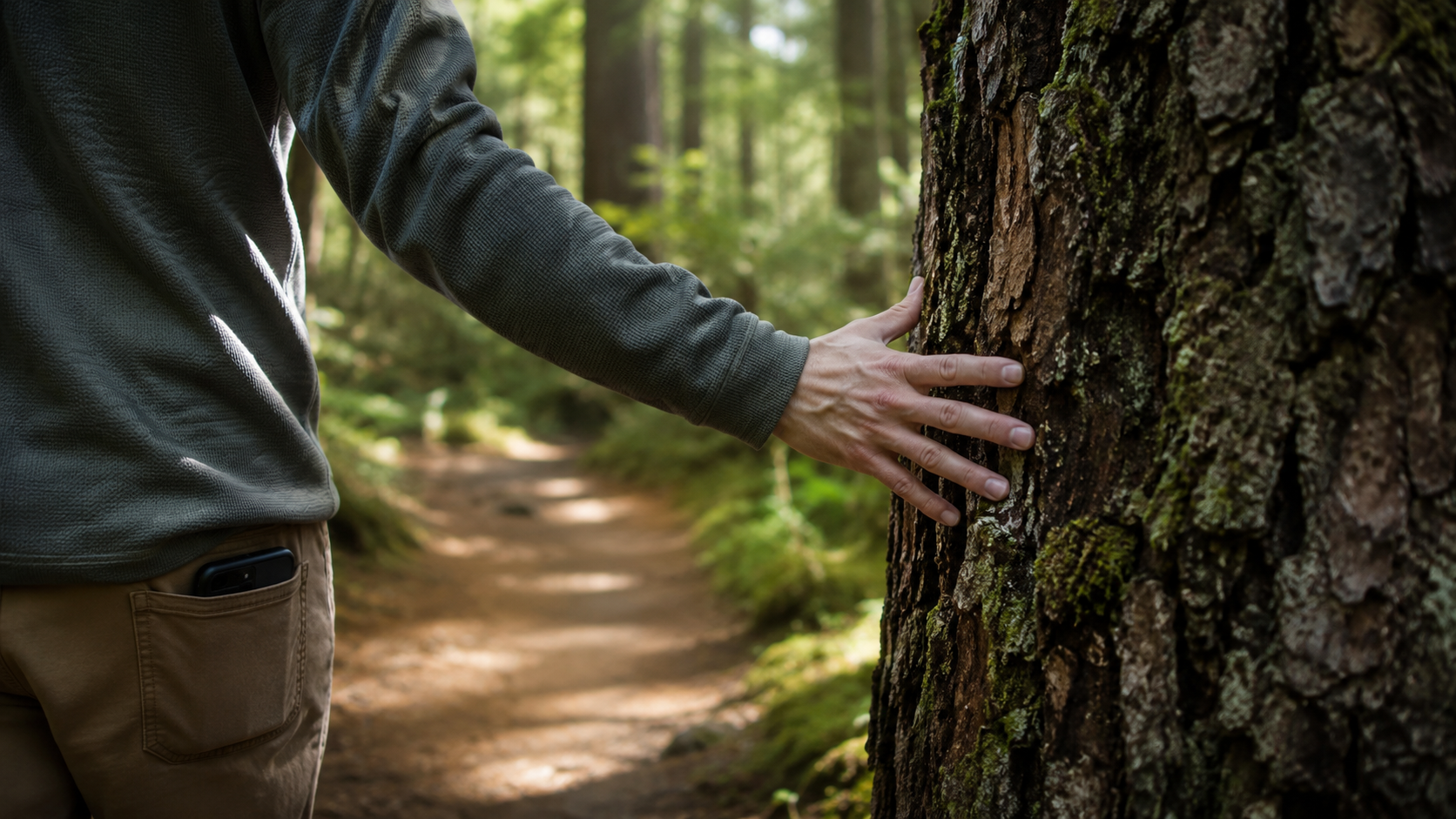 A slow, mindful moment in the woods is captured as a person pauses to touch the bark of a tree along the trail. With their phone put away, the scene reflects the unhurried, sensory experience of connecting with nature.
Nature Doesn't Replace Medicine, But It Can Be a Good Space for Recovery
There's one thing worth remembering when talking about the effects of forest bathing.
The fact that time spent in nature can positively affect health doesn't mean it replaces professional medical treatment.
If you're dealing with high blood pressure, depression, anxiety disorder, cardiovascular disease, or another condition that requires treatment, proper medical care should come first.
It's better to understand forest bathing as a healthy habit you can add on top of that — alongside regular exercise, a balanced diet, enough sleep, and appropriate medical care, gradually increasing the time you spend in nature.
The same holds true spiritually.
The forest itself isn't the ultimate source of our peace.
A Christian's peace is found in God.
But nature can be a genuinely good space that helps us pause our busy gaze and look again toward God our Creator.
Sometimes Your Health Needs a Little Time Where You Measure Nothing at All
Modern health is increasingly managed through numbers.
We track daily steps, count calories, measure blood pressure and heart rate.
This kind of data genuinely helps with health management.
But sometimes, health also needs a bit of time where nothing is being measured at all.
Time spent walking briefly into a forest, looking at trees, feeling the wind.
For that time, set down your work performance, your step count, and your phone notifications completely.
And maybe quietly say to yourself:
I'm living today, in the world God made.
Perhaps the greatest value of forest bathing isn't found in some special natural remedy — it's in giving our endlessly running bodies and minds a chance to stop and recover, even briefly.
Scripture tells us:
"Be still, and know that I am God." (Psalm 46:10, KJV)
This weekend, instead of visiting the woods out of a sense of obligation to exercise, why not walk through a nearby park or forest trail with a slightly different heart?
Look at the trees. Listen to the wind. Walk slowly, and give thanks to God.
That short window of time can become rest for a tired body, breathing room for a crowded mind, and a quiet moment that turns our eyes back toward the Creator.
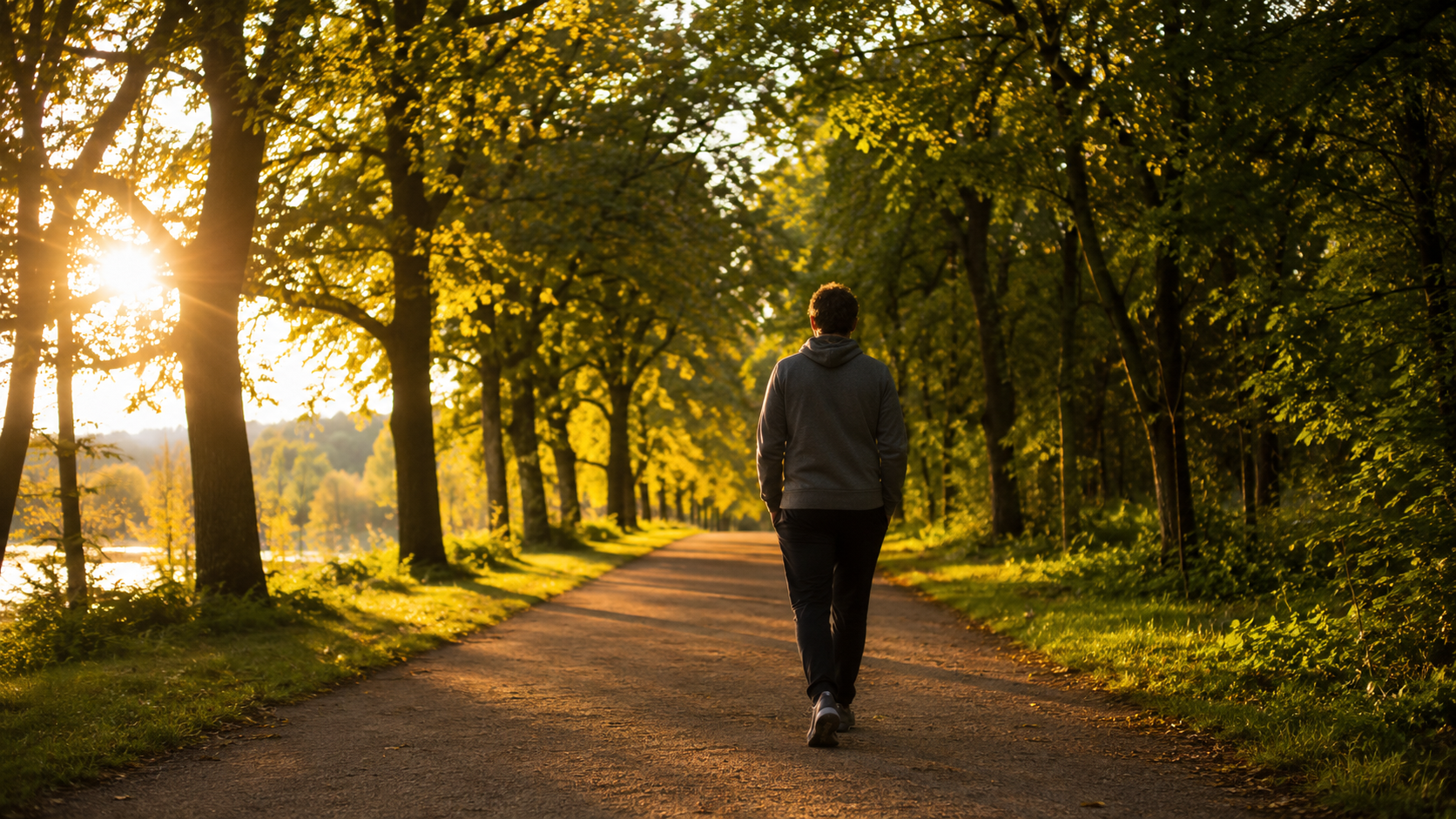 Bathed in warm evening light, a lone walker moves quietly along a tree-lined path. The image conveys a reflective and peaceful mood, suggesting the simple healing value of walking slowly in nature.
This article is intended as general health information and is not a substitute for individual diagnosis or treatment. If you have a condition requiring medical care, please consult a healthcare professional.