How Do You Find Meaning in Suffering — Man's Search for Meaning Left Me With an Answer I Wasn't Expecting
If everything you love can be taken from you in a single afternoon, what's left that's actually yours?
That question doesn't stay theoretical for long. It shows up at 3am after a diagnosis, in the quiet after a divorce papers are signed, in the space where a job used to be. The mind starts circling the same drain: if the worst can happen for no reason at all, what was any of it for?
Meaning in Suffering Isn't a Comfortable Question to Sit With
Most of us don't ask this question out loud. We ask it in the car, alone, after we've said all the composed things to the people checking on us. There's a specific kind of exhaustion that comes from suffering that seems to have no logic to it — no lesson attached, no silver lining waiting on the other side. You can read every verse about God working things for good and still lie awake wondering if that's true for this, for what's actually happening to you right now. The doubt isn't a lack of faith. It's just honest.
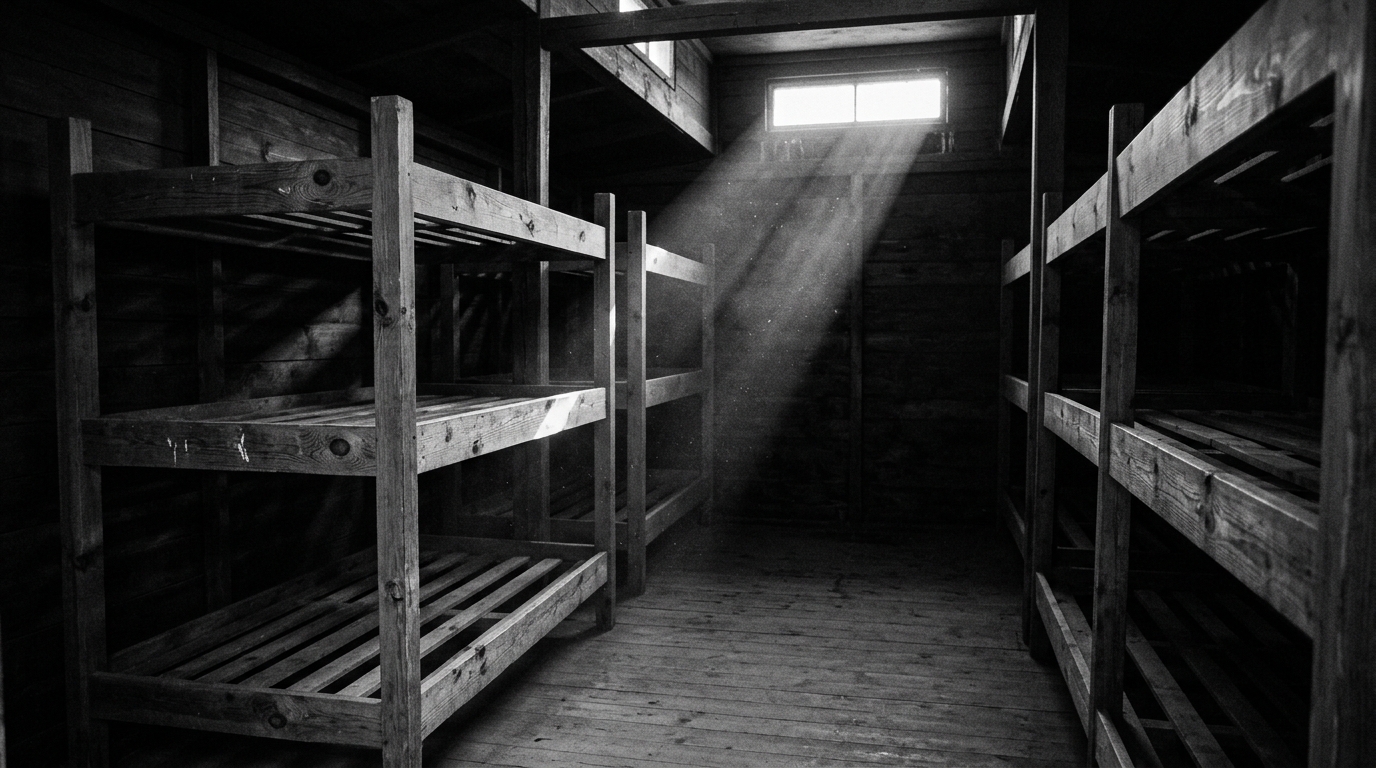 An empty barracks at dawn, the kind of stillness that comes after everything has already been taken.
The Man Who Asked the Question From Inside the Worst Answer
Viktor Frankl was a psychiatrist in Vienna before the war took that identity away along with almost everything else. He lost his parents, his brother, and his pregnant wife in the camps. He wasn't writing about suffering from a safe distance — he was standing inside the version of the question that has no comfortable resolution: people around him were dying for nothing, arbitrarily, and there was no framework left to explain why some lived and some didn't.
What he noticed, watching himself and the men around him, wasn't that suffering made sense. It didn't look like it did — not from where he stood. What he noticed was smaller and stranger — that even inside meaningless suffering, some men kept a kind of inner freedom the guards couldn't touch. Not because they found a reason for the suffering itself, but because they found something to hold onto inside it: a memory of someone they loved, a task left unfinished, a refusal to let the camp decide who they were.
The men who kept that inner freedom weren't the ones who turned further inward — they were the ones still reaching toward someone else, even from inside the wire. A Christian reader recognizes that reach. It has a name older than logotherapy.
He didn't walk out with an explanation for evil. He walked out with something more specific — a working theory that human beings can endure almost any what if they have a why. Not a why for the suffering. A why for staying human inside it.
Meaning Isn't Found, It's Made in Response
Frankl's central move is the one most people miss when they hear the book's premise secondhand. He isn't arguing that suffering has a hidden purpose you just need to locate. He's arguing something almost the opposite — that meaning isn't sitting inside the event waiting to be discovered. It's built in how you respond to it, moment by moment, even when the event itself stays senseless. As he put it, in essence, the last of the human freedoms is choosing your attitude in any given set of circumstances.
That's a very different claim than "everything happens for a reason." It's closer to: nothing has to have a reason for your response to it to still matter.
What would it look like to stop waiting for your suffering to explain itself before you decide what to do with today?
A Christian reader can hold Frankl's observation without needing to argue with it, and still read it differently: what feels like an act of pure self-construction might actually be the moment a person brushes up against a Logos that was already speaking, long before they chose how to respond to it. Frankl doesn't need to believe that for the book to still work. But it's hard not to notice it.
There's a word for that noticing, and it was hiding in plain sight the whole time. Responsibility comes from response-ability — the capacity to answer something. Maybe that was always the word for it.
I read this book during a stretch when I wanted God to explain Himself and He wasn't doing it. Frankl didn't give me that explanation either. What he gave me was permission to stop needing one before I could keep going.
About the Book
Man's Search for Meaning is really two short books stitched together — the first half is Frankl's account of his years in Auschwitz and other camps, told with almost clinical restraint, and the second half lays out logotherapy, the framework he built afterward for helping people find purpose rather than just manage symptoms. What it keeps circling back to is deceptively simple: pain is unavoidable, but despair is a separate choice, and the space between the two is where a person's freedom actually lives. He draws less from doctrine than from lived observation — years of clinical practice, Nietzsche's line about the man with a why, and his own memory of a wife he wasn't sure was still alive. This tends to land hardest with people who are past the point of wanting a tidy answer and are just looking for a reason to get up tomorrow anyway.
A quiet closing thought. Man's Search for Meaning, by Viktor Frankl, is a short book that doesn't try to carry more than it can hold.
If you're curious, it's the kind of book worth keeping close — find it here: Man's Search for Meaning.
Is Man's Search for Meaning a religious book?
Frankl himself wasn't writing theology — he draws from clinical observation, not scripture. But the word he built the whole book around, meaning, comes from the Greek logos, and I couldn't stop noticing that's the same word John's Gospel opens with. He never goes there himself, but I did, and once I saw it I couldn't unsee it.
What is logotherapy in simple terms?
It's the framework Frankl built out of what he survived — the idea that the primary drive in people isn't pleasure or power but the search for meaning, and that we can find it through work, through love, or through how we choose to face unavoidable suffering.
Why do people recommend this book after a loss?
Because it doesn't pretend the loss makes sense. I've handed it to people right after something devastating, not because it fixes anything, but because Frankl had already been where the explanations run out, and he kept going anyway.
Does this book help with depression or hopelessness?
It helped me, personally, on the days when hope felt like a decision rather than a feeling. It's not a replacement for real care if you're struggling — but as a companion to that, it gave me language for choosing to keep going before I felt like it.
📚You Might Also Like
I Thought It Was My Faith. It Never Was. — Basic Christianity
Have You Ever Wanted to Believe But Just… Couldn't? — The Reason for God
You Already Know Right from Wrong. Have You Ever Asked Why? — Mere Christianity