You Already Know Right from Wrong. Have You Ever Asked Why? : Mere Christianity -C.S. Lewis Book Review
You've done something no one saw. No consequences. No witnesses.

And you still felt guilty.
Or the opposite — you watched someone get away with something genuinely unfair, and something in you said that's wrong. Not just I don't like it. Not just that's illegal. Wrong. As in, it shouldn't have happened. As in, there's some standard it violated.
Where does that come from?
That's not a religious question. That's just a human one. And it's the question that cracked open one of the most reluctant conversions in modern history.
The Man Who Argued Against It for Years
C.S. Lewis was not raised as a believer. He became an atheist as a teenager and spent years constructing careful arguments against Christianity.
He was also one of the sharpest minds at Oxford.
Which is what makes his eventual conclusion so interesting. Not that he wanted to believe — he famously described his conversion as reluctant, almost unwilling. But that the arguments, followed honestly, kept pointing somewhere he didn't expect.
Mere Christianity is the book that came out of that journey. Not a testimony. Not a devotional. An argument — built slowly, from the ground up, for anyone willing to follow it.
It Starts Before God Even Enters the Room
Lewis's first move is almost invisible in its simplicity.
He points out that human beings argue. Not just fight — argue. And when we argue, we appeal to something. That's not fair. You promised. That's not how you're supposed to treat people.
We don't say those things to a rock or a thunderstorm. We say them to other people — because somewhere, underneath the argument, both sides already agree that a standard exists.
Every culture across every century has some version of it. The content varies. The existence doesn't.
Lewis doesn't tell you what to do with that observation. He just makes sure you've seen it clearly. And then he asks: where does it come from?
The Options Are Fewer Than You Think
This is where the book gets uncomfortable — in the best way.
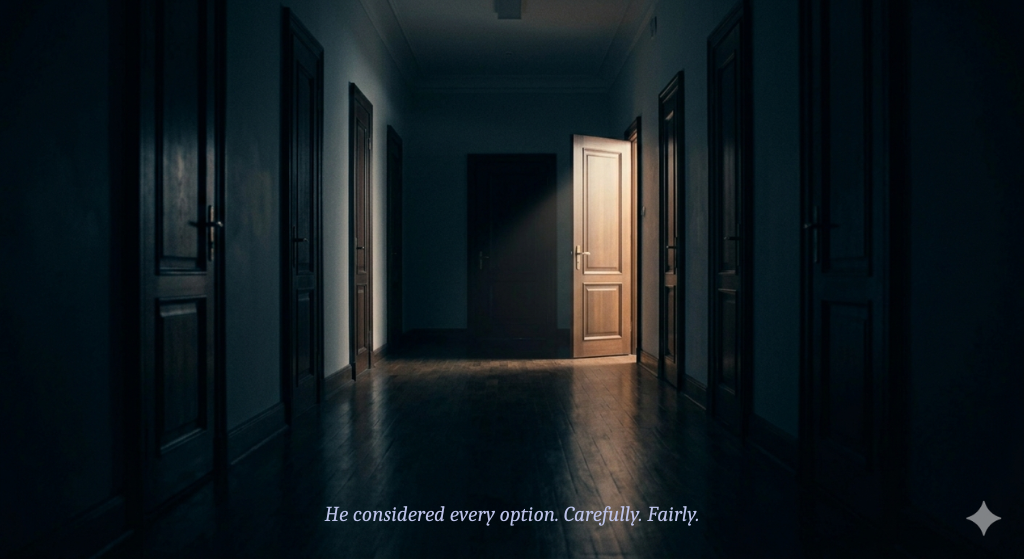
Lewis lays out the possible answers with the patience of someone who has genuinely considered each one. Maybe morality is just social conditioning. Maybe it's evolutionary instinct. Maybe it's nothing — just feelings we've agreed to call rules.
He takes each option seriously. And then he shows, quietly, why none of them quite account for what we actually experience.
Because we don't just have moral instincts. We judge them. We say things like I know I want to, but I shouldn't. Something in us stands outside the instinct and evaluates it. What is that?
By the time Lewis is done with Part 1, he hasn't mentioned Jesus once. He's just been following a thread. And the thread is starting to lead somewhere.
What Christianity Actually Claims
Only at this point — after establishing that something is behind the moral universe — does Lewis turn to what Christianity specifically says.
And he's careful here. He's not talking about any particular denomination. He's not asking you to accept church tradition or religious culture. He's asking about the thing underneath all of it — what Christians across centuries and traditions have actually agreed on.
His argument is that the Christian answer is not only coherent, but more coherent than the alternatives. Not easier. Not more comfortable. More *honest* about what the evidence actually suggests.
He also doesn't pretend the implications are small.
One of the most striking lines in the book: Christianity, if false, is of no importance. If true, it is of infinite importance. The one thing it cannot be is moderately important.
I find that kind of clarity rare. Most books on faith let you stay comfortable. Lewis doesn't.
For the Skeptic in the Room
Lewis is unusually qualified to write for skeptics — because he was one. He knows exactly which objections feel most solid, because he held them. He doesn't dismiss them. He works through them.
I'll be honest — I can't tell you where this book will land for you. That depends entirely on where you're starting from.
What I can say is that it's worth reading slowly. Lewis earns your attention one paragraph at a time. The argument only works if you follow it — and if you do, you'll find it harder to put down than you expected.

A Note on Faith
Mere Christianity deliberately sets aside denominational differences. Lewis isn't recruiting for a particular church. He's making a case for the thing underneath all of them.
If you're exploring faith for the first time, this is one of the best starting points in print. If you've been away for a while and wonder whether there's anything left worth returning to — this is a fair place to look.
It won't make the decision for you.
But it will make you think.
📚 Mere Christianity by C.S. Lewis
If this message resonated with you, you can get your copy on Amazon here (affiliate link). It's regarded as an enduring classic of modern Christian apologetics.
📚You Might Also Like
Why Does It Still Hurt If God Is Good? — The Problem of Pain
How Many Times Did You Lose Yourself Today? — The Screwtape Letters
I Thought It Was My Faith. It Never Was. — Basic Christianity