Is David the Original Superhero? 'House of David', Season 2 Seeks to Answer That Question
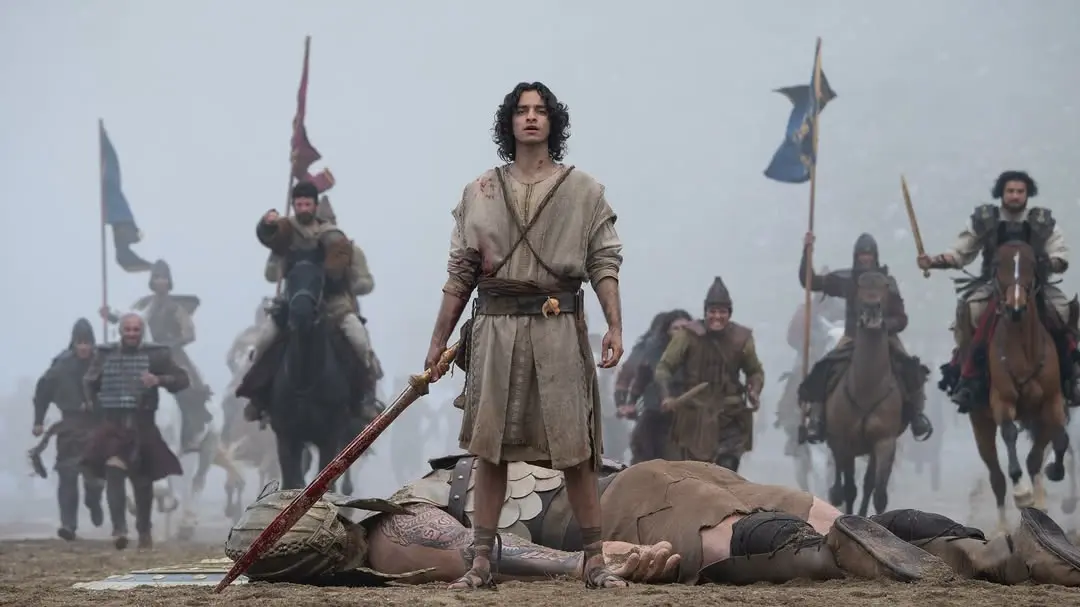 Michael Iskander in 'House of David'. Photo image courtesy of Wonder Project
Buoyed by the success of Season 1 earlier this year, the Amazon streaming series House of David kicked off Season 2 on Sunday evening with a thud … quite literally.
Armed with just a small sling and five smooth stones, young David has taken down the menacing Philistine named Goliath with one well-placed throw, scattering copious amounts of dust while sending the defeated bully to his demise.
But what happens now to this young warrior in the startling aftermath of Goliath’s defeat?
This signature story from the Old Testament is representative of anyone who has ever felt like an underdog or had seemingly insurmountable obstacles to overcome. In David’s case, this meant defeating a literal giant so that his people could claim victory over their oppressor.
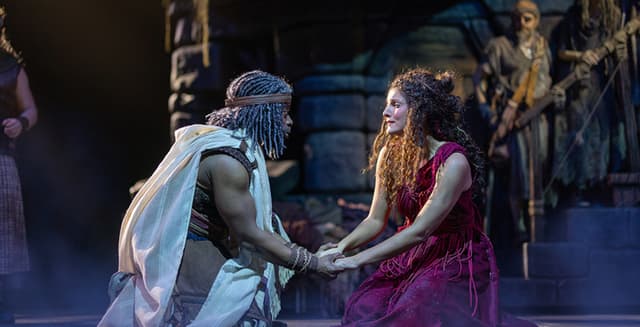
Produced by the Wonder Project, House of David aims to take viewers on a journey rooted in Scripture, to show how relatable the Bible really is to 21st Century audiences.
I recently sat down with House of David co-director Jon Gunn to discuss why David’s story of fame, fortune, and indiscretions resonates with so many people today, the vital importance to retain Biblical accuracy in the series, and how the young lad who would rise to be king just might be the world’s first documented superhero.
The response to House of David, Season 1 was amazing. Why do you think your production of this story resonated with so many viewers via Prime?
First of all, it's such a compelling story. It's one of the great stories of the Bible, and we have made it with a tremendous amount of love and wanted to share a version of the story that we ourselves would want to see. It is a very authentic, very human, very complicated, and relatable version of the story that brings it to life with some urgency and humanity. I think the very thing that we wanted to love about it is that it was epic like Lord of the Rings, but it was personal as a family and relationship story. We fought really hard to cast the right actors and go to the right locations and bring it to life with a lot of love and a lot of passion. I'm glad that that has translated. It’s so satisfying to read the comments and hear from fans that they love the very things we hoped they would love, in the ways that we hoped they would love it. And in many ways that surprised us. It's been overwhelming, though, more than we could have imagined. I’m super glad about that, excited, and grateful.
The story of David, is such a well-known story from the Bible and one that I need to believe that you needed to get absolutely right to not alienate the faith community. What types of things did you do to ensure Biblical accuracy in the series?
We have a number of Biblical scholars and advisory boards that we pass everything through. We have rabbinic scholars; we have Jewish and Christian advisors. We vet everything very carefully so that we understand both for the historic accuracy of that time period, the Bronze Age, and how things were. They also give us a better understanding of the Scripture. From that, we're going to take liberties in places where we feel comfortable taking liberties. The Bronze Age was a very brutal time, and we will tell a story that's safe for the whole family to watch. So, we try to dial it into a place that's very relatable and watchable for a modern audience while really embracing the things that make this era unique. And then we make sure to get the Scriptural component of it right.
Our intentions are very solid. We're going to have to imagine how a character might feel in a particular moment or how they went from this point to that point, but we've got the benchmarks there from the Bible. So, we're just trying to connect from thing to thing, and with our imagination sort of fill in with our best assessment. For example, why might someone do that? What would that feel like? And that's one of the great joys of starting with a Biblical story and then getting the opportunity to sort of do the archeological and emotional exploration.
What types of things did you do to make the story really come alive on screen and create mass appeal for the 21st Century audience?
The same thing is true in telling any good story, which is how do you make it as relatable as possible? Yes, these people lived 3,000 years ago, but you're also talking about a mother and her daughter, and the frustration of a teenager wanting to emerge and live their life. The jealousy between sisters, the secrets that people keep from one another, the desire to make your father proud, falling in love at a young age, being frustrated to the point that you wish you could be doing more with your life. For me, it was important. (Co-director) Jon Erwin and I talk a lot about this, to bring truth and humanity to these characters so that they're living in a present moment in time. Not a dusty old Bible story of characters that weren't real people, but what was it like for David, a shepherd, to live on a Tuesday morning, knowing that in the evening he's going to go play the lyre at a wedding with people that will never really accept him in their life or their world.
That's real stuff, that when you transport yourself to that moment and imagine what it's like to be in these kinds of relationships that we've all been in, sibling relationships, parent-child relationships, status, and power issues between different classes. These are all things that people can relate to in the present day, and it's fun to bring them to life in a way that has the urgency of living in the moment.
David’s story has become shorthand for being the ultimate underdog. That is something so many people see in themselves. But David wasn’t an overnight success. Could you share with me the richness of his life’s journey of becoming who he was meant to be?
I think one of the things that's so aspirational about David is that he was the lowest and the lowliest of his family, of his tribe, and of his time. And yet there was a greater destiny and purpose waiting for him. And so, to rise up into that destiny is not an easy thing to do. For so many people, that is a journey of saying, I believe I'm meant to do more, but what are the risks I must take? What are the ways I must challenge myself? What's the faith that is required to shut out all the voices that tell me I'm not worthy, and to believe the truth that I am. That's one of the things that I think makes it such a beloved story. It’s that David is going to overcome tremendous obstacles, the first and largest of which is Goliath. a giant that struck fear into the thousands around him, and step by step believing that God has a purpose for him and he's going to rise into that purpose.
David quite possibly could be one of our world’s first heroes in recorded history. Why is it so important to tell his story to contemporary audiences?
You're absolutely right. I think that most of those characters, Spiderman, Luke Skywalker, or Harry Potter, are all based on David’s story. And that is the hope and belief that I could be meant for something great and that destiny is going to come at a price. There are challenges and we see that all the time, whether it's a person finding fame and success, that if you're not careful, can come with a lot of pain and a lot of heartache. But there's just a purity to that belief that we have, especially as young people to say, ‘I want to do something great and meaningful. I want to serve a greater purpose.’ That has inspired so many stories for so many generations, and there's something timeless about it. Because David is kind of the origin of those stories in many ways, it's a wonderful one to get to tell in the context of what you're saying, which is that we have all of these superheroes that we love to watch rise above their place in life. But David was the first to do it.
Changing gears, I think you found a gem in Michael Iskander to play the role of David. Can you share what he brings to the table as an actor that makes your life much easier as a director?
It's so scary when you set out to tell a story that is so dependent on one character. You can't tell House of David without the right David. And we just searched for so many months trying to find somebody. We wanted somebody authentically Middle Eastern. David is from Egypt, who's born in Egypt. We wanted somebody who was young enough to be the shepherd who you would underestimate, but powerful enough in spirit and conviction to become a king. We wanted somebody with an incredible singing voice that was like he was the very voice of God. That is a difficult thing to find, to be able to sing and to sing in Hebrew that believably, be imbued with this passion, and to have a heart for God in the way that Michael does.
And on top of it all, when he was in high school, he threw discus which has a natural connection to using a sling. Michael is very much like David. We did sort of pluck him out of obscurity. He had no experience in front of the camera, although he had done a little theater. He was on Broadway as part of the ensemble of Kimberly Akimbo. He had no experience in front of the camera. So, we had to find somebody who was not yet discovered but had so much passion and conviction for this role. In that way, he was very much like David. He had a lot of bravado, and he seemed to be wise beyond his years. You could tell he believed in this and felt this is a character he was meant to play. He had the confidence that David had in spirit.
In your role as director, have you learned anything new about David or his life that has galvanized or strengthened your belief in humanity?
I feel like I've learned so much, but first, I think for all of us digging this deep into David's story, there was a lot that most people don't know about David. There is a lot that's fun for us to explore. There is a conviction in David that I find very inspiring. It reminds me of what it's like to have the purity and truth of just saying, I'm going to shut out the voices telling me I'm not good enough and I'm going to step into my destiny no matter what the cost. I love the truth and simplicity of that challenge. It's not easy to live day to day. And it does come with a lot of pain and a lot of struggles. It is a good reminder to me personally of wanting to live my authentic life and live it with boldness. And David is a great role model for that.
After viewers have had a chance to watch an episode or hopefully the entire series, what would you like to see people get out of that experience? What is your greatest hope for House of David, Season 2?
I really do hope that it inspires people to look at their own lives and the ways in which they can rise and step up into their own destiny and their own purpose. I would like to see people inspired to live a truthful and authentic life. Beyond that, I just hope that it's fun and entertaining. I find it to be an entertaining show to watch, and that's a major priority for us. We want to show that people just enjoy watching, and spending time with these characters. I'm very hopeful that that's how people feel. I believe Season 2 is better than Season 1, and if you love the first season, you're going to love the second.
WATCH A TRAILER FOR HOUSE OF DAVID, SEASON 2: