Music & Painting (Part 7): Modernism, Abstraction, and Fragmented Vision
The early twentieth century brought profound changes to society. Industrialization, technological advances, and the upheaval of world wars challenged long-held assumptions about how people understood the world.
Artists and composers responded by seeking new forms of expression. Painters moved beyond recognizable images, while composers questioned traditional tonality. Modernism was more than a new artistic style—it was a new way of seeing and hearing reality.
Beyond Representation
For centuries, Western painters sought to represent the visible world. In the early twentieth century, however, many artists moved toward abstraction, exploring color, line, shape, and movement as subjects in themselves.
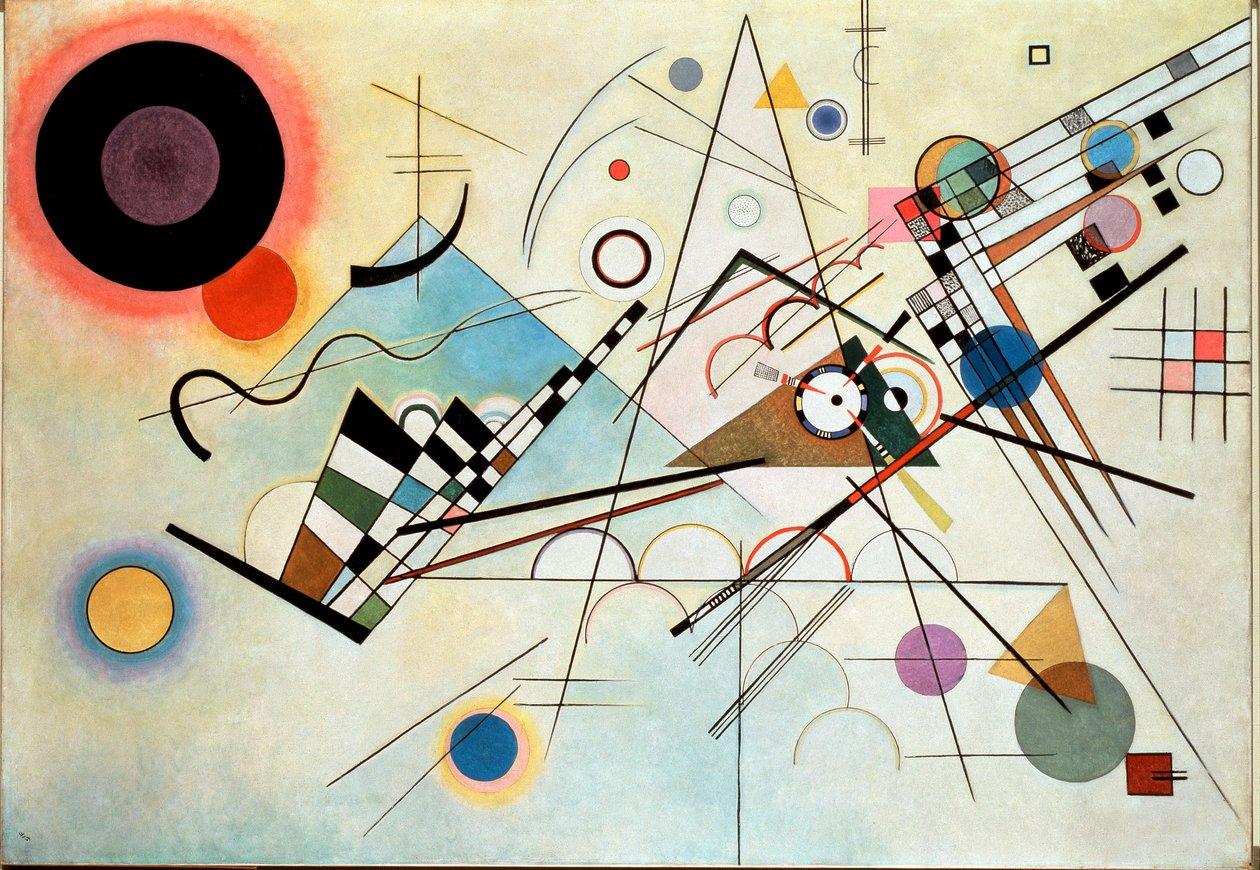 Wassily Kandinsky, Composition VIII (1923)
Wassily Kandinsky's Composition VIII offers a striking example. Rather than depicting recognizable objects, the painting invites viewers to experience relationships, tensions, and rhythms. Much like music, it communicates through structure and movement rather than direct representation.
Fragmented Cities and New Rhythms
Piet Mondrian's Broadway Boogie Woogie presents a vibrant vision of modern life. Inspired by New York City and the energy of jazz, the painting transforms streets and movement into a network of colorful lines and rhythmic patterns.
 Piet Mondrian, Broadway Boogie Woogie (1942–43)
Rather than depicting the city realistically, Mondrian captures its pulse through abstraction. The work suggests that reality can be understood not only through images but also through patterns, relationships, and movement.
A New Musical Language
While painters explored abstraction, composers were also challenging long-established traditions.
Arnold Schoenberg's Pierrot Lunaire (1912) became one of the defining works of musical modernism. Through its use of atonality—music that moves beyond a traditional tonal center—the work explores fragmented melodies and unexpected musical gestures.
Like modern painting, the work invites us to listen differently. Rather than seeking familiar patterns and resolutions, we encounter a world of contrasts, uncertainty, and new expressive possibilities.
Seeing Beyond Familiar Forms
Modernist art can sometimes feel challenging because it abandons many familiar points of reference. Yet its purpose was not simply to reject the past. Artists and composers were searching for new ways to communicate in a rapidly changing world.
Their work reminds us that understanding often begins when we move beyond what is comfortable and familiar. New forms of beauty may emerge when we learn to see and hear with fresh attention.
Modernism reminds us that seeing the world anew requires openness, humility, and a willingness to recognize beauty in unexpected places.
Read previous: Music & Painting (Part 6): Impressionist Light and Sonic Color