People Are Confessing Their Sins to AI. The Church Should Be Asking Why.
The rise of AI spiritual companions isn't a tech problem — it's a community failure
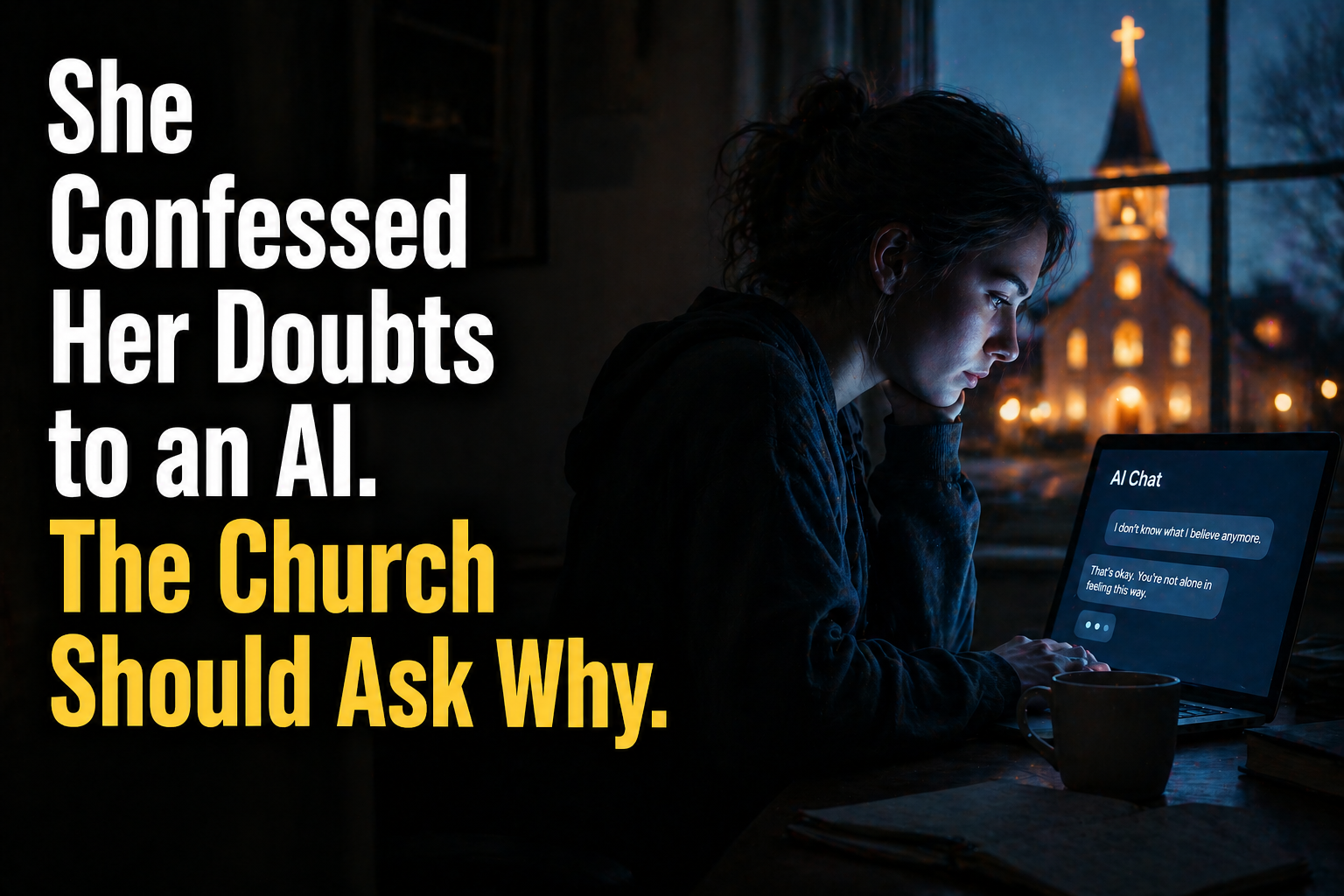 A few weeks ago, a graduate student knocked on my office door. She studies theology. She's been in church her whole life. She sat down and told me — with obvious hesitation — that she had been using an AI chatbot to process her doubts about God. Not as a research tool. As a confessor.
She'd been at it for three months. She felt understood. She felt unjudged. And she felt, somehow, more alone than she had before she started.
That combination — feeling heard and feeling alone — is one of the most precise diagnostics of what AI can and cannot do. And it's becoming one of the defining pastoral challenges of 2026.
The Market Has Already Moved

The faith-based tech boom is not coming. It's here. You can now pay $1.99 per minute to have a video call with an AI-generated avatar of Jesus — created by the company Just Like Me — that remembers your previous conversations, prays with you in multiple languages, and, according to its CEO Chris Breed, makes users feel 'a little accountable.' He described the attachment users form to it as being like a friend.
There's also Magisterium AI, trained on 2,000 years of Catholic theological tradition. There are evangelical chatbots designed to help users overcome addiction, answer scriptural questions, and receive prayer. There are apps that generate personalized devotionals, Bible reading plans calibrated to your emotional state, and AI 'coaches' for spiritual formation.
"AI cannot pray for you, because the AI is not alive. — Cameron Pak, Christian software engineer and AI ethicist"
Pope Leo XIV — who has publicly acknowledged the human genius behind AI — has also named it as one of the most critical challenges facing humanity, warning specifically that it could negatively impact people's intellectual, neurological, and spiritual development. That's not a Luddite position. That's a shepherd paying attention.
Why People Are Turning to AI for Spiritual Care
Before we judge the trend, we need to understand it — because the reasons people confide in AI chatbots are an indictment of what they're not finding in their faith communities.
They turn to AI because: it is available at 2am when anxiety peaks and no pastor picks up; it does not gossip; it does not make them feel spiritually inferior for having doubts; it does not respond to vulnerability with Bible verses delivered as rapid-fire solutions; and it does not have a history with them that creates social risk in every disclosure.
Every one of those reasons is a pastoral failure that the church owns. The AI didn't create the problem. It just filled the vacuum the church left.
▌ Sobering Stat: A 2025 Pew Research Center study found that 73% of Americans say AI should play no role in advising people about their faith in God — yet the market for faith-based AI apps is growing rapidly. The disconnect between stated preference and actual behavior is a signal worth reading.
What AI Gives — and What It Cannot

I want to be precise here, because I think vague critiques of AI spiritual tools are less useful than specific ones.
AI can legitimately serve as: a Bible study tool with breadth and availability no human can match; a first-pass resource for theological questions; a journaling companion that helps users organize their own thoughts; and an accessibility bridge for homebound, isolated, or geographically remote believers who have no immediate faith community.
What AI structurally cannot do: bear witness to your suffering in a way that costs it anything; stay with you through the long arc of repentance and restoration; intercede for you with a God it has no relationship with; hold you accountable with the moral authority that comes from shared embodied community; or be present — not as data, but as a person, in a room, in your story.
Presence is not a feature. It's not a premium tier. It is the core of what the Christian tradition means by incarnation — God choosing to enter our embodied condition rather than communicate from a safe and efficient distance. The Incarnation is the ultimate argument against delegating pastoral care to a disembodied system.
What the Church Needs to Do Differently
Here is my honest assessment after years of research and pastoral observation: the church doesn't have an AI problem. It has a belonging problem that AI is exposing.
The solution is not to condemn AI spiritual tools from the pulpit — that will alienate the people who are already using them, often because they felt alienated by the church first. The solution is to become a community that people actually want to bring their 3am despair to.
That means: normalizing doubt in your small groups; training lay leaders in active listening rather than answer-dispensing; making it culturally acceptable to be struggling without being labeled spiritually deficient; creating genuine confidential pathways for pastoral care; and checking in on people — not with a mass email, but with a specific, personal, unhurried conversation.
The graduate student who knocked on my door eventually said something I've been thinking about ever since: 'The AI listened better than most people I've talked to at church.' That's not a compliment to the AI. That's a challenge to us.
AI can simulate pastoral presence. The church can actually provide it. But only if we choose to.
References:
Religion News Service — From BuddhaBot to $1.99 Chats with AI Jesus: https://religionnews.com/2026/04/13/from-buddhabot-to-1-99-chats-with-ai-jesus-the-faith-based-tech-boom-is-here/
Hartford International — How Ministry Leaders Are Embracing AI with Purpose: https://blog.hartfordinternational.edu/2025/08/20/how-ministry-leaders-and-churches-are-embracing-ai/
Crossmap Blog Publication - Fatih Tech: https://blogs.crossmap.com/faithtech
#AIFaith #SpiritualCare #FaithAndTech #AIJesus #ChristianMentalHealth #PastoralCare #DigitalDiscipleship #ChurchCommunity