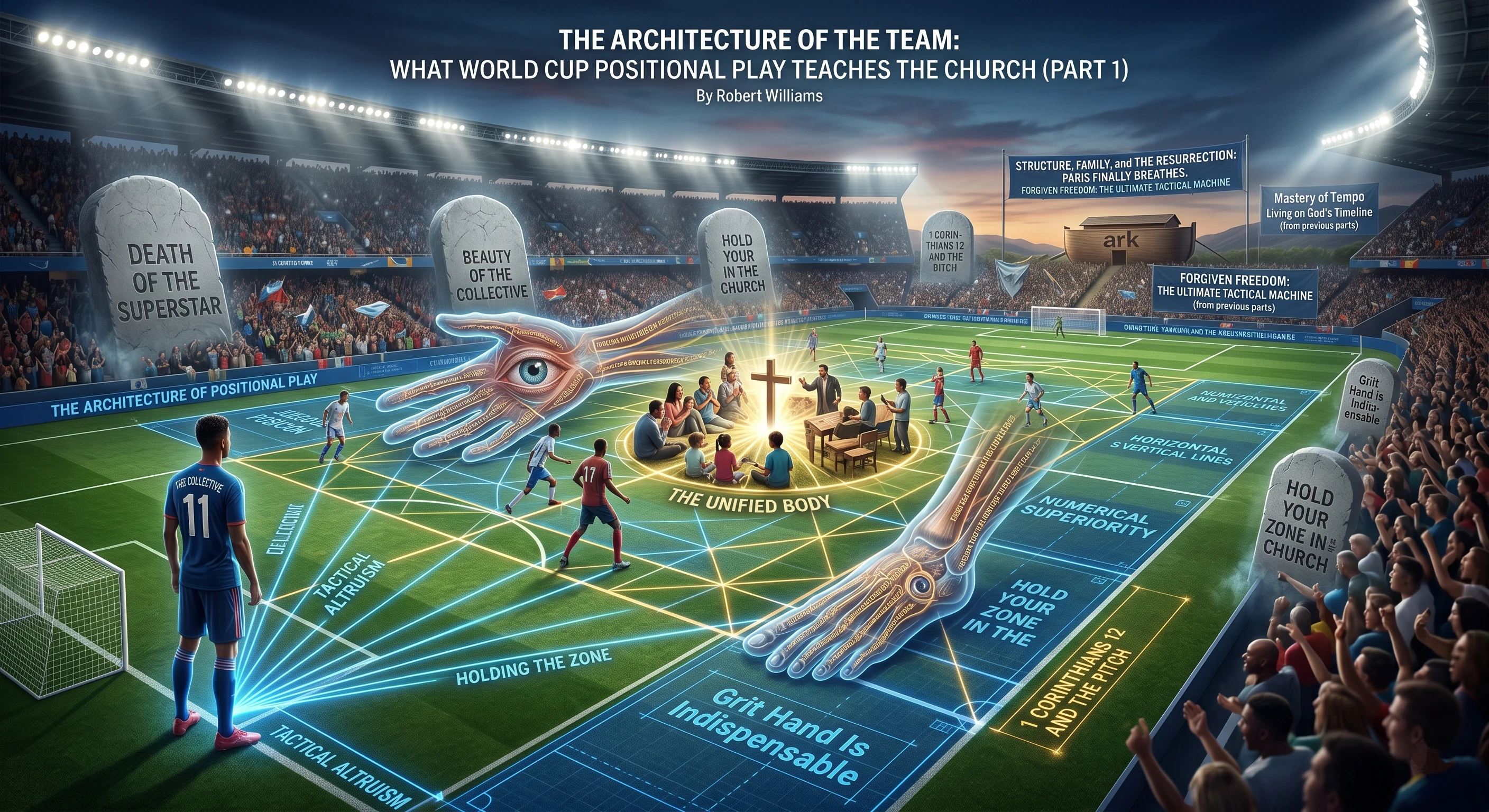
The Architecture of the Team: What World Cup Positional Play Teaches the Church (Part 1)
Welcome to a special World Cup edition of 'The 91st Minute'. Every four years, the globe pauses to watch the most spectacular sporting event in human history. We see nations united, tears of heartbreak, and moments of transcendent athletic glory. But for the Christian, the World Cup is not merely an entertaining distraction. It is a profound, living metaphor. In this three-part series, we will strip away the commercial hype to examine the deep tactical structures of the tournament, discovering what the beautiful game can teach us about our spiritual lives, our local churches, and our eternal calling. Today, we begin with the death of the superstar and the beauty of the collective.
The Myth of the Hero
When the World Cup promotional campaigns launch, the media inevitably frames the tournament as a clash of individual titans. The posters feature the faces of solitary superstars, arms crossed, staring defiantly into the camera. The narrative is heavily individualized: Can the legendary striker carry his nation to glory? Will the golden boy cement his legacy?
We are conditioned to look for the hero. But if you analyze the tactical evolution of the modern World Cup, a completely different reality emerges.
Teams that rely exclusively on "hero-ball"—giving the ball to their most talented player and hoping for a miracle—almost always fail on the grandest stage. They are routinely dismantled by nations that may lack a singular global icon, but possess a flawless mastery of the collective. In modern tactical terminology, the antidote to the superstar is a philosophy known as Positional Play (Juego de Posición).
The Discipline of Tactical Altruism
Positional play is not just a formation; it is a rigid, mathematical architecture of space.
In this system, the pitch is divided into specific zones. The fundamental rule is that no more than a certain number of players can occupy the same horizontal or vertical line at any given time. The goal is to stretch the opposing defense to its absolute breaking point, creating numerical superiorities all over the field.
But here is the most crucial, psychologically demanding aspect of positional play: it requires immense tactical altruism.
To make the system work, a player must be willing to sacrifice their own glory for the structure. A winger might be instructed to stand completely still, hugging the chalk on the far touchline for ten minutes, barely touching the ball. Why? Because by standing there, they are dragging the opposing full-back wide, opening a massive, invisible corridor in the center of the pitch for a teammate to run into and score.
The winger gets no assist. They get no highlight reel. But their unseen, disciplined positioning is the exact reason the goal was scored. They did not play for the applause; they played for the team.
1 Corinthians 12 and the Pitch
This concept of tactical altruism is one of the most stunning visual representations of the Church found in the New Testament.
Two thousand years before modern managers began drawing tactical zones on a whiteboard, the Apostle Paul wrote a masterclass on spiritual positional play to a deeply divided, prideful church in Corinth:
"Just as a body, though one, has many parts, but all its many parts form one body, so it is with Christ... The eye cannot say to the hand, 'I don’t need you!' And the head cannot say to the feet, 'I don’t need you!' On the contrary, those parts of the body that seem to be weaker are indispensable." (1 Corinthians 12:12, 21-22, NIV)
The church in Corinth was obsessed with "superstars." Everyone wanted the visible, flashy spiritual gifts. Everyone wanted to be the striker, scoring the goals under the floodlights. Because of this, their tactical structure was collapsing into chaos and division.
Paul had to remind them of the fundamental architecture of the Kingdom: You are a body. The glamorous striker (the eye) cannot look at the gritty, uncelebrated defensive midfielder (the hand) and say, "I don't need you." The entire system relies on every part faithfully maintaining its position.
Holding Your Zone in the Church
We live in a deeply individualistic, hyper-competitive society that constantly urges us to be the hero of our own story. Tragically, this mindset frequently bleeds into the Church. We easily become frustrated when we feel our talents are not being recognized, or when we are assigned to a quiet, unglamorous role in our community. We abandon our positions to chase the spotlight.
Watching a brilliant World Cup team execute positional play should be a convicting mirror for the modern Christian.
Are you willing to practice tactical altruism in your local church? Are you willing to hold a difficult, unseen position—perhaps serving quietly in the children's ministry, praying faithfully for others in secret, or consistently setting up chairs in an empty hall—simply because it opens up the space for the Gospel to advance?
The greatest victories in the Kingdom of God are rarely the result of a lone superstar. They are the result of a beautifully organized body, where men and women are perfectly content to be invisible, as long as the Team wins.
(In Part 2, we will look at the terrifying emotional weight of the World Cup, the crushing tactics of the high press, and how a believer maintains 'Shalom' when the whole world is rushing at them.)