The Burden of Gold: Why Superstars Could Not Buy Europe (Part 1)
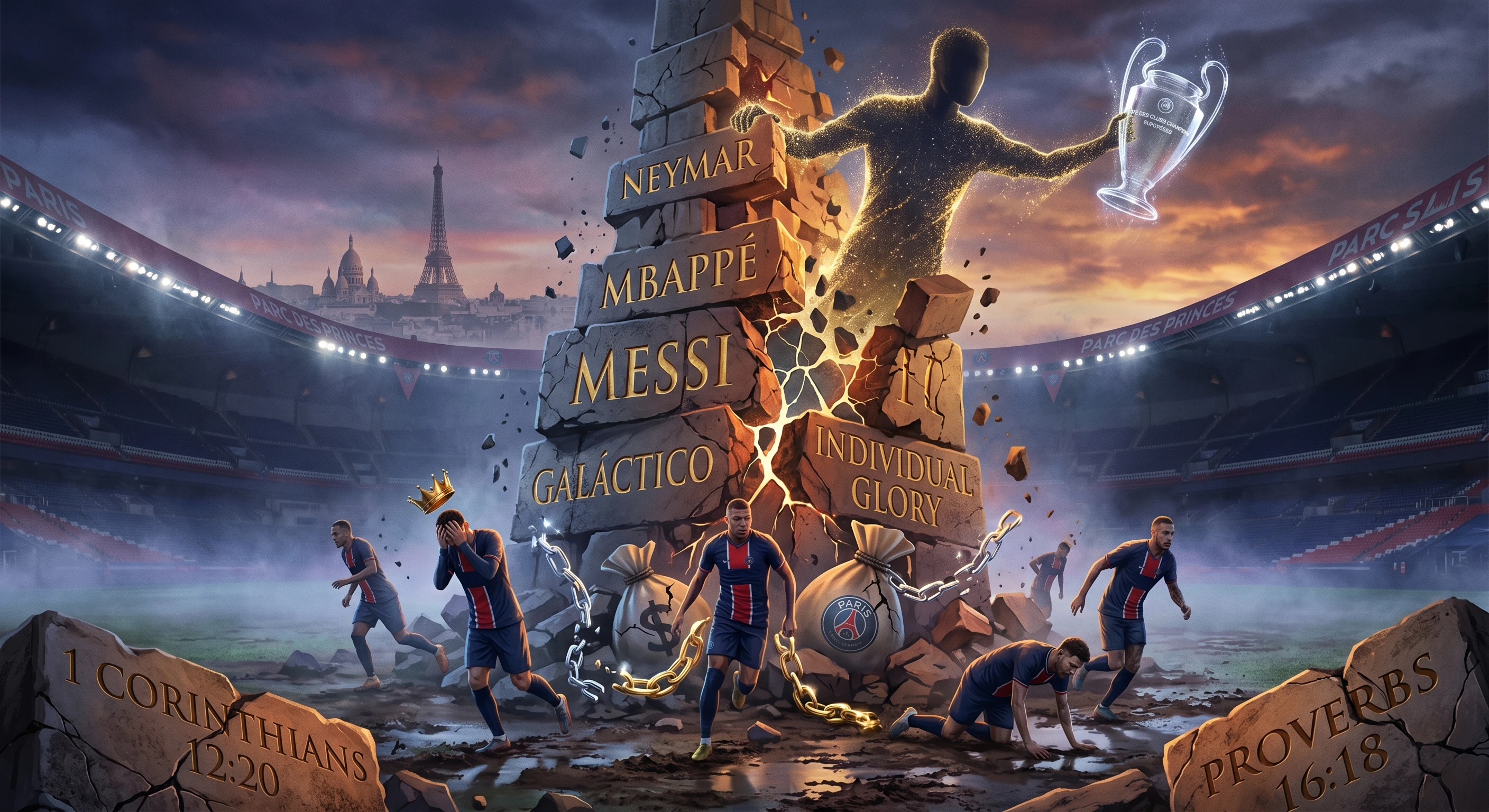
For over a decade, Paris Saint-Germain operated not just as a football club, but as a modern-day Tower of Babel. Backed by the infinite wealth of Qatar Sports Investments, the Parisian executives attempted to reach the heavens of European football by sheer financial force. They sought to answer a singular, arrogant question: Can you buy the UEFA Champions League if you simply acquire the greatest individual talents on earth?
For years, the answer delivered on the pitch was a resounding, brutal no.
Before the tactical and cultural revolution that finally brought the Big Ear to the Parc des Princes in the 2025/2026 season, PSG was a glittering cautionary tale. They were a museum of attacking royalty—Neymar, Kylian Mbappé, Lionel Messi—yet they continually collapsed on Europe's biggest stages. To understand the magnitude of their eventual triumph, we must first dissect the tactical and spiritual disease that plagued them for years: the idolatry of the individual over the collective body.
The Illusion of the Galáctico: A Body of Only Eyes
The Apostle Paul’s metaphor of the human body in his first letter to the Corinthians is perhaps the greatest tactical manifesto ever written for team sports:
"If the whole body were an eye, where would the sense of hearing be? ... As it is, there are many parts, but one body." (1 Corinthians 12:17, 20, NIV)
For years, PSG’s recruitment strategy fundamentally ignored this divine logic. By assembling a front line of untouchable superstars, they essentially built a football team that was all "eyes"—glamorous, visionary attackers who demanded to be seen, but refused to do the exhausting, unseen work of the hands and feet.
In domestic league play, their overwhelming individual superiority masked the cracks. But against elite European machines, playing with three forwards who refuse to press or track back is tactical suicide.
- The Broken Body: Because the superstar forwards walked out of possession, the opposing defense could build up without pressure.
- The Overworked Members: The Parisian midfielders were constantly forced to cover impossible distances, creating massive gaps in the half-spaces. The "hands and feet" of the team were left to suffer alone.
PSG essentially played high-stakes European football with eight men out of possession. They were a Ferrari with a beautiful exterior, but a completely hollow engine block. They had completely forgotten that true glory requires mutual sacrifice.
The Psychological Glass Jaw
Tactical imbalance was only half the disease. The other half was a deeply ingrained spiritual fragility.
When a team is built entirely on the pride of individual glory rather than the humility of collective sacrifice, it lacks a safety net. A tightly knit community protects its members when they stumble; a superstar model demands perfection and breeds isolation. Consequently, whenever PSG faced severe adversity, they completely fractured.
The ghosts of the Parc des Princes are well documented. The infamous La Remontada against Barcelona in 2017, or the collapse against Real Madrid in 2022. These devastating defeats were not mere bad luck. They were the inevitable result of a dressing room built on human ego rather than covenantal trust.
Proverbs warns that "Pride goes before destruction, a haughty spirit before a fall" (Proverbs 16:18). When the storm came in those crucial knockout matches, there was no foundational structure to lean on. The players looked around for someone else to produce magic, rather than locking arms and suffering together in the trenches.
The Death of the Seed
To finally lift the Champions League trophy, PSG had to accept a painful, biblical reality: the Hollywood era of the ego had to die.
Jesus taught a paradoxical truth about true victory and fruitfulness:
"Very truly I tell you, unless a kernel of wheat falls to the ground and dies, it remains only a single seed. But if it dies, it produces many seeds." (John 12:24, NIV)
The executives and the fanbase had to realize that Europe’s ultimate prize does not bow to Instagram followers, Ballon d'Or counts, or commercial revenue. The Champions League demands the death of the ego. It requires a dressing room willing to bleed for the badge, track back in the 89th minute, and lay down their personal glory for the sake of the brother playing next to them.
The dismantling of the superstar model was not a failure of ambition; it was the birth of true maturity. The individual "seeds" of the old Parisian kings had to fall to the ground and die, so that a functioning, ruthless, and unified machine could finally be resurrected in their place.
The ground was finally cleared. The ego was dead. It was time to engineer a real team.