The English Compromise
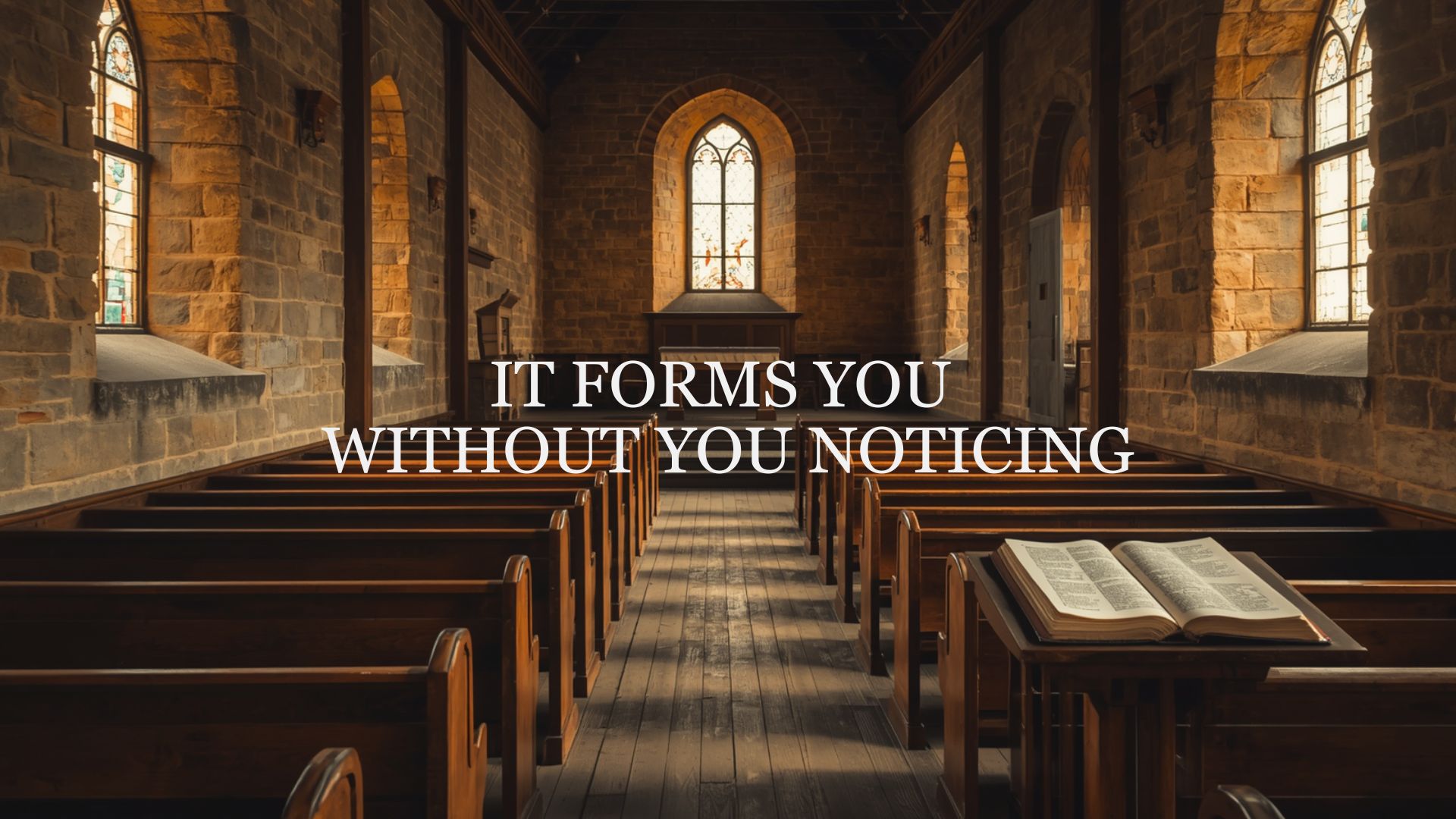
I walked into a small Episcopal church years ago — just passing through a city, nothing planned — and ended up staying for a communion service I hadn't expected to attend.
At some point, the congregation spoke together in words I didn't recognize. I found the page and read along.
We do not presume to come to this thy table, O merciful Lord, trusting in our own righteousness, but in thy manifold and great mercies. We are not worthy so much as to gather up the crumbs under thy table.
I had been leading contemporary worship for a long time by then. Confident worship. Hands-raised, full-band, declare-the-victory kind of worship. And I stood in that little Episcopal church and felt something I hadn't expected to feel: small. Honestly, genuinely small — not in a defeated way, but in the way you feel when you realize you are standing in front of something much larger than yourself.
A man named Thomas Cranmer wrote those words in the sixteenth century. And I found myself wanting to know how they got there.
The English Reformation started with a divorce.
Not a theological crisis. Not a rediscovered scripture. A king who wanted to end his marriage, a pope who wouldn't let him, and a kingdom that eventually had to decide what kind of church it would be when the dust settled.
By the 1540s, the shape of the broader Reformation debate was already clear. On one side stood Rome — the Latin Mass, worship in a language most congregations didn't understand, the accumulated tradition of a thousand years. On the other stood the continental reformers: Luther, then Calvin, each pushing further than the last. Luther gave the congregation its voice. Calvin stripped away nearly everything else. The spectrum was wide, and getting wider.
England watched all of this and said: we'll take some of both, thank you.
Which is either wisdom or cowardice, depending on who you ask.
The man who had to make that work on paper was Cranmer.
He was Archbishop of Canterbury under Henry VIII, and then Edward VI, and he spent the better part of two decades trying to hold together a church that had broken from Rome without quite knowing what it wanted to become. He read the reformers — Luther, Bucer, Bullinger. He exchanged letters with Calvin. He understood the Roman rite from the inside. And he had a gift the English Reformation desperately needed: he knew how to write English.
Not just correct English. Beautiful English. The kind of sentences that carry weight without feeling heavy.
In 1549, the first Book of Common Prayer was published under Edward VI. It was, on the surface, a practical document — a single volume giving every church in England the same order of service, in the vernacular — in English, the language people actually spoke — so that any worshiper walking into any parish anywhere in the country would know exactly where they were. One prayer book, one language, one shared form.
But the content of what Cranmer wrote was something else entirely.
To see what he was actually working with, you have to picture the room he was standing in.
Rome said: the Mass is a sacrifice. The priest offers Christ on the altar. The bread and wine become the body and blood. The congregation participates by receiving what the priest has consecrated — mostly by watching, increasingly from a distance.
Calvin said: something real happens at the table, but spiritually. Christ is truly received by faith through the Spirit, not by the elements themselves changing. The congregation participates by trusting what the Spirit does.
Cranmer said: something happens at this table. I'm not sure either of you has it exactly right.
His language in the communion liturgy became a kind of masterwork of deliberate ambiguity — words that Reformed congregations could read as spiritual presence and that Catholic-leaning Anglicans could read as something closer to Rome's view, words almost no one had to refuse. Whether that was theological genius or a strategic dodge is a question Anglican theologians are still arguing about.
But it meant the church stayed together. And the words — the words were extraordinary.
The 1549 Prayer Book was considered too Catholic by reformers and revised in 1552. Then Mary I took the throne and abolished it entirely, restoring the Mass. Then Elizabeth I brought it back. Each revision was a new negotiation between competing visions of what English Christianity should be.
What survived all of that was the rhythm. Morning Prayer and Evening Prayer. Short, precisely shaped prayers gathered around the theme of the day. The liturgical year, retained from the Catholic tradition but stripped of the more contested feast days. Calvin's Geneva had the Psalms and the Word. Rome had the Mass. England had something that borrowed from both and belonged entirely to neither — a liturgical form that would eventually travel across the Atlantic and shape prayer books in traditions far outside Anglicanism.
What strikes me, looking back, is not the politics that produced the Prayer Book. It's that the people who worshiped with it for the next four hundred years didn't experience it as a compromise at all.
They experienced it as home.
The Prayer of Humble Access — that named, fixed piece of the BCP communion liturgy — wasn't something someone made up on the spot. It was something handed down. There's something in that kind of continuity that works on you slowly, the way a river works on stone. It isn't just that you learn the words. The words learn you.
Standing in that small Episcopal church, I had no idea I was receiving something Cranmer had crafted under enormous political pressure, in a moment when the church might have torn itself apart. I only knew the words were true, and that I needed them.
It forms you without you noticing.
Which is maybe what the best liturgy always does.