The Sacrifice of the Empty Space: What Total Football Teaches Us About Christian Community
As we explored in Part 1, the tactical revolution of 1970s Ajax brought an unprecedented level of freedom to the football pitch. Total Football dismantled the rigid, legalistic boundaries of traditional formations. Players were no longer chained to static positions; they were free to move, overlap, and create.
However, there is a dangerous misconception about Total Football. If you only watch the highlight reels, it appears to be a purely offensive utopia—a system where everyone is encouraged to attack with reckless abandon. But any football manager knows that absolute freedom without responsibility is a recipe for disaster. If all ten outfield players surge forward into the attacking third, what happens when they lose the ball?
The answer is simple: they would be completely destroyed on the counter-attack.
So, how did Ajax avoid this fatal flaw? The secret to their dominance was not just in their attacking brilliance, but in an unsung tactical discipline: the sacrifice of the empty space.
The Art of Tactical Covering
In Total Football, every attacking movement creates a structural vulnerability. When a legendary overlapping full-back like Ruud Krol sprinted forward to deliver a cross, he left a massive, gaping hole in the defensive line behind him.
The genius of Rinus Michels’ system lay in what happened next. The moment Krol vacated his position, another player—often a tireless midfielder like Johan Neeskens—would immediately drop deep to fill that empty space. It was a system built on radical, unspoken trust. The attacking player could only play with complete freedom because he knew, without a shadow of a doubt, that a teammate was sacrificing their own glory to cover his back.
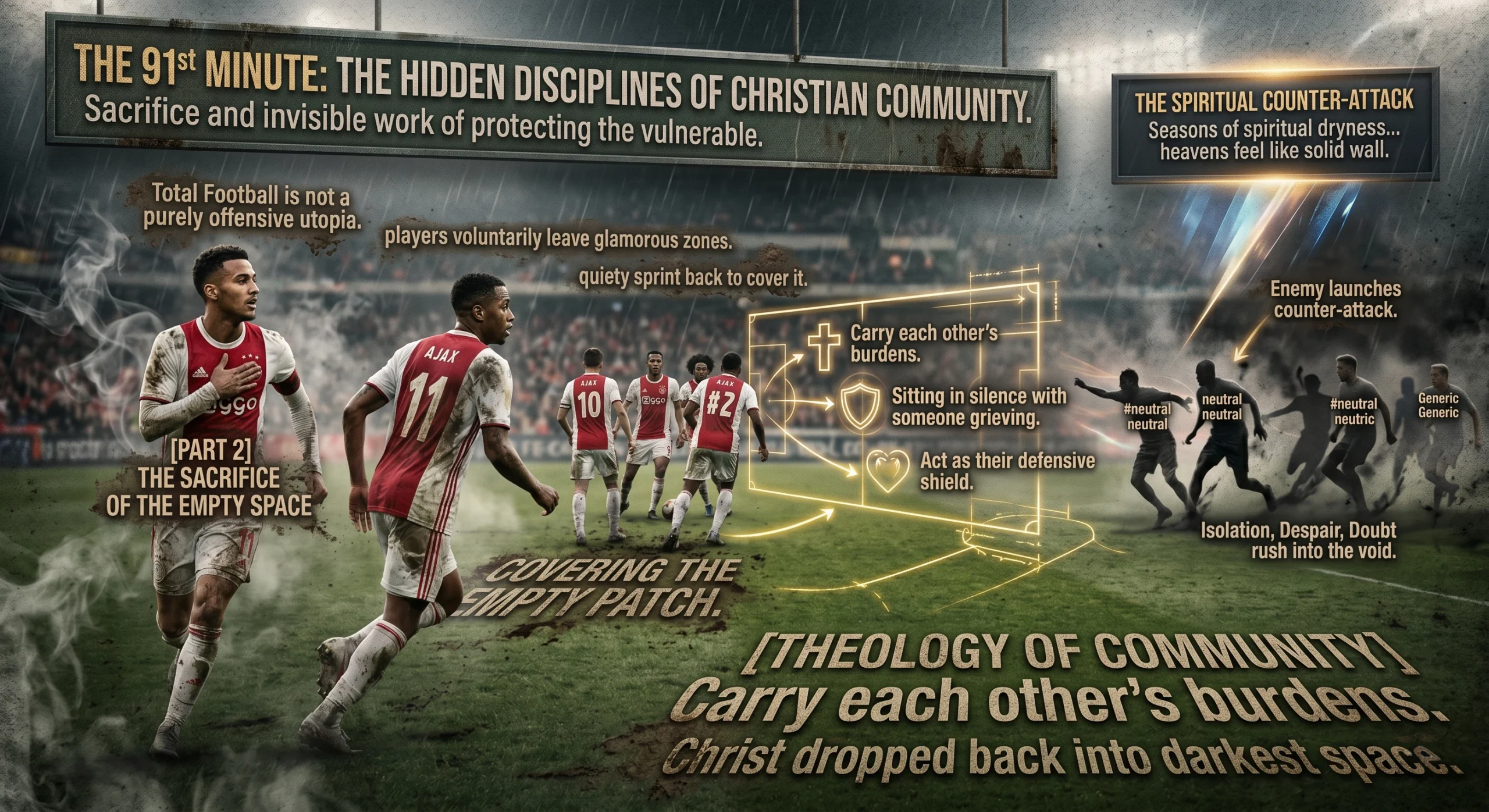
Without this selfless covering, Total Football collapses in seconds. It requires players to voluntarily leave the glamorous attacking zones and sprint back to do the exhausting, invisible work of defending an empty patch of grass.
The Spiritual Counter-Attack
This tactical dynamic perfectly illustrates the harsh reality of life in the Church. We love to talk about the freedom of the Gospel. We celebrate when brothers and sisters step out in faith to launch new ministries, pursue bold careers, or start families.
But life is unpredictable, and spiritual warfare is real. There are seasons when a believer is forced out of their normal “position.” Grief, severe illness, burnout, or sudden financial ruin can abruptly pull someone out of the formation. They are no longer able to lead the small group, serve in the ministry, or even maintain their own emotional stability.
When a believer is dragged out of position by the crushing weight of reality, they leave behind an “empty space”—a vulnerability. And it is precisely in these moments of structural weakness that the enemy launches a spiritual counter-attack. Isolation, despair, and doubt rush into the void.
The True Measure of the Body of Christ
How does a church survive these counter-attacks? The answer is found in the tactical blueprint of the New Testament.
The Apostle Paul did not envision the Church as a collection of individual superstars playing for their own statistics. He described it as a living, interdependent organism. In his letter to the Galatians, he issues a direct tactical instruction to the community:
“Carry each other’s burdens, and in this way you will fulfill the law of Christ.” (Galatians 6:2, NIV)
True Christian solidarity means recognizing when a brother or sister has left a gap, and quietly sprinting back to cover it. It means making meals for a family overwhelmed by a medical crisis. It means stepping up to take over a ministry when a leader is burning out. It means sitting in silence with someone who is grieving, acting as their defensive shield when they have no strength left to fight.
This type of covering requires immense sacrifice. When you drop back to cover someone else’s empty space, you have to hit pause on your own attacking momentum. You have to sacrifice your own convenience, your time, and sometimes your own spiritual spotlight to do the invisible, exhausting work of protecting the vulnerable.
This is the very essence of the Cross. Jesus Christ dropped back into the darkest, emptiest space of human sin and covered our ultimate vulnerability with His own life.
Total Football proves that a team’s true strength is not measured by how many players rush into the opponent’s penalty box, but by who is willing to stay behind and guard the empty space. In The 91st Minute of our lives, when the counter-attack comes, will we be a community that covers for one another?
In the final installment, Part 3 of the Roots & Legacy series, we will look at the man who orchestrated the chaos—the Maestro—and what it means to yield our lives to the Holy Spirit’s direction on the pitch.