The System Above the Star: Engineering the Parisian Press (Part 2)
When the ego dies, a vacuum is created. The departure of the Hollywood era at Paris Saint-Germain left the Parc des Princes feeling momentarily empty, but to the meticulous eye of a tactician, that emptiness was a blank canvas.
For the first time in the Qatar Sports Investments (QSI) era, the manager was given ultimate authority. He was no longer tasked with managing the delicate egos of global brands; his job was to build a footballing machine. The transformation of PSG into the 2025/2026 UEFA Champions League winners was not achieved through another massive transfer window, but through the rigorous, almost religious installation of two tactical doctrines: Positional Play and the Gegenpress.
Through these systems, the Parisian squad learned a profound spiritual and tactical truth: true freedom on the pitch is not found in doing whatever you want, but in joyful submission to a higher structure.
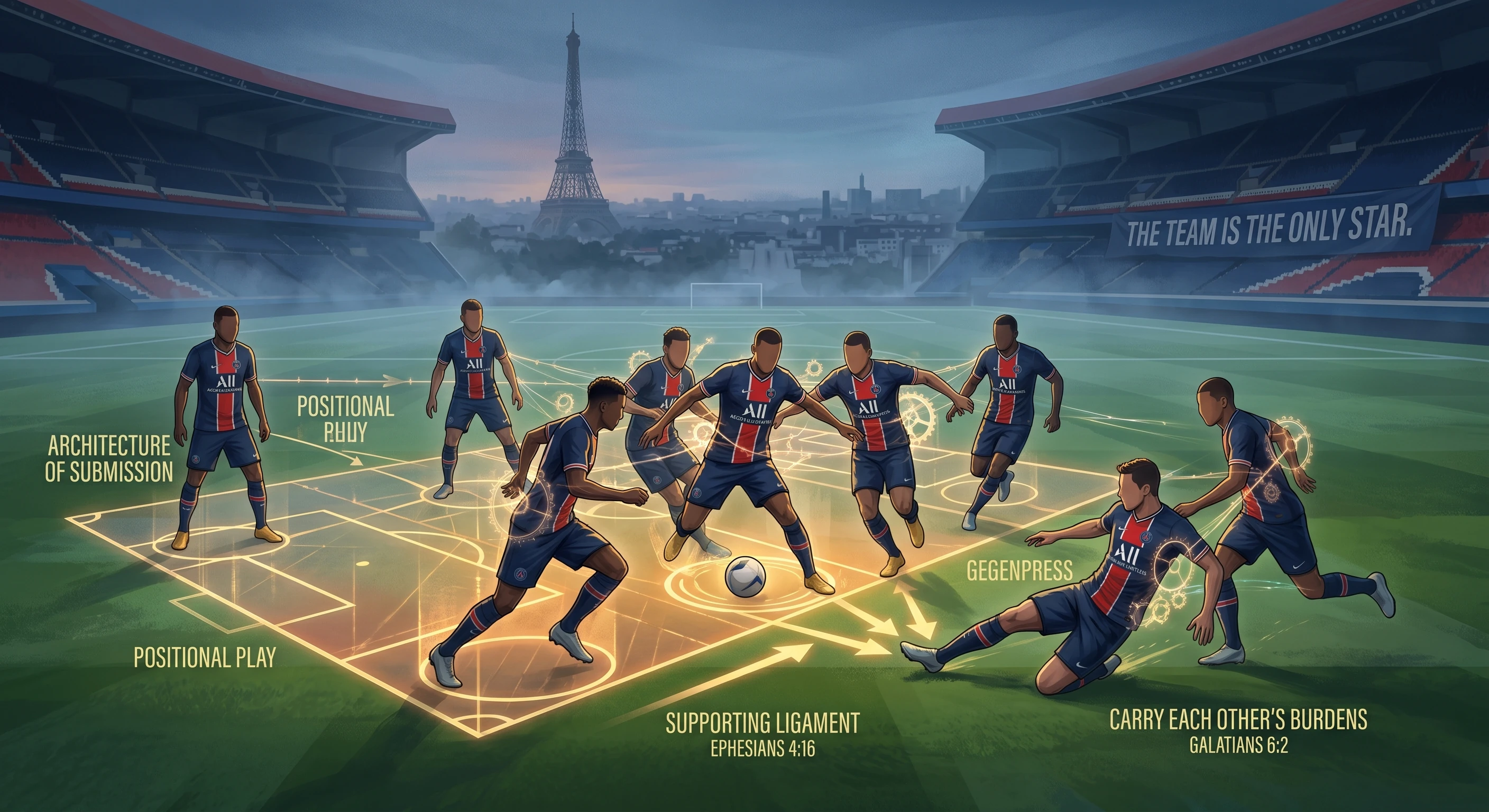
The Architecture of Submission: Positional Play
For years, PSG’s attack resembled a chaotic pickup game. Superstars would drift wherever they pleased, demanding the ball at their feet, severely disrupting the team’s spacing.
To fix this, the new regime implemented a strict adherence to Juego de Posición (Positional Play). In this system, the pitch is divided into specific zones. Players are required to occupy these zones to stretch the opponent, manipulate passing lanes, and create numerical advantages.
The hardest part of Positional Play is not the running; it is the waiting. A winger might be required to stand completely isolated on the touchline for ten minutes, rarely touching the ball, simply to pin back the opposing full-back and create space for a midfielder inside. It requires a player to suppress his desire for personal involvement for the sake of the overarching blueprint.
This is the exact blueprint of a healthy, spiritually mature community. The Apostle Paul described the Church not as a collection of independent stars seeking the spotlight, but as a meticulously designed structure where every part submits to the whole:
“From him the whole body, joined and held together by every supporting ligament, grows and builds itself up in love, as each part does its work.” (Ephesians 4:16, NIV)
When PSG’s forwards finally learned to hold their width, trusting the system rather than demanding the ball, the team was “joined and held together.” Submission to the tactical law birthed an unstoppable, collective attacking rhythm.
The Spiritual Art of the Gegenpress
If Positional Play organized their attack, it was the Gegenpress (Counter-pressing) that revolutionized their defense and their dressing room culture.
In the old era, when a PSG forward lost the ball, he would often throw his hands up in frustration and slowly jog back, leaving the midfield to deal with the deadly counter-attack. The new system demanded the exact opposite. The Gegenpress requires the team to hunt the ball with violent intensity for five to seven seconds immediately after losing possession.
Tactically, it is designed to win the ball back high up the pitch before the opponent can organize. But psychologically, it is the ultimate expression of brotherhood.
When a teammate makes a mistake and loses the ball, the Gegenpress dictates that you do not blame him; you instantly sprint to cover his error. You suffocate the space so his mistake does not become a fatal flaw. It is the living embodiment of a foundational Christian command:
“Carry each other’s burdens, and in this way you will fulfill the law of Christ.” (Galatians 6:2, NIV)
This relentless counter-pressing transformed the PSG dressing room. They stopped pointing fingers and started running for each other. The forwards became the first line of defense, and the previously overworked midfielders finally breathed. The tactical structure became a spiritual discipline of bearing one another’s burdens.
“The Team is the Only Star”
By the time the Champions League knockout stages arrived, the transformation was evident in every passing sequence and every defensive transition. The manager’s relentless mantra—“The team is the only star”—had taken deep root in the Parisian soil.
When you watched PSG play in the quarter-finals and semi-finals, you did not see three detached attackers and eight laborers. You saw a single, breathing organism. You saw wingers sprinting back to make sliding tackles. You saw midfielders covering for overlapping full-backs. You saw a team that had discovered the breathtaking beauty of collective sacrifice.
They had successfully engineered the machine. The egos had been crucified, and the system had resurrected a squad of brothers. But one final, terrifying test remained. To claim the ultimate prize, this newfound spiritual and tactical discipline would have to survive the unforgiving crucible of the Champions League Final.