"Wait, Isn't This a Turnip?" Kohlrabi Might Change Your Mind Once You Try It
The first time you spot kohlrabi in the produce aisle, a few questions probably come to mind.
Is this a turnip? Is it some kind of cabbage? How do you even eat this thing?
Its round, sturdy shape looks a little unfamiliar. But take one bite, and you'll likely be surprised by how sweet and crisp it actually is.
We eat food every day, which makes it easy to forget how remarkable it actually is. But even a small vegetable growing out of the ground carries the variety and abundance of what God created.
Today, let's take a closer look at one of the less familiar vegetables out there: kohlrabi.
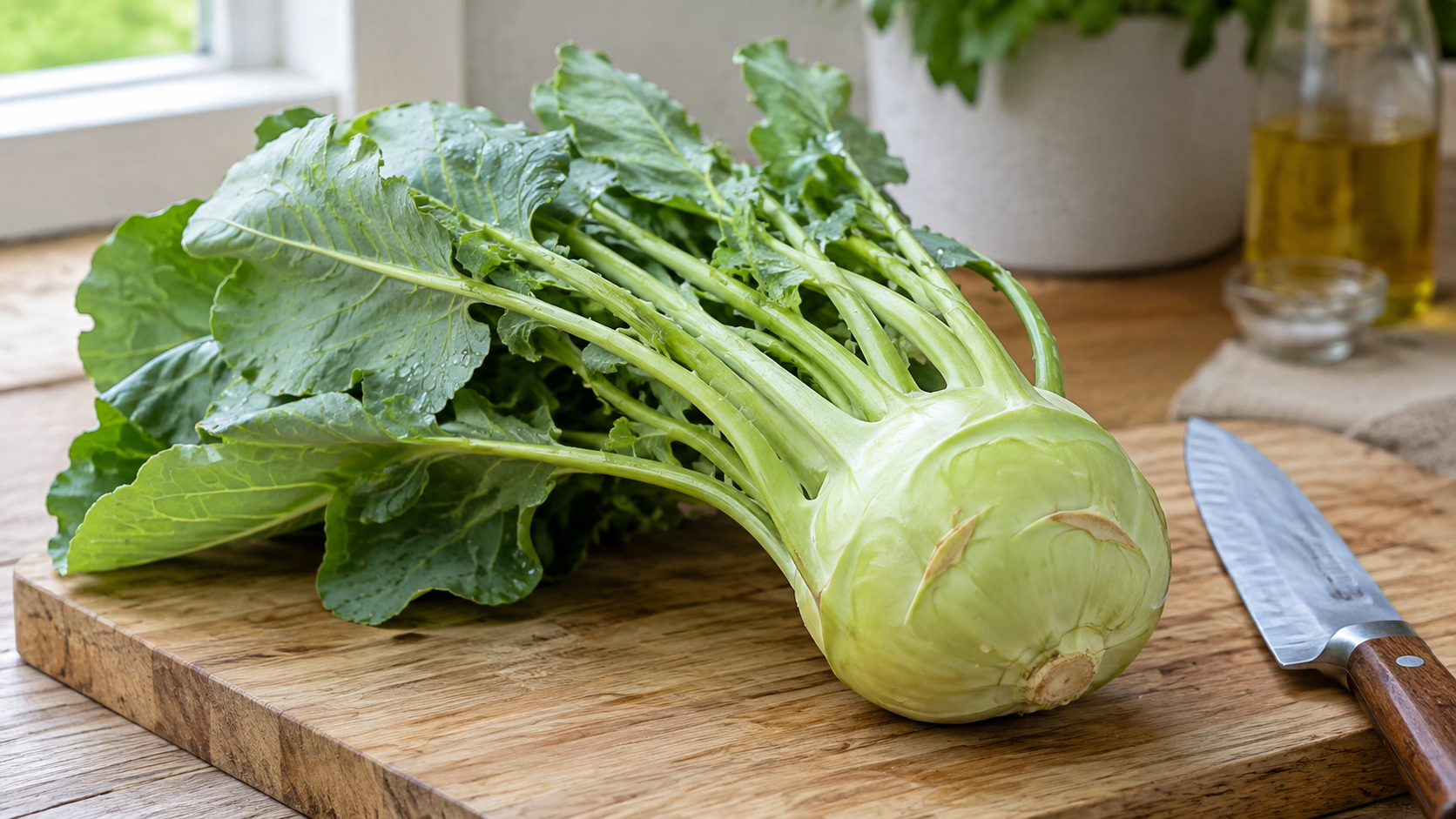 A fresh kohlrabi bulb with leafy greens sits on a wooden cutting board, highlighting its crisp texture and natural appearance as a versatile, nutrient-rich vegetable.
What Exactly Is Kohlrabi?
Kohlrabi looks like a turnip, but it's actually part of the same cruciferous family as cabbage, broccoli, and kale.
It tastes milder than a typical radish, with a subtle sweetness, and has that crisp bite you'd get from a pear or an apple.
You can eat it raw, or work it into salads, quick pickles, stir-fries, and all kinds of other dishes — it fits into a regular kitchen more easily than you'd expect.
Scripture puts it this way:
"And God said, Behold, I have given you every herb bearing seed, which is upon the face of all the earth, and every tree, in the which is the fruit of a tree yielding seed; to you it shall be for meat." (Genesis 1:29, KJV)
The vegetables and fruit we encounter every day aren't something we're simply entitled to — they can be seen as a genuine gift, part of the creation God allowed us.
1. A Vegetable That Delivers Vitamin C
Kohlrabi contains vitamin C.
Vitamin C is a nutrient your body needs for normal immune function, and it also plays a role in antioxidant activity.
Since kohlrabi can be eaten raw, thin slices or julienned strips work well in a salad.
That said, it's better not to think of any single food as something that specially boosts immunity or prevents disease on its own — eating a genuine variety of vegetables and fruit in balance matters more.
Health, too, is built less from one special food and more from small habits repeated every day.
2. When You Want to Round Out Your Fiber Intake
Kohlrabi also contains dietary fiber.
Fiber supports normal bowel function and helps you feel satisfied after eating.
In a modern diet, meat and refined carbohydrates tend to take up a growing share of the plate, while vegetable intake often falls behind.
Rather than sticking only to familiar vegetables, adding something new — like kohlrabi — to the table once in a while is a genuinely good approach.
It looks like a small change, but choices like this, repeated over time, can shift your whole diet.
3. Why It's Useful for Managing Weight
One of the hardest parts of managing weight is hunger and the pull of snacking.
Kohlrabi is relatively low in calories while offering both water content and fiber — and above all, that satisfying crunch.
That makes it a good stand-in for anyone reaching for a raw vegetable instead of chips or a high-calorie snack.
Cut it into sticks ahead of time for an easy snack, or toss it into a salad.
What matters here is not managing your health through starvation or pushing your body to extremes.
For a Christian, the body isn't something to be used up however we please — it's something valuable, entrusted to us to care for well, so we can live out the life God has given us.
"What? know ye not that your body is the temple of the Holy Ghost which is in you...?" (1 Corinthians 6:19, KJV)
Caring for your health isn't only about competing for appearance — it can be part of a genuinely faithful, stewardship-minded life, caring wisely for the body God gave you.
4. A Range of Plant Compounds From the Cruciferous Family
Kohlrabi belongs to the same cruciferous family as broccoli, cabbage, and kale.
Vegetables in this family carry not just vitamins and minerals, but a range of plant compounds too.
Rather than treating any of it as some specific "detox food," it's better to work it into a diet built around a genuine variety of vegetables.
One thing worth knowing: cruciferous vegetables, including kohlrabi, contain small amounts of compounds called goitrogens, which can affect thyroid function. If you have a thyroid condition or are being treated for one, it's worth checking with your doctor before eating large amounts of cruciferous vegetables like kohlrabi consistently over a long period. For most people eating a normal amount as part of a regular diet, this isn't a significant concern.
Often, health comes down less to a special trick and more to ordinary principles:
Eat a reasonable amount. Eat a genuine variety. Keep moving. Rest enough.
Isn't the life of faith fairly similar?
It's not one dramatic resolution in a single day — it's the small, daily habits of reading Scripture, praying, and giving thanks that gradually change a life.
How Should You Actually Eat Kohlrabi?
Kohlrabi is more versatile than you might expect:
- Thinly sliced or julienned into a salad
- Tossed with vinegar and a touch of sweetness for a tangy quick pickle
- Cubed for pickling or preserving
- Lightly stir-fried with other vegetables
- Cut into sticks for a simple snack
The skin can be a bit tough, so peeling it is usually more comfortable, depending on how mature it is. [A sturdy swivel vegetable peeler like this one] makes quick work of kohlrabi's thicker skin without much effort (affiliate link — I may earn a small commission at no extra cost to you). If you're trying it for the first time, start with a single thin raw slice.
Crisp, subtly sweet — you might find yourself thinking, this is actually better than I expected.
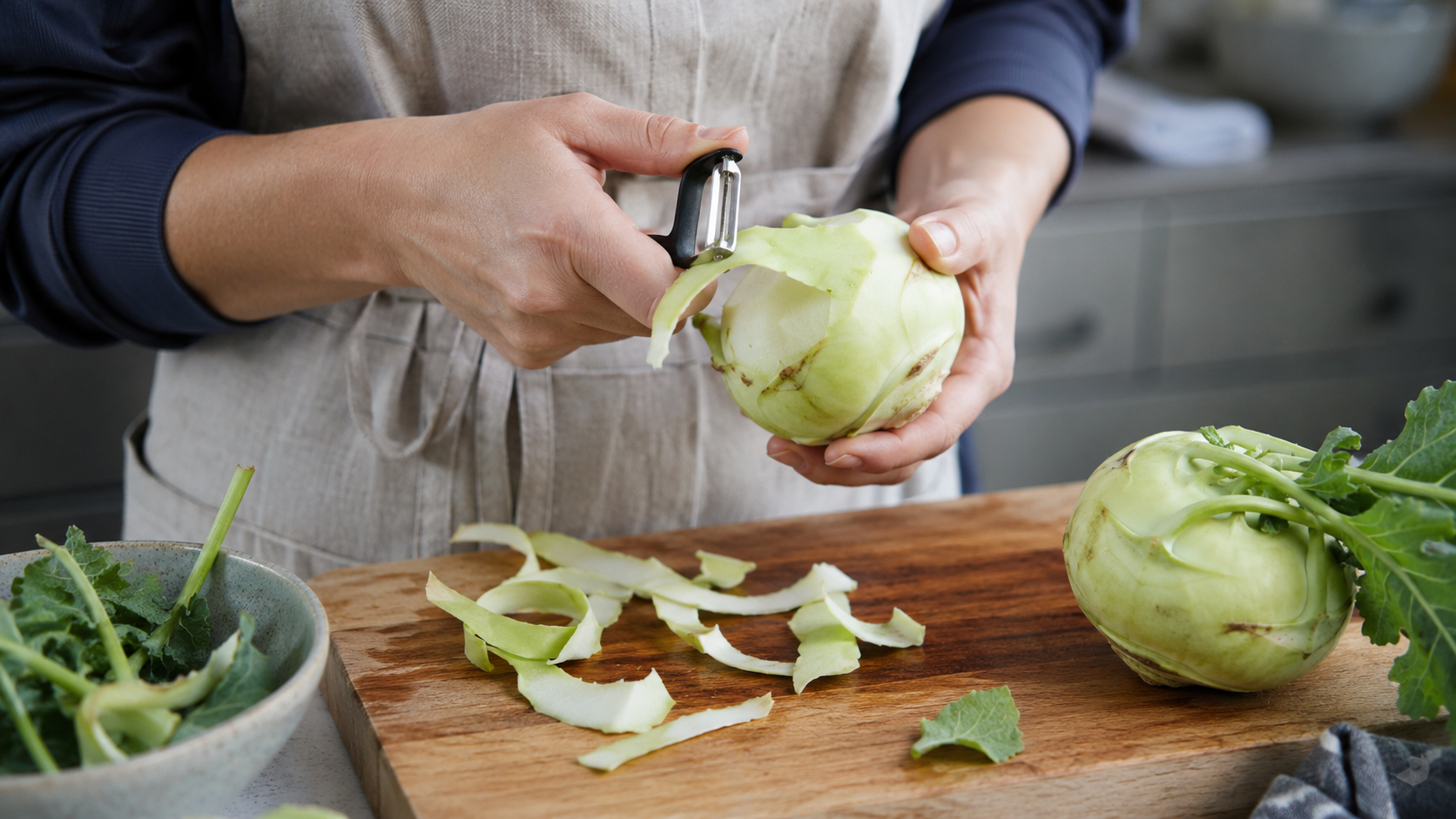 Preparing fresh kohlrabi is simple with a vegetable peeler. Removing the tougher outer skin reveals the crisp, mildly sweet flesh that can be enjoyed raw, added to salads, or used in a variety of healthy dishes.
Even a Healthy Food Isn't "The More, The Better"
Even foods known to be good for you aren't automatically better in large quantities.
Suddenly eating a lot of a high-fiber vegetable can bring on bloating or discomfort. If you're being treated for a specific condition, or following a particular dietary restriction, it's worth adjusting your intake to fit your own health situation.
The core of a healthy diet isn't relying on one specific food — it's balance and self-control.
Scripture repeatedly emphasizes self-control as an important posture for living.
The same applies to eating.
Rather than excessive worry about health, or chasing whatever food is trending, receiving the variety of food God has allowed with gratitude, and choosing wisely, matters more.
Finding Gratitude at Today's Table
We eat every single day.
And because it's so routine, it's easy to forget just how much of a gift that actually is.
A vegetable easily picked up at the grocery store, a single meal set on the table, an ordinary dinner shared with family — these are all genuine reasons for gratitude.
Jesus gave thanks before sharing food too.
"And it came to pass, as he sat at meat with them, he took bread, and blessed it, and brake, and gave to them." (Luke 24:30, KJV)
Choosing good food for your health matters. But before that, what if we started with gratitude toward God for allowing us food today?
Even in a small, overlooked vegetable like kohlrabi, there's an opportunity to rediscover the richness of God's creation.
The Takeaway
Kohlrabi offers vitamin C and fiber, and its crisp texture makes it genuinely useful in salads and as a healthy snack.
And for a Christian, healthy eating was never just a method for living longer.
It can be a small act of stewardship — caring gratefully for the body God gave you, so you can live out the life entrusted to you today, more healthily.
Kohlrabi — the vegetable that looks like a turnip, easy to walk right past.
Next time you see it at the store, consider putting it in your cart.
Even in the ordinary moment of tasting an unfamiliar vegetable, you might rediscover the richness of what God has made.
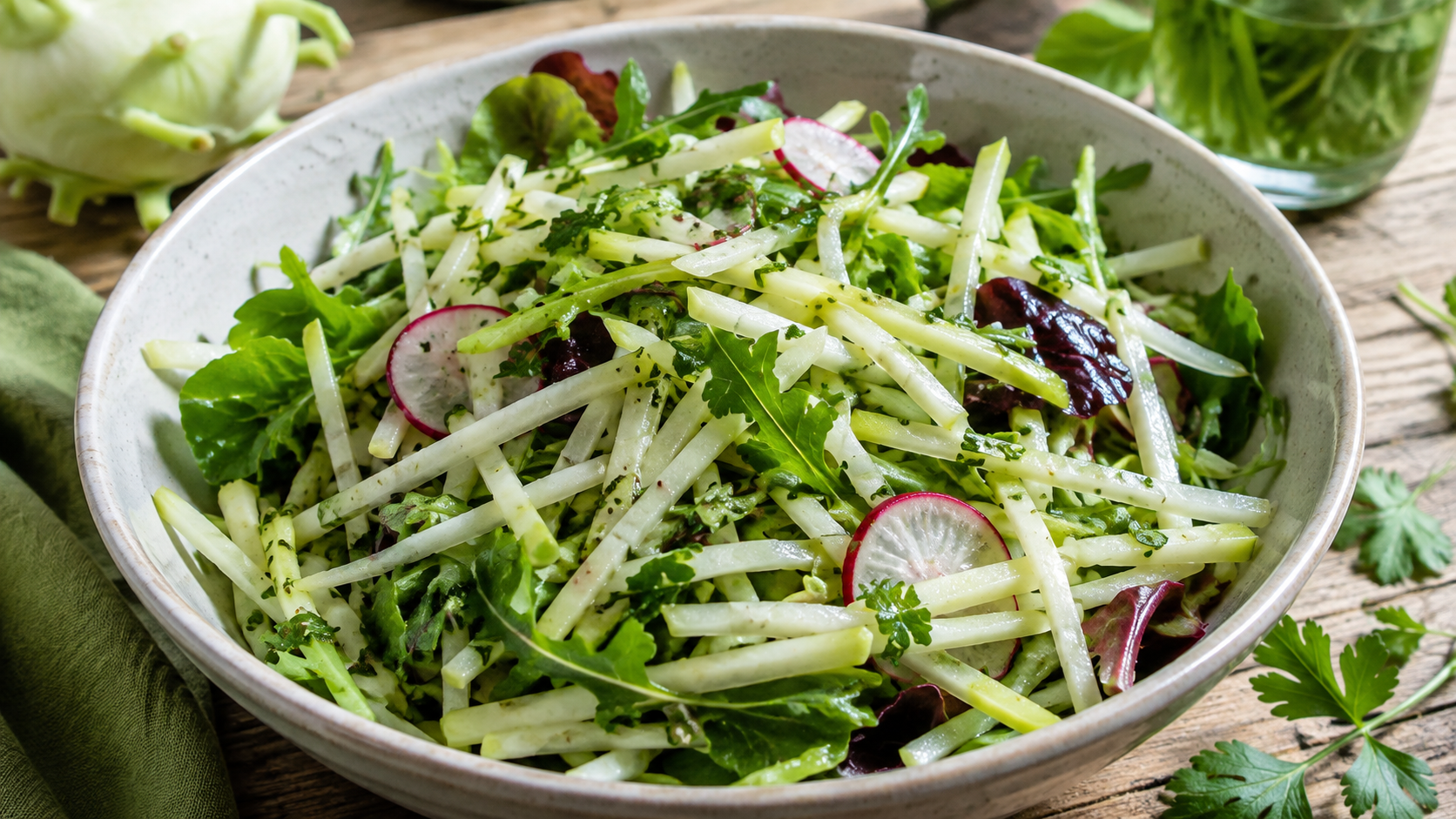 Thin strips of crisp kohlrabi are combined with mixed greens, radishes, and fresh herbs to create a light and refreshing salad that makes it easy to add more vegetables to everyday meals.
This article is intended as general health information and is not medical advice for diagnosing or treating any condition. If you have a thyroid condition or another health issue requiring dietary restriction, please consult a healthcare professional.