Why Can't a Piano Be Perfectly in Tune? Bach's Prelude in C-sharp Major, BWV 848
Earlier in this series, we looked at simple mathematical relationships in music: an octave has a frequency ratio of 1:2, a perfect fifth 2:3, and a perfect fourth 3:4. These simple ratios help explain why some intervals sound so naturally balanced.
However, even a carefully tuned modern piano is not mathematically “perfect.” These pure intervals cannot all fit together perfectly on the same keyboard. If we tune one interval exactly, another will be slightly off. To make music possible in every key, the piano has to make a carefully calculated compromise.

When Perfect Ratios Don't Fit Together
We can see the problem when we try to build a piano around these pure intervals. When we keep stacking perfect fifths, the notes eventually fail to line up exactly with the octaves. This tiny mismatch creates a problem when we try to fit all these relationships onto one keyboard.
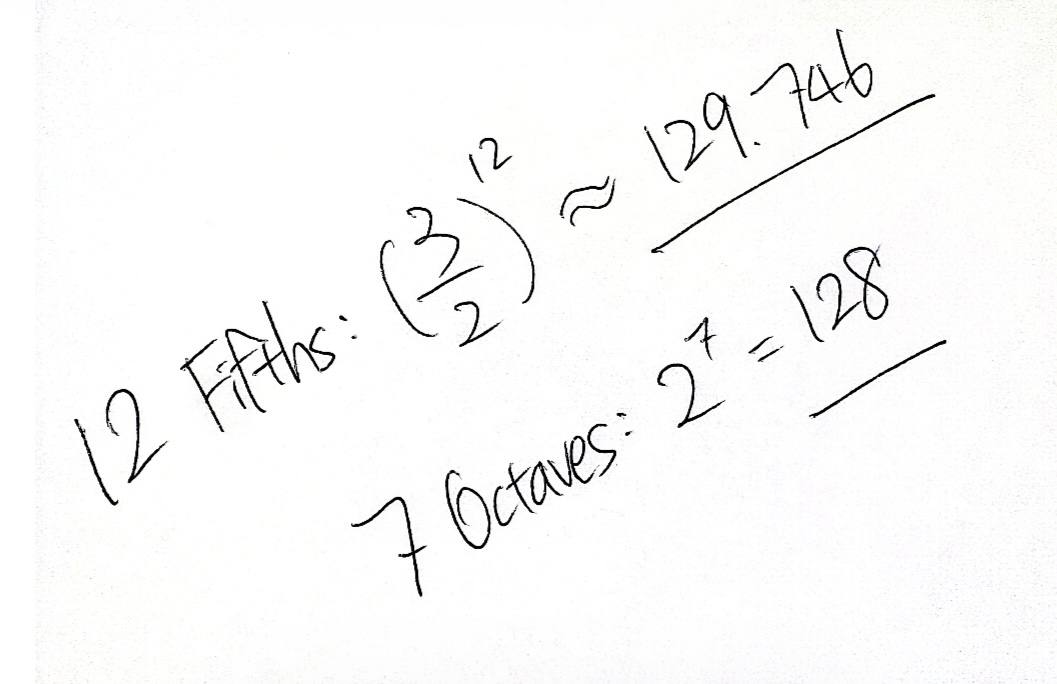 Twelve pure fifths do not quite equal seven octaves
That small difference creates a problem when we try to fit all these relationships onto one keyboard. So musicians developed different tuning systems to distribute the difference and make the keyboard work across many keys.
The Compromise Behind a Modern Piano
The tuning system used by most modern pianos is called 12-tone equal temperament. Instead of making every interval perfectly pure, it divides the octave into twelve equal steps. After twelve semitones, we arrive at the octave, which still has its exact 2:1 ratio.
The trade-off is that most other intervals are no longer exactly the simple ratios we started with. A perfect fifth, for example, is very slightly different from a pure 3:2 ratio. In other words, the piano sacrifices a little mathematical purity.
But that small compromise makes the keyboard much more flexible. Because the twelve semitones are equally spaced, a pianist can play in every key without having to retune the instrument. The piano gives up a little perfection so that music can have much more freedom.
Bach and a Keyboard of Many Possibilities
This brings us to J. S. Bach's The Well-Tempered Clavier and its Prelude in C-sharp Major, BWV 848, from Book I. The collection contains a Prelude and Fugue in every major and minor key, showing how a keyboard could move freely between keys.
C-sharp major is an interesting example. With seven sharps, it is one of the less familiar keys. In some older tuning systems, keys like this could sound noticeably different from others, making them harder to use. Yet Bach used this key, showing the possibilities of flexible tuning.
The title The Well-Tempered Clavier is important here. Well-tempered and equal-tempered are not the same thing. Bach's collection reflects well-tempered tuning systems that made it practical to explore a much wider range of keys.
Beautiful Without Being Perfect
There is something interesting about that compromise. We often think of compromise as settling for less, but equal temperament shows us another way to see it. A modern piano gives up a little mathematical perfection so that the entire keyboard can work in every key, making an enormous variety of music possible.
Perhaps there is something worth noticing here about life, too. We may wish we had more time, more ability, more confidence, or fewer weaknesses before we begin. But usefulness and beauty do not always require perfect conditions.
“He has made everything beautiful in its time.” — Ecclesiastes 3:11
A piano reminds us that perfection is not always what makes something beautiful or useful.
We may not always understand why certain limitations or imperfections are part of our lives. But God sees the whole picture when we cannot. What seems incomplete to us may still have a place in what He is making beautiful in its time.
Read previous: The Mathematics of Rhythm: Brahms’s Hungarian Dance No. 5