You're Not Too Busy. You're Just Hurrying (Review of The Ruthless Elimination of Hurry)
Have you ever finished a full day — emails answered, meetings attended, errands done — and felt, not satisfied, but hollowed out?
I have. More times than I'd like to admit. And for a long time, I told myself it was the season. A busy season. It would pass. But seasons kept arriving, one after another, each one a little more frantic than the last. The pace never slowed. I just got better at justifying it.
Then I read a sentence that stopped me cold. John Mark Comer, in his book The Ruthless Elimination of Hurry, writes that his spiritual director — a man he describes as one of the most Christlike people he knows — once gave him the simplest, most unsettling diagnosis he'd ever heard:
"Hurry is the great enemy of the spiritual life."
Not sin. Not doubt. Not theological confusion. Hurry.
The problem isn't your schedule. It's your soul.
Comer is a pastor in Portland, Oregon, and he writes with the honesty of someone who nearly burned out mid-ministry. He was running a fast-growing church, speaking, leading, producing — and quietly coming apart. The book begins not as a productivity manual, but as a confession. He had built a life that left no margin for what actually matters: being with God, being present to his family, being human.
He draws heavily on Dallas Willard, who argued that "hurry sickness" is the primary spiritual disease of our age. Comer unpacks why: hurry crowds out the very practices that form us into people who look like Jesus. You cannot rush contemplative prayer. You cannot skim the Sermon on the Mount. You cannot be emotionally present to your child while your mind is already three tasks ahead.
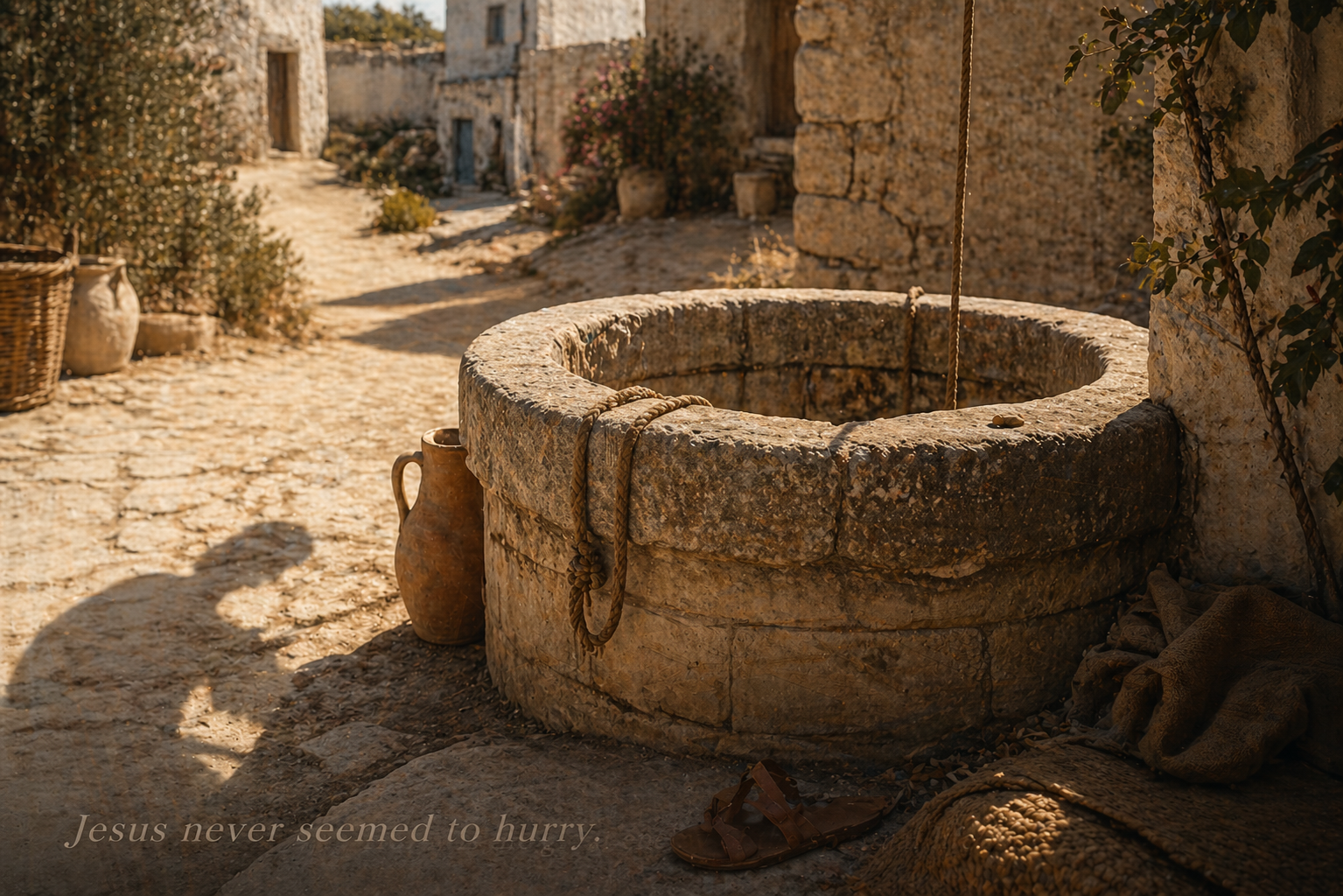
The insight that stayed with me longest is this: Jesus, who had the most important mission in human history, never seemed to hurry. The Gospels show him stopping for individuals. Sitting at wells. Sleeping through storms. Withdrawing before dawn to pray, even when crowds were pressing in. Comer asks the obvious, uncomfortable question — if Jesus didn't hurry, why do we assume we have to?
Four practices Comer actually prescribes
The second half of the book is practical, and this is where Comer earns his keep as a pastor rather than just a critic of modern life. He builds his framework around four ancient disciplines that Jesus himself practiced:
Sabbath. Not a guilt-laden Sunday obligation, but a full, weekly ceasing — from work, from productivity, from the performance of usefulness. Comer is specific: put the phone away, stop buying things, make space for delight. He frames Sabbath not as rule-following but as an act of trust — the belief that the world will not fall apart if you stop managing it for one day.
Simplicity. Comer makes the case that much of our hurry is self-inflicted: we take on too much, own too much, want too much. He's not anti-ambition, but he presses hard on the question of whether our lives are shaped by the values of the Kingdom or the values of consumer culture. The two, he argues, are largely incompatible.
Solitude and Silence. These come as a pair. Comer points out that Jesus regularly withdrew to deserted places — not after ministry, as a reward, but before it, as preparation. Solitude is where we learn to hear. Silence is how we stop filling every moment with noise, digital or otherwise, that numbs us to the presence of God.
Slowing. This one is deceptively small. Comer suggests literal, physical practices: drive in the slow lane, choose the longer checkout line, eat a meal without your phone on the table. The goal isn't inefficiency. It's interrupting the reflex that treats every moment as something to be optimized.
I found that last one worth sitting with — not because it's the most theologically profound point in the book, but because it exposed how deeply the hurry habit has settled into my body, not just my calendar.

A word for those who are tired of being told to slow down
If you've read enough Christian self-help to feel allergic to this genre, I understand the hesitation. But Comer isn't selling a lifestyle upgrade. He's making a theological argument: that the shape of Jesus's life is the shape we are invited into, and that shape is fundamentally unhurried. The kingdom of God, he writes, does not advance through urgency. It advances through faithfulness.
That reframing hit differently than I expected.
I've long believed, at least intellectually, that I don't have to earn my place with God. But I've lived as though I do — packing in enough good work, enough output, enough visible faithfulness, to feel secure. Comer names that cycle as a form of spiritual hurry, and I think he's right.
This isn't a book that will rearrange your week. It's one that, if you let it, will rearrange your wants — which is slower, harder, and more lasting.
If any of this resonates, I'd genuinely recommend picking it up here. (affiliate link)
📚You Might Also Like
What If the Thing Quietly Destroying You Isn't What You Think It Is? — Live No Lies
The Paradox of Love: Why a "No" is the Kindest "Yes" — Boundaries
The Spear You Don’t Throw Back: A Masterclass in Radical Silence — A Tale of Three Kings