Azusa Street Changes Everything
I grew up in a tradition that was deeply uncomfortable with the body.
Not in a Victorian way, exactly. Nobody was telling us bodies were shameful. It was more — quieter than that. The assumption was simply that real worship happened from the neck up. You engaged your mind. You controlled your voice. You stood still or you sat down. If something happened to you emotionally, that was between you and God, and you dealt with it privately.
I didn't question this for a long time. It was just what church felt like.
Then I started reading about 1906.
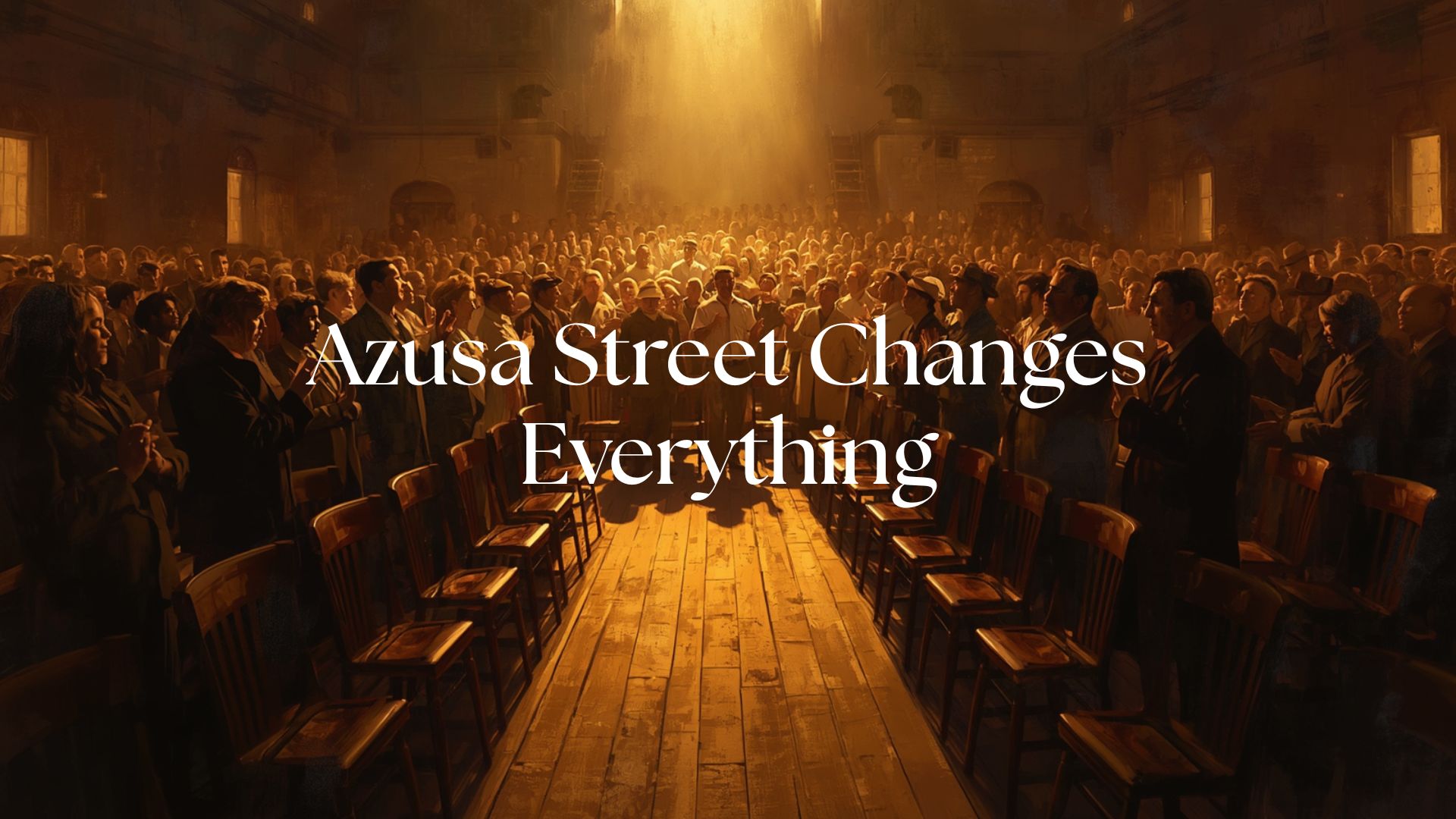
312 Azusa Street, Los Angeles. A former stable, converted to a church, in a neighborhood nobody would have chosen for a revival. No formal pulpit. No paid choir. No order of service. The leader — a partially blind Black preacher named William Seymour — sometimes prayed with his head inside a wooden crate stacked on his makeshift pulpit, reportedly to stay out of the way. Newspapers mocked the place almost immediately. One headline called it "Weird Babel of Tongues."
What was happening there was, by any measure, unprecedented. People were speaking in languages they had never learned. They wept and fell and danced. Prayer ran for hours with no planned endpoint. And coming back the next day. The meetings ran continuously for three years.
Within two years, Pentecostalism had spread to over fifty countries.
I want to be careful here.
The moment I write about Azusa Street, I know I'm stepping into territory where people have strong feelings in every direction. There are Christians who see it as the most significant outpouring of the Spirit since Pentecost itself. There are others who are deeply skeptical — of the emotionalism, the theology, the things claimed in its name since. I sit somewhere in the middle: genuinely uncertain, genuinely curious, not quite ready to dismiss and not quite ready to fully claim it either.
What I'm not uncertain about is the historical reality: Azusa Street changed what Christian worship looks like. That's not a theological verdict. It's just what happened.
Here's the thing about every previous argument this series has traced — the organ controversy, the piano debate, the guitar wars — they were all, underneath the surface, arguments about sound. Which instruments belong? Which sounds carry something sacred?
Azusa Street didn't argue about the sound. It blew past the question entirely.
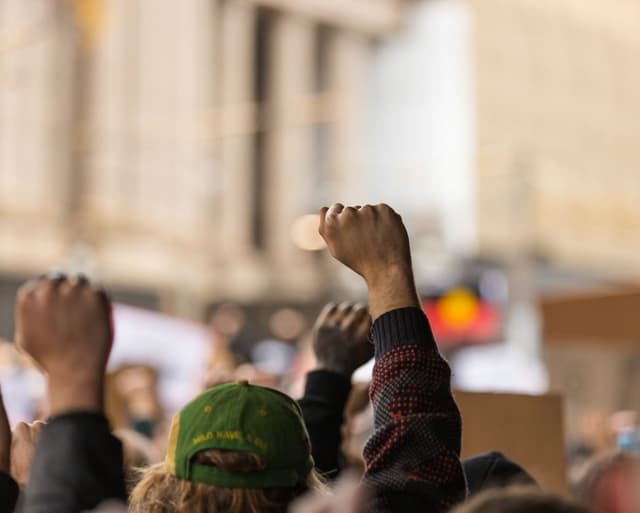
At Azusa, the body itself became a form of worship. Not a distraction from it. The physical responses — the weeping, the falling, the raised hands, the speaking in tongues — were not problems to manage. For the people in that room, the body was where the Spirit was actually doing something.
For the traditions I grew up in, this was alarming. If real worship happened from the neck up, then a room full of people weeping and falling and speaking in languages they didn't know was a spectacle, not a service.
But the Pentecostal tradition was reading the same Bible. And in that Bible, the body keeps showing up — hands lifted, knees bent, faces to the ground, shouts of praise, silence so deep you can feel it. The body, in Scripture, is not the problem worship has to work around. It's one of the instruments.
There's something about Azusa Street that gets less attention than the tongues and the falling, and I think it might be the most remarkable thing about it.
It was racially integrated.
In 1906. In Los Angeles. At a time when most American institutions — including, especially, American churches — operated on strict racial division, Azusa Street brought together Black, white, Latino, and Asian worshipers in the same room. An eyewitness, the white journalist Frank Bartleman, wrote: "The color line was washed away in the blood."
That didn't last. Within a few years, racial division had crept back in — Seymour's own movement split along racial lines — and most Pentecostal denominations eventually segregated like everyone else. The history is complicated and painful.
But for a brief window, something happened at Azusa Street that the rest of the American church couldn't manage. And it happened in a worship service.
When I trace the DNA of what most contemporary Protestant worship looks like today — the raised hands, the emotional engagement, the expectation that the Spirit will move, the informality, the physical freedom — almost all of it flows, directly or indirectly, from the Pentecostal and charismatic streams — its later, broader cousin in mainline and evangelical churches — that Azusa Street seeded.
The worship wars of the 1980s and '90s — which I'll get to next time — were fought over the forms those streams produced: the guitars, the production, the concert lighting. But by then, the deeper shift had already happened. The assumption that Sunday morning should feel alive, immediate, physically engaged — that came from 1906.
People thought they were arguing about guitars. They were actually arguing about Azusa Street.
I'm still working out what I think about all of it.
I was formed in a tradition that prized order and control. Some of what I received from that I still hold. But I've also stood in rooms where something was clearly happening — something moving through the whole person, not just the mind — and I've had to reckon with the fact that my instinct to manage it, to keep it at arm's length, might be missing something real.
The spiritual gifts in the Bible are not tidy. They never were. Neither is the Spirit.
Maybe the question Azusa Street leaves us with isn't was that legitimate? Maybe it's: what is worship allowed to do to the body? What is the Spirit allowed to do with the whole of us?
I don't have the answer. I'm still asking the question.