[Christian Movie Review] I Can Only Imagine — A Story About Forgiveness, Redemption, and the Song That Changed Everything
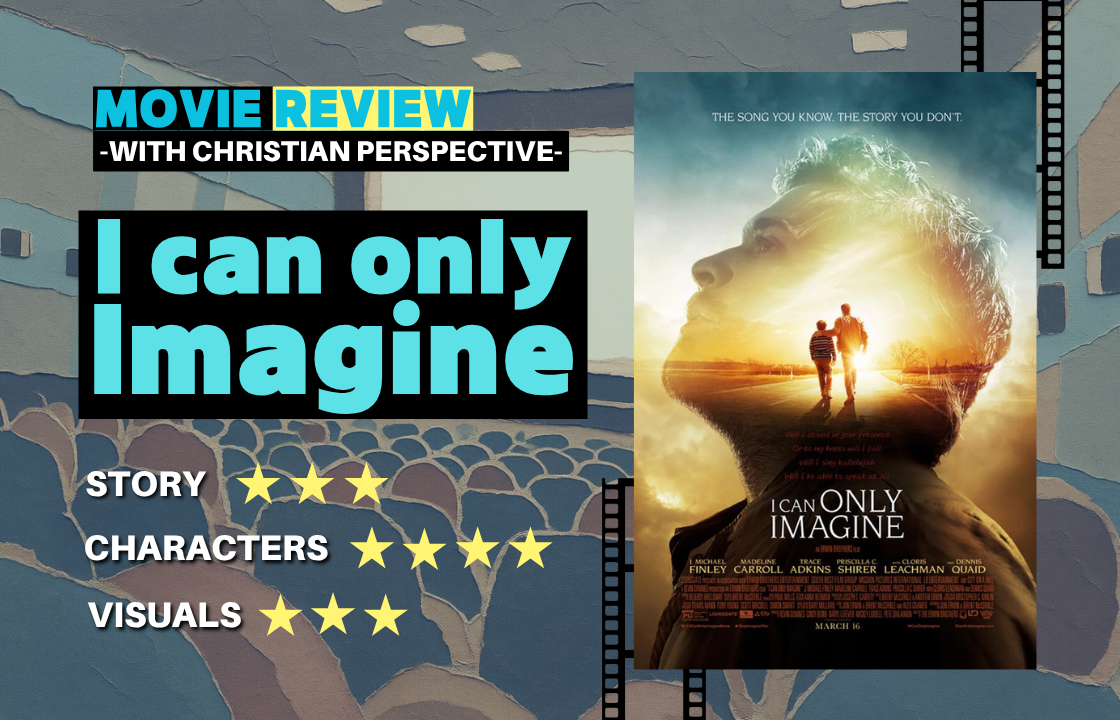 Christian review image for I Can Only Imagine featuring themes of forgiveness, redemption,
and family restoration
Before We Talk About the Song, There Was a Story
Most people know "I Can Only Imagine" as a song. Released by MercyMe in 1999, it became the best-selling Christian single of all time — and one of the best-selling singles in any genre. But fewer people know where it came from.
The 2018 film directed by Andrew and Jon Erwin tells that story. It follows Bart Millard — the man who wrote those lyrics — from a childhood marked by abuse and fear, through his years of running from both his father and his faith, all the way to the moment he sat down and wrote one of the most played songs in modern Christian history.
And the twist that makes this story remarkable? The man Bart was running from — his father, Arthur Millard — had become someone else entirely. Through a genuine encounter with Jesus Christ, the same man who had beaten and terrorized his son became, by all accounts, one of the most gentle and transformed men anyone who knew him could describe.
That transformation is the heart of the film. Not the song. The song is just what came out of it.
What Christians and General Audiences Said
When the film released in March 2018, it exceeded nearly everyone's expectations — especially at the box office. Made on a budget of around $7 million, it went on to gross over $83 million worldwide. That kind of return for a faith-based independent film was genuinely remarkable.
Among Christian audiences, the response was overwhelmingly warm. Many viewers — particularly those who had grown up hearing the song without knowing its backstory — found the film deeply moving. Churches organized screenings. Small groups used it for discussions on forgiveness and family. Pastors referenced it from the pulpit.
The story of Arthur Millard's transformation resonated especially hard with people who had experienced broken family relationships, wondered whether change was truly possible, or carried wounds from a difficult upbringing. The film gave those questions a human face and a real answer.
General audiences and secular critics were more measured in their responses. Many praised the lead performances — J. Michael Finley as Bart and Dennis Quaid as Arthur — and acknowledged that the story itself was genuinely compelling. Some reviewers noted that the film was more accessible than typical faith-based productions, and that it avoided some of the more heavy-handed tendencies the genre is sometimes known for.
The common critique from outside Christian circles was that the film followed familiar biopic conventions a little too comfortably — the rise, the fall, the redemption arc — without pushing deeply enough into the harder questions it raised. A few critics noted that Arthur's transformation, while portrayed as miraculous (and by all accounts, it was), was handled somewhat quickly in the film's second half, which made it feel tidier than the real thing probably was.
But even those who weren't moved by the faith elements tended to acknowledge the emotional power of the father-son story at its core.
What the Film Gets Biblically Right
Transformation Is Real — and It Can Be Radical
The theological center of this film is the genuine possibility of human transformation through an encounter with Christ. Arthur Millard is not presented as a man who slowly improved his habits or gradually became more self-aware. He is presented as a man who was fundamentally changed.
That is exactly what the New Testament says happens in conversion. Paul describes it as becoming "a new creation" — the old has gone, the new has come (2 Corinthians 5:17). The film takes that language seriously. It doesn't soften Arthur's past or suggest he just needed better coping strategies. It shows a man who was genuinely remade.
For audiences who have grown up in churches where transformation language is common but the visible evidence is often modest, watching Arthur's change portrayed so starkly is striking. The film asks: do we actually believe this is possible? And it answers with a resounding yes.

Forgiveness as a Process, Not a Decision
One of the film's most honest elements is how it handles Bart's forgiveness of his father. It isn't instantaneous. Bart doesn't come home, see that his dad has changed, and simply move on. The wound is too deep for that.
The film shows forgiveness as a journey — one that is painful, nonlinear, and costly. Bart resists. He wrestles. He has to confront not only what was done to him, but what holding onto it is doing to him. His mentor Shannon in the film challenges him on this directly: the bitterness he carries isn't just personal — it's starting to show up in his music, his relationships, and his walk with God.
This mirrors what Jesus taught in Matthew 18:21-35. Forgiveness isn't a feeling that arrives when you're ready. It is a choice — repeated, sometimes difficult — that is rooted in an awareness of how much we ourselves have been forgiven.
The film handles this theme more honestly than many Christian movies do. It doesn't pretend forgiveness is easy. It just insists that it's necessary.
Grace That Doesn't Excuse, But Does Restore
What the film portrays in Arthur's storyline is a picture of grace that is both costly and complete. The film doesn't minimize what Arthur did. There's no attempt to explain it away or soften the impact on Bart. The abuse was real, the damage was real, and the film doesn't flinch from that.
But it also shows that grace doesn't require us to pretend those things didn't happen in order to be genuine. Arthur's transformation doesn't erase his past. It just means that his past is no longer the whole story. That's a deeply biblical picture of what redemption actually looks like.
Where the Film Falls Short
The Transformation Feels Too Clean
Here's the honest tension in this film: Arthur Millard's real-life story is extraordinary. People who knew him — including Bart himself — have spoken at length about how genuinely transformed he was in his final years. It wasn't a performance. The change was real.
But the film compresses that transformation into a relatively small amount of screen time, and in doing so, it makes it look somewhat smooth. There's a moment where Arthur is different, and then he stays different. The struggles, the setbacks, the daily grind of someone learning to live a completely new kind of life — that complexity gets abbreviated.
This matters not because the film is being dishonest, but because it can inadvertently set unrealistic expectations. Real transformation — even genuine, Spirit-led transformation — is usually messier than this. It involves relapse, doubt, slow growth, and years of rebuilding trust. By making it look this clean, the film may unintentionally discourage people whose own stories are less linear.
Bart's Spiritual Journey Gets Somewhat Rushed
The film focuses heavily on the father-son relationship, which is understandable — that's the emotional engine of the story. But as a result, Bart's own spiritual arc sometimes feels underdeveloped.
We see him drift from faith. We see him come back. But the interior dimension of that journey — what he actually believed, what he doubted, what it cost him to return — is often told rather than shown. For a film about a man who would eventually write one of the most theologically rich songs in contemporary Christian music, we get surprisingly little insight into how he actually thought about God.
This isn't a fatal flaw. But it does mean that Bart's transformation feels slightly more circumstantial — driven by his father's change — than internally owned.
The Supporting Characters Are Thinly Drawn
Several supporting characters — Bart's high school girlfriend, his bandmates, even his early mentors in the music world — function more as plot devices than as fully realized people. They appear when the story needs them and recede when it doesn't.
In a film about the community that surrounds a person through crisis and growth, this feels like a missed opportunity. Faith rarely happens in isolation. The church community, the friendships, the people who speak hard truths and stay anyway — these relationships matter. The film nods at them without exploring them very deeply.
Symbolism Worth Paying Attention To
The Song as a Moment of Surrender
The actual writing of "I Can Only Imagine" in the film is portrayed as something that happens almost involuntarily — Bart sits down, and the song comes out in about ten minutes. That's consistent with how he's described it in real life.
What's theologically interesting about this is what it says about creative work done in and through grief. Bart wrote the song shortly after his father's death. He wasn't trying to write a hit. He was trying to process the loss of a man who had become, against all odds, someone he actually missed.
The song became, in that moment, an act of worship that emerged from a place of raw honesty. That's a picture of what the Psalms are — not polished religious content, but unfiltered human experience brought before God and somehow transformed in the process.
Football and the Body
One recurring motif in the film is Bart's relationship to football — a sport his father pushed him into and where he showed genuine promise before injury ended that chapter. It's a small but interesting symbol of the things we carry from our families that are neither purely good nor purely bad. Football gave Bart discipline and identity, even if the way he got there was painful. The body that was hurt in one context became the voice that would reach millions in another.
It's not an explicit theological symbol, but it echoes something true about how God often works through what was broken rather than around it.
Arthur's Final Days
The film's portrayal of Arthur in his final years — gentle, faithful, deeply connected to his church community, reading Scripture, writing letters — paints a picture of what sanctification actually looks like over time. It isn't dramatic. It's quiet. It's slow. It's ordinary.
This is perhaps the most underappreciated symbol in the film: holiness doesn't always look like a lightning bolt moment. Sometimes it looks like an old man sitting in a church, having been changed by something no one can fully explain, living out the rest of his days in ordinary faithfulness.
Why This Film Still Matters
I Can Only Imagine came out in 2018, but the questions it raises are not going anywhere.
How do you forgive someone who genuinely hurt you? What do you do when the person who damaged you most becomes someone you don't recognize? Is transformation actually possible for the people in your life who seem most locked into who they are?
These are not abstract theological questions. They're the questions people bring into church every Sunday. They're the questions that sit underneath marriages, estrangements, deathbed conversations, and years of therapy.
The film doesn't answer all of them perfectly. But it takes them seriously, and it grounds them in a story that actually happened — which gives them a weight that a purely fictional narrative wouldn't have.
For Christians, the film is also a useful reminder that the most powerful testimony is often the simplest one: I was one thing, and then I encountered Jesus, and now I am something different. Arthur Millard never gave a famous speech or led a crusade. He just changed. And that change was enough to write a song that has been sung by more people than either of them could have imagined.
More Than a Christian Music Biopic
I Can Only Imagine is not a perfect film. Its structure is conventional, some of its characters are underdeveloped, and the transformation at its center is portrayed with a tidiness that the reality probably didn't have.
But it tells a true story about a real man who was genuinely remade by grace — and about the son who had to decide whether to believe that, and what to do with his own pain in the meantime.
That story deserves to be told. And for the most part, this film tells it well.
If you watch it expecting easy answers and a neat emotional resolution, you might leave a little satisfied but not particularly challenged. But if you watch it with the questions open — Do I actually believe people can change? Have I forgiven the people I need to forgive? What am I still holding onto? — it has the potential to stay with you.
And if you haven't heard the song in a while, give it another listen after the credits roll. It hits differently once you know where it came from.
Tags: I Can Only Imagine film review, Christian movie 2018, MercyMe Bart Millard, biblical forgiveness, redemption film, faith-based biography, Dennis Quaid, J. Michael Finley, Erwin Brothers, Christian film theology