Fasting or Intermittent Fasting? (2) Similar Patterns, Different Center
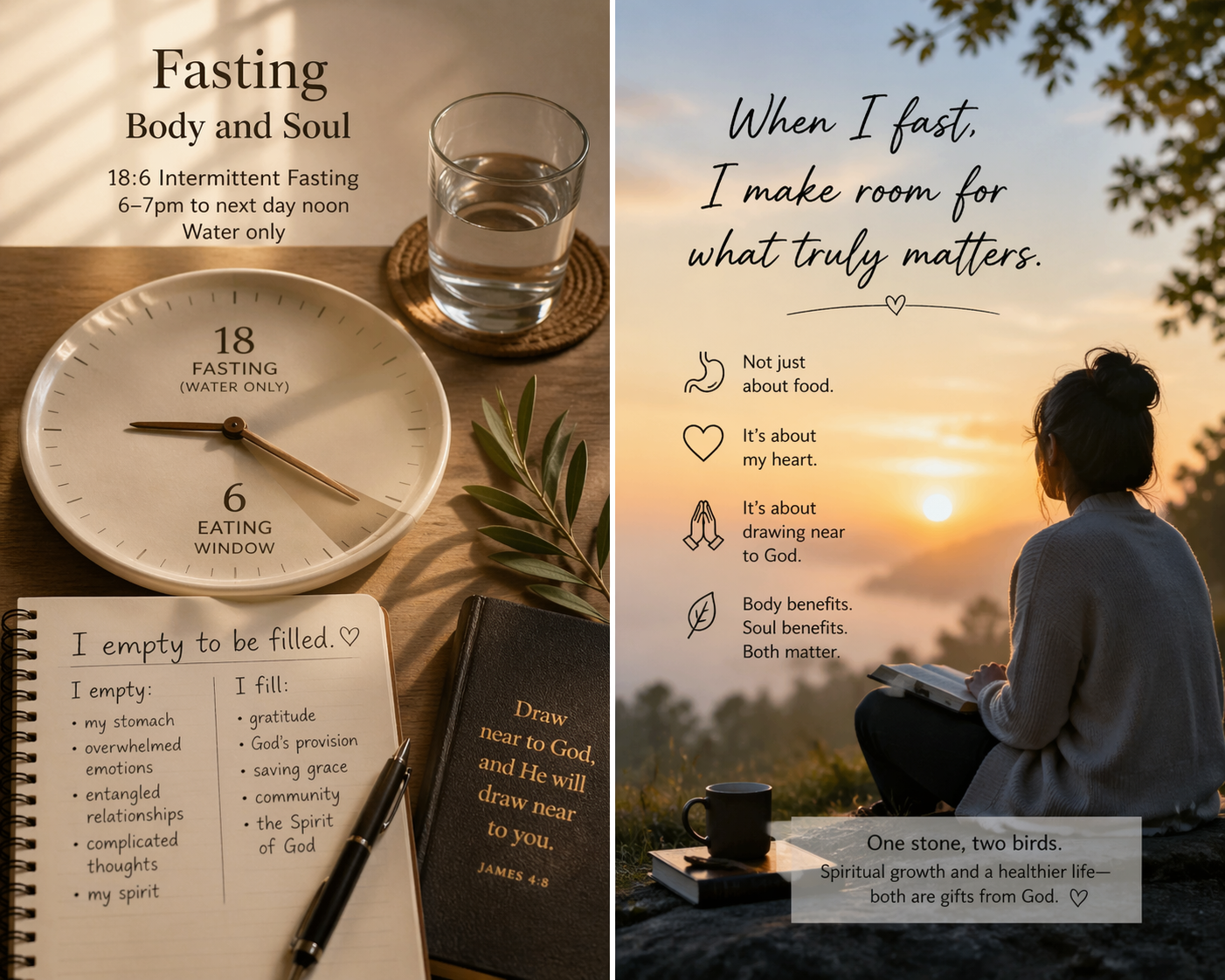
Christian fasting and intermittent fasting practices involve stepping away from food for a period of time. Both require discipline. Both simplify daily life. Yet the similarity goes deeper than just behavior. At their core, they reflect a shared pattern: creating space by letting go of something immediate in order to gain something greater.
Intermittent fasting is usually centered on the body. It aims to improve physical health—balancing hormones, supporting digestion, and allowing the body to recover. Christian fasting, however, is centered on God. It is not primarily about the body, even though the body is involved. It is about redirecting attention, reordering desires, and becoming more aware of God’s presence.
This difference in focus is important. Two people can do the exact same thing—skip meals, feel hunger, change their routine—and yet be moving in completely different directions. One may be pursuing physical health, while the other is seeking spiritual clarity.
The Bible presents fasting as something deeply intentional. Before beginning His public ministry, Jesus spent time in fasting:
“After fasting forty days and forty nights, he was hungry.” (Matthew 4:2)
This moment was not about endurance or self-discipline alone. It was about preparation. It was a time of focus, testing, and alignment with God’s will.
Fasting also appeared as a regular rhythm in people’s lives:
“I fast twice a week…” (Luke 18:12)
This shows that fasting was not always an extreme act. Sometimes, it was simply part of a repeated pattern—a way of structuring life around something greater than daily needs.
At the same time, Jesus made it clear that fasting is not about appearance or performance:
“When you fast, do not look somber as the hypocrites do…” (Matthew 6:16)
Fasting, in its true form, is quiet. It is inward. It is relational.
Interestingly, modern research has shown that intermittent fasting can support physical health in meaningful ways. It may improve insulin sensitivity, reduce inflammation, and help the body repair itself at a cellular level. In that sense, something practiced for spiritual reasons long ago also carries physical benefits today.
This does not mean the two practices are the same. But it does remind us of something important: the human body and soul are not separate systems. What affects one often influences the other.
In the end, fasting—whether approached from a health perspective or a spiritual one—invites us to pause. It interrupts the constant flow of consumption. It creates a gap.
And in that gap, we begin to see what truly sustains us.