Five skills every teenager needs — and how parents can help build them
Raising children who are ready for life, not just ready for the next exam
There is a question that quietly follows most Christian parents of teenagers around the house: "My child is keeping up with school. But are they becoming the kind of person who can actually live well?"
Grades matter. But grades end. The character, habits, and inner capacities a teenager develops in these years travel with them for the rest of their life. Proverbs put it plainly — and parents have been returning to this verse ever since:
"Train up a child in the way he should go: and when he is old, he will not depart from it."
Proverbs 22:6, KJV
The Hebrew behind "train up" carries the image of a parent putting something in a child's mouth — the way you help a newborn begin to feed. It is not passive. It is intentional, patient, and repeated. This is not about producing performance. It is about forming a person.
With that in mind, here are five skills that teenagers need to develop before they leave home — and the role Christian parents can play in helping them grow.
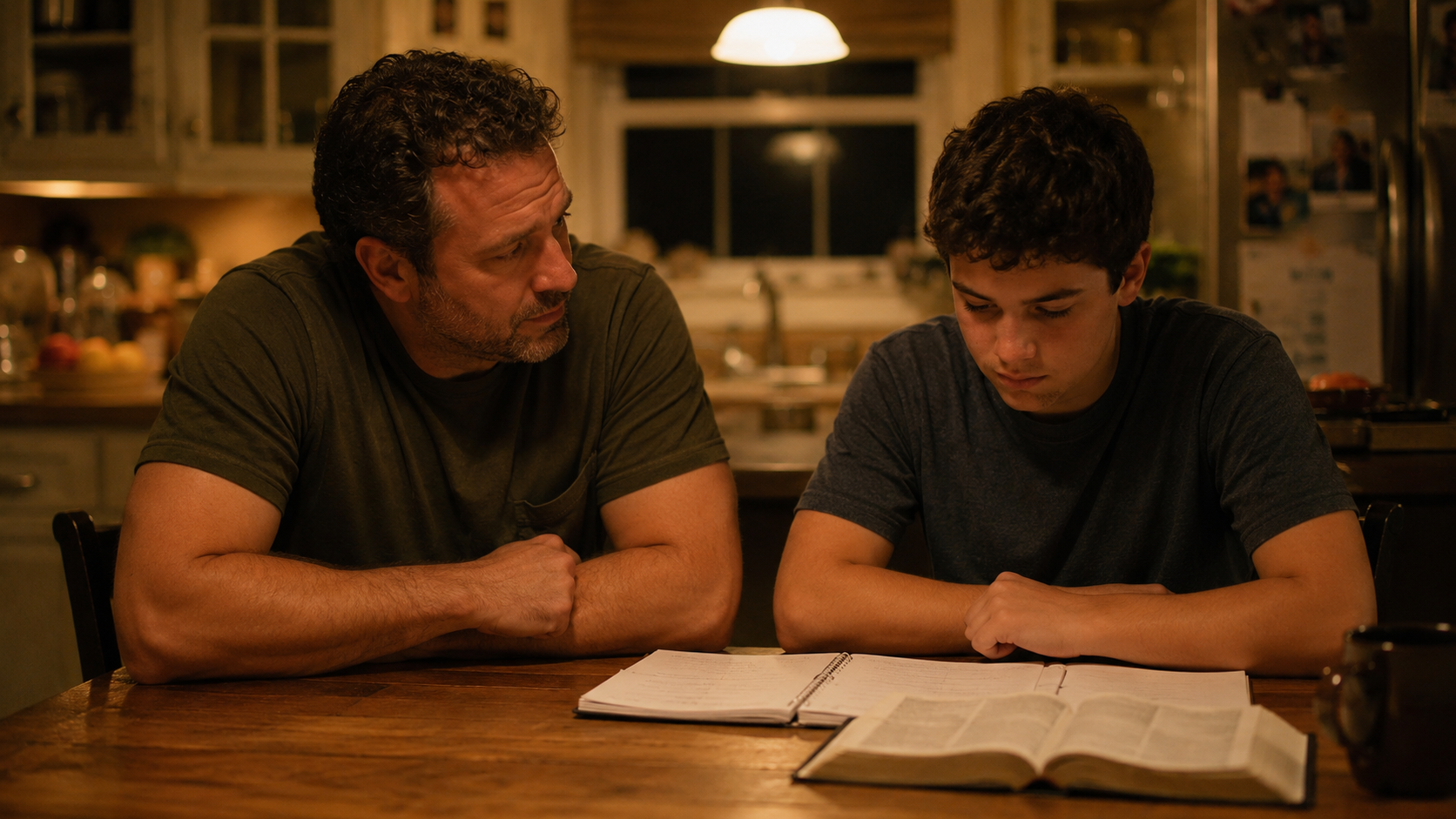 Late at night, a father and son share a quiet moment at the kitchen table. With open notebooks and a Bible between them, the scene captures the warmth of listening, reflection, and the unspoken bond between parent and child.
1. Planning — learning to steward time and purpose
Planning is not about filling every hour with productivity. At its root, it is about understanding that time is a gift — and that gifts are meant to be used with intention. A teenager who can set a goal, break it into steps, and follow through is not just more organized. They are practicing the kind of faithful stewardship the Bible calls us to.
"Commit thy works unto the LORD, and thy thoughts shall be established."
Proverbs 16:3, KJV
Planning without God at the center is just self-management. But planning as an act of offering — laying out your days and holding them with open hands — is something different altogether.
How parents can help
Instead of "Why haven't you done it yet?" try: "What's your plan, and when do you want to get it done?" Help them set goals that are specific and small enough to actually attempt. Let them try, fall short, and revise — that process is where real planning skill grows. Share your own weekly rhythm and how you bring it before God.
2. Focus — learning to resist distraction
Teenagers today are not simply distracted. They are living inside a system that has been engineered, at enormous expense, to capture and hold human attention. This is the environment their faith and character formation has to happen in.
Focus, in this context, is not just a productivity skill. It is a form of resistance. It is the practiced ability to choose what deserves your attention — and to hold that choice against the constant pull of what is easier, louder, and more immediately gratifying.
"Finally, brethren, whatsoever things are true, whatsoever things are honest, whatsoever things are just, whatsoever things are pure, whatsoever things are lovely, whatsoever things are of good report; if there be any virtue, and if there be any praise, think on these things."
Philippians 4:8, KJV
Paul's instruction is essentially a lesson in directed attention. The mind does not simply wander into godliness. It has to be trained to dwell on what is true and good. That training starts in the ordinary choices of an ordinary afternoon.
How parents can help
Try structured focus blocks — 25 minutes of work, then a genuine break. Designate phone-free times as a family, not just a rule for teenagers. Model what it looks like to give someone your full attention. Multitasking is overrated; let your teenager see you doing one thing well.
3. Self-control — learning to feel without being ruled by feeling
Self-control is frequently misunderstood, in Christian homes as much as anywhere else, as the suppression of emotion. But that is not what the Bible describes. Fruit of the Spirit-level self-control is not the absence of anger, fear, or desire — it is the freedom to respond rather than merely react.
"He that is slow to anger is better than the mighty; and he that ruleth his spirit than he that taketh a city."
Proverbs 16:32, KJV
This verse takes self-mastery seriously — more seriously, in fact, than military conquest. Ruling one's spirit is presented as the greater achievement. And the teenager who learns to feel the full weight of a difficult emotion without immediately acting on it has learned something that will shape every relationship and every decision they ever make.
How parents can help
Don't dismiss the emotion — name it and make room for it. "That makes sense" before "here's what you should do." Let the feeling settle before the conversation goes forward. And above all: model it. A parent who handles their own frustration with grace is teaching self-control more powerfully than any lecture.
The teenager who learns to feel deeply without acting impulsively has acquired something more valuable than any academic credential.
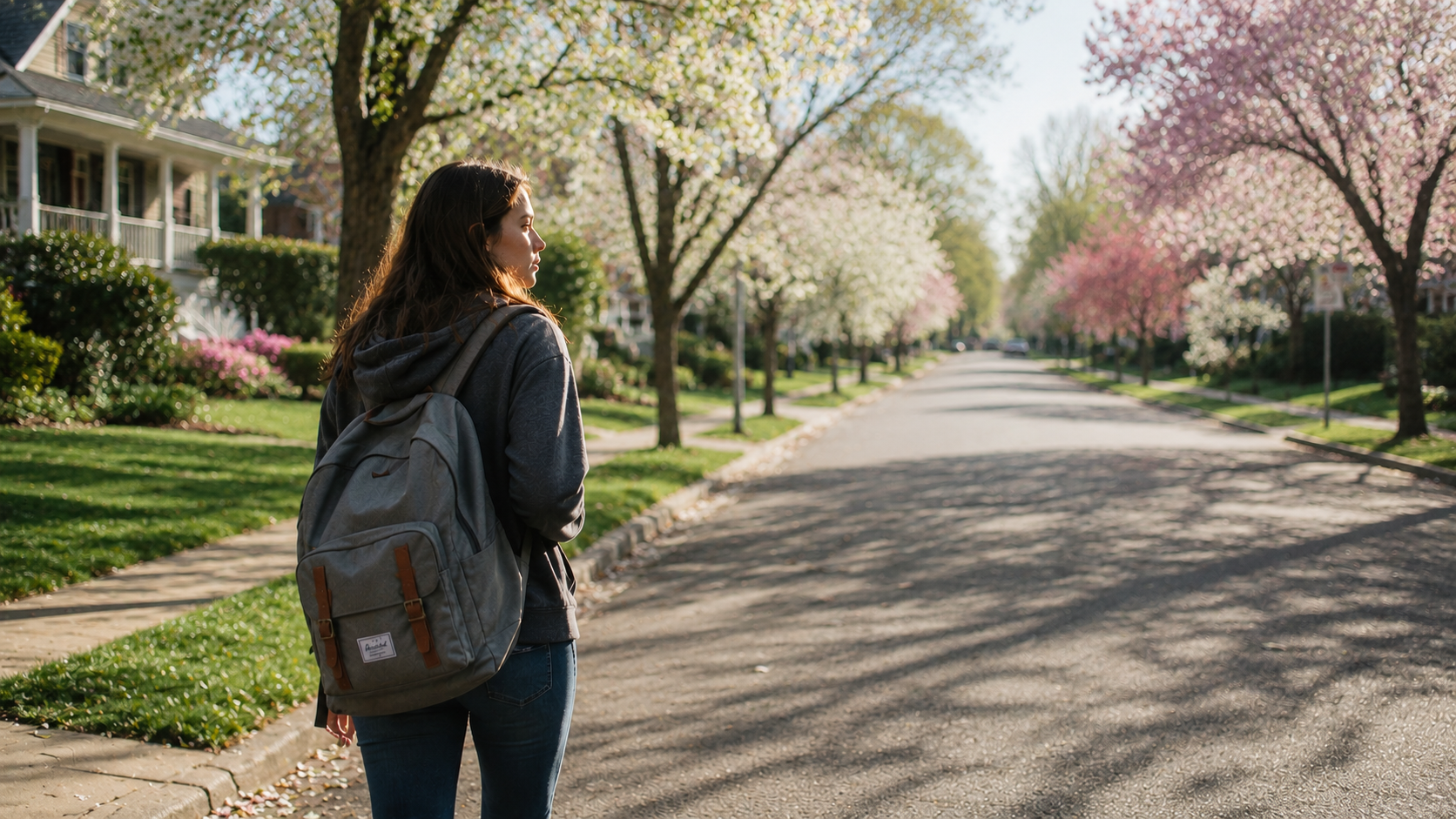 In the quiet light of early morning, a teenage girl walks through a peaceful suburban neighborhood, carrying both her backpack and a quiet sense of determination. Surrounded by blooming spring trees and soft sunlight, the moment captures the feeling of moving forward with hope and purpose.
4. Awareness — learning to see beyond yourself
Awareness — of your own patterns, of other people's inner lives, of how you come across in a room — is the foundation of both genuine empathy and genuine wisdom. Without it, a person moves through relationships leaving damage they never intended and never notice.
Scripture ties this directly to the life of faith. The two great commandments — love God, love your neighbor — both require the ability to step outside your own immediate experience and actually see someone else.
"Look not every man on his own things, but every man also on the things of others."
Philippians 2:4, KJV
This kind of awareness is not intuition you either have or don't. It is a habit, practiced over thousands of small moments — the question asked, the pause before responding, the curiosity about why someone said what they said rather than just how it landed on you.
How parents can help
Go beyond "How did that make you feel?" — add "Why do you think they responded that way?" Use ordinary family conflicts as low-stakes practice in perspective-taking. Read together, watch films together, and talk honestly about the motivations of the characters. Real people are as complex as fictional ones, and your teenager needs practice seeing that.
5. Flexibility — learning to hold plans loosely
Life will not go the way your teenager plans. Tests will be failed. Friendships will end unexpectedly. The path they were certain about will close. The question is not whether disruption will come, but what they will do when it arrives.
A teenager who has only ever been protected from failure has not been protected at all. They have simply been kept from the training ground. Flexibility — the capacity to absorb disappointment, adjust course, and keep going — is built in the moments that don't go right.
"For a just man falleth seven times, and riseth up again."
Proverbs 24:16, KJV
Rising again is presented not as exceptional — it is presented as characteristic of the just. Resilience is not the absence of failure. It is the habit of getting back up. And that habit has to be formed somewhere, in someone, over time. The teenage years are exactly that somewhere.
How parents can help
When a plan fails, resist the impulse to fix it immediately or assign blame. Instead: "So what happens now? What are your options?" Let imperfect outcomes teach rather than traumatize. And let your teenager watch you adapt when things don't go your way — how a parent handles disappointment teaches more than any conversation about resilience ever will.
 In the stillness of the morning light, a teenager quietly writes reflections beside an open Bible. The worn journal pages, marked with notes and underlines, suggest a personal journey of faith, thought, and steady growth lived one page at a time.
A note for parents
If you've been reading this list and feeling quietly convicted, that's probably right. Planning, focus, self-control, awareness, flexibility — none of these are skills we fully master and then hand down. They are things we are still learning, often alongside our teenagers, sometimes because of them.
The most powerful formation tool any parent has is not a curriculum or a conversation. It is a life, lived honestly in front of another person who is watching closely and learning from everything they see.
"And these words, which I command thee this day, shall be in thine heart: And thou shalt teach them diligently unto thy children, and shalt talk of them when thou sittest in thine house, and when thou walkest by the way, and when thou liest down, and when thou risest up."
Deuteronomy 6:6–7, KJV
The vision here is not a scheduled family devotional (though that has its place). It is a life so saturated with faith that it naturally spills into every ordinary moment — at the table, on the drive, at the end of the day. That is how character forms. Not in the big moments. In the accumulated weight of the small ones.
Today, try asking your teenager one of these:
"What's something you're trying to get better at this week?"
"When things get hard, what helps you keep going?"
"Is there someone in your life right now who might need a bit more grace from you?"
Those questions, asked with genuine curiosity and no agenda, are some of the most formative things a parent can offer.
A parent's prayer
Lord, You entrusted this child to me — not because I have it figured out, but because You are at work in both of us. Give me the wisdom to guide without controlling, to correct without crushing, to model what I'm trying to teach. Where I have failed them, bring restoration. Where they are struggling, meet them in ways I cannot. And remind me, on the hard days, that You love them more than I do — and that is more than enough. In Jesus' name, Amen.