Habits That Keep the Body God Entrusted to Us Healthy: Calcium and Vitamin D
"Beloved, I wish above all things that thou mayest prosper and be in health, even as thy soul prospereth." (3 John 1:2, KJV)
As we get older, our thinking about health starts to shift.
In our younger years, walking, running, and climbing stairs happened without a second thought. But at some point, even small changes in our knees, back, and muscles start getting our attention.
Especially past midlife, it matters to start caring for bone health ahead of time.
For a Christian, caring for your health may never have been simply about living longer. It can be seen as a form of stewardship — caring well for the body God has entrusted to us, so we're able to carry out what's been given us to do.
Scripture puts it this way:
"What? know ye not that your body is the temple of the Holy Ghost which is in you, which ye have of God, and ye are not your own?" (1 Corinthians 6:19, KJV)
So what should we actually be paying attention to in order to keep our bones and muscles healthy?
Two foundational nutrients stand out: calcium and vitamin D.
 Staying active through simple daily movement can help support bone strength, muscle health, balance, and mobility as we age.
Why Does Calcium Matter?
Calcium is one of the most abundant minerals in the human body.
Most people think of calcium purely in terms of bones, but it's actually involved in far more — muscle movement, nerve signaling, and normal bodily function overall.
Most of the calcium in your body is stored in your bones and teeth.
Getting enough calcium — through food, and through supplements when necessary — can genuinely help maintain bone health across your whole life.
This matters not just for growing teenagers, but especially for people in midlife and beyond, when bone density tends to decline more easily.
Why Calcium and Vitamin D Are Usually Discussed Together
Getting enough calcium alone doesn't complete the picture for bone health.
For calcium to actually be absorbed properly in your gut and put to use in your body, vitamin D plays a critical role.
Put simply: calcium is the key building material for bone, and vitamin D is the nutrient that helps your body actually put that calcium to use.
That's exactly why so many calcium supplements on the market are formulated as Calcium + Vitamin D3. [A combination supplement pairing the two nutrients together] can be a convenient way to cover both at once, if your diet or sun exposure leaves a gap (affiliate link — I may earn a small commission at no extra cost to you).
But that doesn't mean taking more is automatically better, just because a label pairs the two together.
It's worth considering how much you're already getting through your regular diet, along with your age and overall health status.
Start by Checking Your Own Table First
Before reaching for a supplement, it's worth first checking what's actually on your plate.
Calcium is relatively easy to get from foods like:
- Dairy products — milk, yogurt, cheese
- Small fish eaten with the bones, like sardines
- Tofu and legumes
- Certain leafy greens like kale and bok choy
- Calcium-fortified foods
Small habits — a glass of milk with breakfast, adding tofu or sardines to a meal — can genuinely help.
Health, more often than not, is built from small choices repeated every day, rather than dramatic changes.
The life of faith works similarly. Just as short daily prayers and Scripture reading gradually build up our souls, healthy eating and exercise steadily build up our bodies over time.
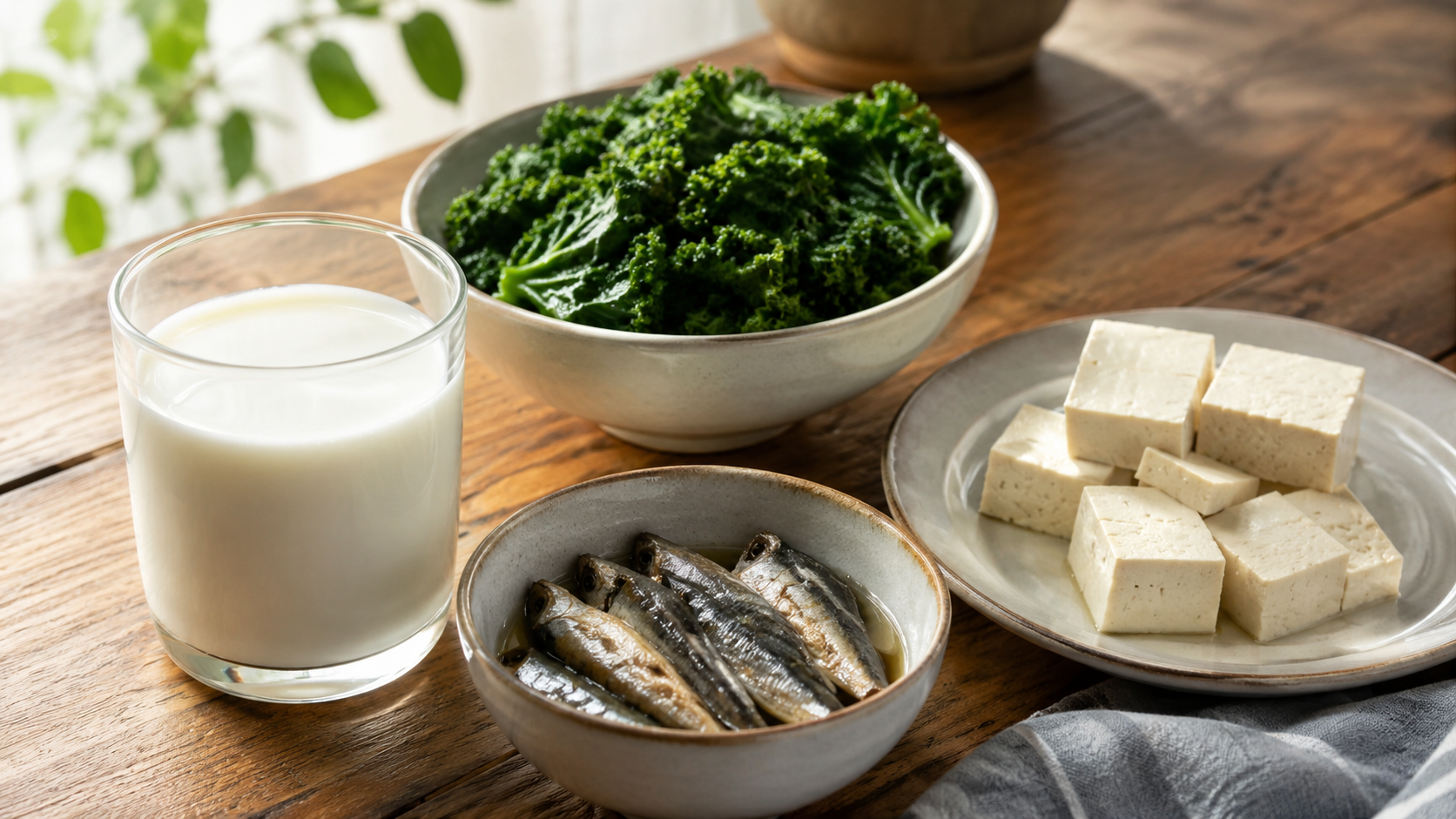 Milk, sardines, tofu, and leafy greens are among the foods that can help provide calcium as part of a balanced diet that supports healthy bones.
Vitamin D Is Connected to Sunlight, Too
Vitamin D can come from food, but your body also produces it when your skin is exposed to sunlight.
Since modern life involves so much time indoors, and many people don't get enough sun exposure, interest in vitamin D status has been growing.
That said, how much sun exposure is actually "enough" varies significantly by season, skin tone, latitude, and lifestyle, so it's hard to give a single blanket answer like "a few minutes a day is enough for everyone."
If a health screening shows a low vitamin D level, it's worth talking with a doctor about whether to address it through diet, sun exposure, or a supplement.
Exercise Matters for Bone Health Too
Calcium and vitamin D alone don't complete the picture for bone health either.
Activities that place healthy stress on bones and muscles — walking, taking the stairs, light strength training — matter too.
As we age in particular, maintaining muscle mass and balance plays a real role in reducing the risk of falls and fractures.
Where possible, it's worth building habits like:
Walking a bit more.
Doing light strength training.
Getting enough sleep.
Eating a balanced diet.
What About Coffee and Salty Food?
Drinking coffee doesn't immediately weaken your bones.
That said, if you're getting too much caffeine, or your overall diet is unbalanced along with insufficient calcium, it can affect your overall nutritional balance.
It's also worth cutting back on excessive sodium.
In the end, what matters isn't banning any specific food outright — it's the balance of your overall diet.
What to Remember When Taking a Calcium Supplement
A supplement is ultimately meant to complement your regular diet, not replace it.
More isn't automatically better.
If you have a history of kidney stones, kidney disease, or hypercalcemia, or you take medication regularly, it's safer to check with a doctor before starting a calcium or vitamin D supplement on your own.
Also, certain medications can be affected by taking calcium alongside them, so you may need to adjust the timing of when you take each.
Caring for Your Health Is Also an Expression of Gratitude
We often only realize how precious our health is after it's already declined.
But caring gratefully for the body God has given us, even while we're healthy, can genuinely be part of a life of faith.
Eating well, resting well, exercising, and getting the screenings you need go beyond simple self-care — they're preparation to carry out the family, work, church, and calling entrusted to you for a long time to come.
Paul urged us this way:
"Whether therefore ye eat, or drink, or whatsoever ye do, do all to the glory of God." (1 Corinthians 10:31, KJV)
Even the meal you choose today, or the short walk you take, can be a small act of treasuring the body that's God's gift to you.
The Takeaway
Bone health isn't built overnight.
Getting enough calcium and vitamin D, eating a balanced diet, exercising consistently, and resting enough — all of it matters together.
And above all, rather than viewing your health only through fear, what if we saw it as an area of gratitude, a way to live out more fully the life God has entrusted to us?
May your body, mind, and soul all be built up in health today.
"Lord, help me care gratefully for the body You've allowed me today, and grant me the wisdom to carry out the life and calling You've given me in good health."
 Regular outdoor activity offers both physical and emotional benefits, while sunlight exposure can contribute to the body’s natural production of vitamin D.
This article is intended as general health information and is not a substitute for individual diagnosis or treatment. If you need a supplement, or have a specific condition or take regular medication, please consult a doctor or pharmacist.