Ignacy Jan Paderewski the Prime Minister: When Music Served a Nation — Menuet in G Major
What happens when a musician’s life grows beyond the concert hall?
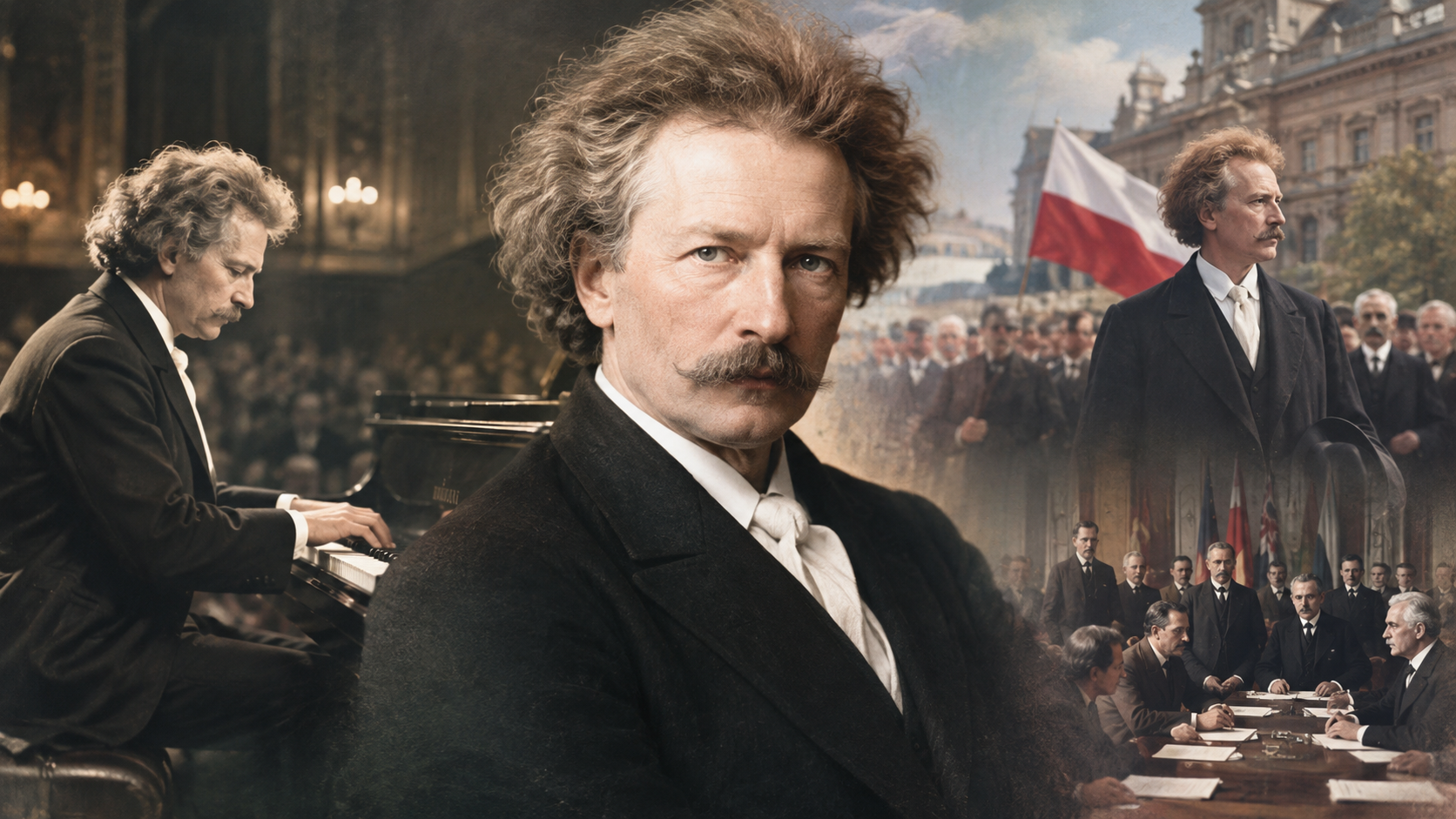
Ignacy Jan Paderewski (1860–1941) was already a world-famous pianist and composer when he became involved in the struggle for Polish independence. His concerts had made him famous, but they also gave him a public voice that he chose to use for his country.
From Pianist to Prime Minister
During World War I, Paderewski used his public appearances in the United States to advocate for Polish independence. He met U.S. President Woodrow Wilson and spoke about Poland’s future, helping draw attention to the Polish cause. Wilson’s Fourteen Points later called for an independent Polish state.
When Poland regained its independence in 1918, Paderewski’s role took an unexpected turn. In 1919, he became Prime Minister of Poland and Minister of Foreign Affairs. That same year, he represented Poland at the Paris Peace Conference with Roman Dmowski and signed the Treaty of Versailles.
His musical career had taken him to some of the world’s most prestigious stages. Now, he was helping shape decisions about his country’s future.
Listening to Menuet in G Major
Before he was a statesman, Paderewski was a musician—and a very successful one. The video above is especially remarkable because it shows Paderewski himself performing the piece in the 1937 film Moonlight Sonata.
His Menuet in G Major, Op. 14, No. 1, is one of his best-known compositions. Its graceful melody and elegant, old-world charm reveal another side of Paderewski: not just the celebrated performer, but the composer behind the music.
Watching him at the piano, it is easy to see him simply as a musician. Yet by the time this film was released, he had already served as Poland’s prime minister. His life had reached far beyond the concert stage.
When a Gift Becomes a Way to Serve
Most of us will never have an opportunity quite like Paderewski’s. But his story raises a question that applies to ordinary life, too: What do we do with the gifts and opportunities we have been given?
A musical gift can become a career, knowledge can become a way to teach, and a position can become an opportunity to help others. Paderewski’s story shows that what we develop for ourselves can sometimes become a way to serve others.
“Each of you should use whatever gift you have received to serve others.” — 1 Peter 4:10
Our gifts are not only about what we can accomplish or how far they can take us. They can also become ways to serve others. Paderewski’s life reminds us that a gift can open a door, but what we do with that opportunity matters.
For Paderewski, music opened that door—and he chose to walk through it in service of his country.
Explore more of Paderewski’s piano music here. (affiliate link)
Read previous: E. T. A. Hoffmann the Jurist: A Life Between Law, Literature, and Music — Undine Overture