Is Haskap Berry Better Than Blueberry? What the Research Actually Shows, and a Christian's Healthy Approach to Eating
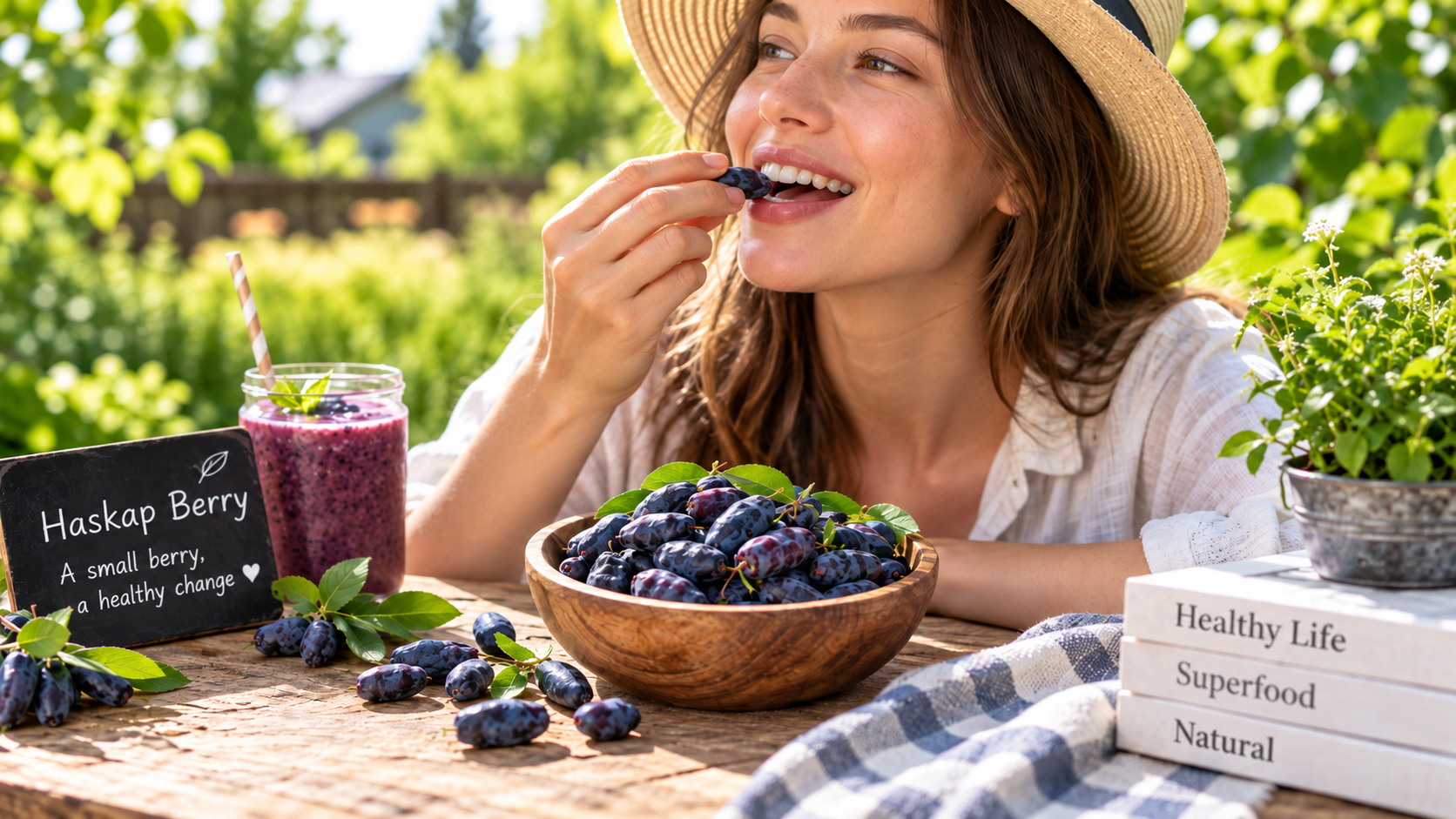 Fresh haskap berries can be enjoyed on their own or added to smoothies, yogurt, or oatmeal. Rich in anthocyanins and other polyphenols, they can be a flavorful way to add more variety to a balanced diet.
Go looking for healthy fruit these days, and you'll eventually run into an unfamiliar name: haskap berry.
In English, it's also called honeyberry or blue honeysuckle. It looks similar to a blueberry, but a bit more elongated, with a deep purplish-blue color.
Lately, haskap has been introduced as a "new superfood" because of its rich anthocyanin and polyphenol content, with claims covering blood pressure, memory, antioxidants, exercise performance, and inflammation.
But when it comes to health information, one attitude Christians genuinely need is discernment over exaggerated expectation.
Scripture puts it this way:
"For every creature of God is good, and nothing to be refused, if it be received with thanksgiving." (1 Timothy 4:4, KJV)
We can enjoy the variety of foods God has allowed us with gratitude — but that doesn't mean pinning excessive hope on any single food either.
Haskap berry is no exception.
Looking at the research so far, haskap is genuinely an interesting fruit, rich in anthocyanins and polyphenols. But human research hasn't accumulated enough to say it definitively prevents or treats a specific disease.
So how much actual health value does haskap berry have?
The Anthocyanin Behind That Deep Purple Color
One of the biggest reasons haskap draws attention is its distinctively deep purple color.
The compound behind that color is anthocyanin, and haskap is known to be particularly rich in one specific anthocyanin: cyanidin-3-O-glucoside (C3G).
It also carries various polyphenols, vitamin C, and iridoids.
That's part of why haskap gets called an "antioxidant fruit."
There's an important distinction worth making here, though.
Being rich in antioxidant compounds and preventing a specific disease are not the same thing.
Good results in a test tube or animal study don't automatically mean the same effect shows up when a person actually eats it.
In an age flooded with health information, discerning that gap matters more than ever.
1. A Berry Rich in Antioxidant Compounds
Haskap's defining feature is its rich polyphenol and anthocyanin content.
Researchers are studying how these compounds might influence various physiological processes related to oxidative stress in the body.
That doesn't mean eating a lot of haskap prevents aging or cancer, though.
Right now, it's most accurate to understand it as "one fruit among many that's rich in antioxidant compounds."
That posture matters for a healthy faith perspective too.
We can acknowledge the value of the food God has given us, without turning any single food into a cure-all. Healthy food can be a good tool for caring for our bodies — but food itself was never what ultimately guarantees our life and safety.
2. Does It Actually Help Blood Pressure and Vascular Health?
One notable research area for haskap is blood pressure and vascular health.
A small study involving older adults observed reductions in diastolic blood pressure and heart rate under certain conditions after consuming haskap extract.
That's part of why researchers suspect the anthocyanins in haskap may influence physiological processes related to vascular function.
But because the number of participants was small, the results shouldn't be over-interpreted.
"Eating haskap lowers your blood pressure."
"It's a great fruit for treating high blood pressure."
At the current research stage, claims this confident go too far.
Blood pressure is affected by weight, exercise, sleep, sodium intake, stress, and medication, among other factors.
Haskap can be part of a healthy diet, but it doesn't replace blood pressure medication or medical treatment.
3. Does It Help With Memory?
Another interesting research area is memory and cognitive function.
A small study of older adults observed positive changes in word recall and certain cognitive test scores after consuming haskap extract.
Looking at that result alone, it's easy to think, "haskap improves memory."
But it's worth looking at the study more closely.
This wasn't a long-term study tracking whether people who ate haskap over time developed less dementia — it measured changes in cognitive function shortly after consuming a specific dose over a relatively short window.
And the effect wasn't consistent across every cognitive measure tested either — mood, working memory, and executive function results were more mixed.
So at this stage, saying **"haskap prevents dementia"** is an overstatement.
That said, as part of ongoing research into anthocyanins — found in blueberries and other berries too — and their relationship to brain health, haskap is genuinely a food worth watching going forward.
4. It's Being Studied for Athletes Too
Haskap has also been studied in relation to exercise performance.
In studies looking at haskap consumption and performance among adult runners, some endurance-related measures showed improvement.
Researchers are looking into whether polyphenols and anthocyanins might influence processes related to blood flow or oxygen utilization.
The results are interesting, but the studies remain small in scale.
So there's no need to treat haskap like a special performance-enhancing supplement.
The basics — regular exercise, enough sleep, a balanced diet — matter far more.
5. How Far Should You Trust "Anti-Inflammatory Effects"?
Search for haskap, and you'll commonly run into the phrase "anti-inflammatory effects."
Cell and animal studies have indeed reported that haskap's polyphenol content influences certain physiological responses related to inflammation.
But that doesn't mean eating haskap treats arthritis or chronic inflammatory disease in humans.
Right now, it's more accurate to say "potential anti-inflammatory effects are being studied."
Claims like "it treats inflammation" or "it eliminates inflammation" go beyond the current evidence.
6. Blood Sugar and Gut Health Are Also Under Study
Recently, haskap's relationship to blood sugar, fat metabolism, and gut microbiota has been studied too.
Animal studies have produced some interesting results, but long-term human research is still limited.
That actually captures haskap's current standing well.
Haskap is less "a fruit with fully proven benefits" and more "a fruit genuinely worth further research."
When sharing health information, distinguishing between "what we currently know" and "what hasn't been confirmed yet" matters.
So, Is It Better Than Blueberry?
This is probably the question on everyone's mind.
Material introducing haskap often claims it has "several times more anthocyanins than blueberries."
Depending on variety and growing conditions, haskap's anthocyanin and polyphenol content can genuinely run quite high.
But a higher amount of a specific compound doesn't necessarily mean the fruit's actual health effect is greater.
If anything, blueberry's real strength is the relatively larger body of human research behind it.
Haskap's compounds are genuinely interesting, but human research on it remains limited.
So there's no need to choose between "haskap or blueberry."
Eating a genuine variety — blueberries, haskap, strawberries, raspberries — is the more realistic choice.
The plants and fruits God created carry a remarkable variety of colors, flavors, and nutrients. Rather than fixating on one food, enjoying that variety with gratitude may actually be the more balanced approach to eating.
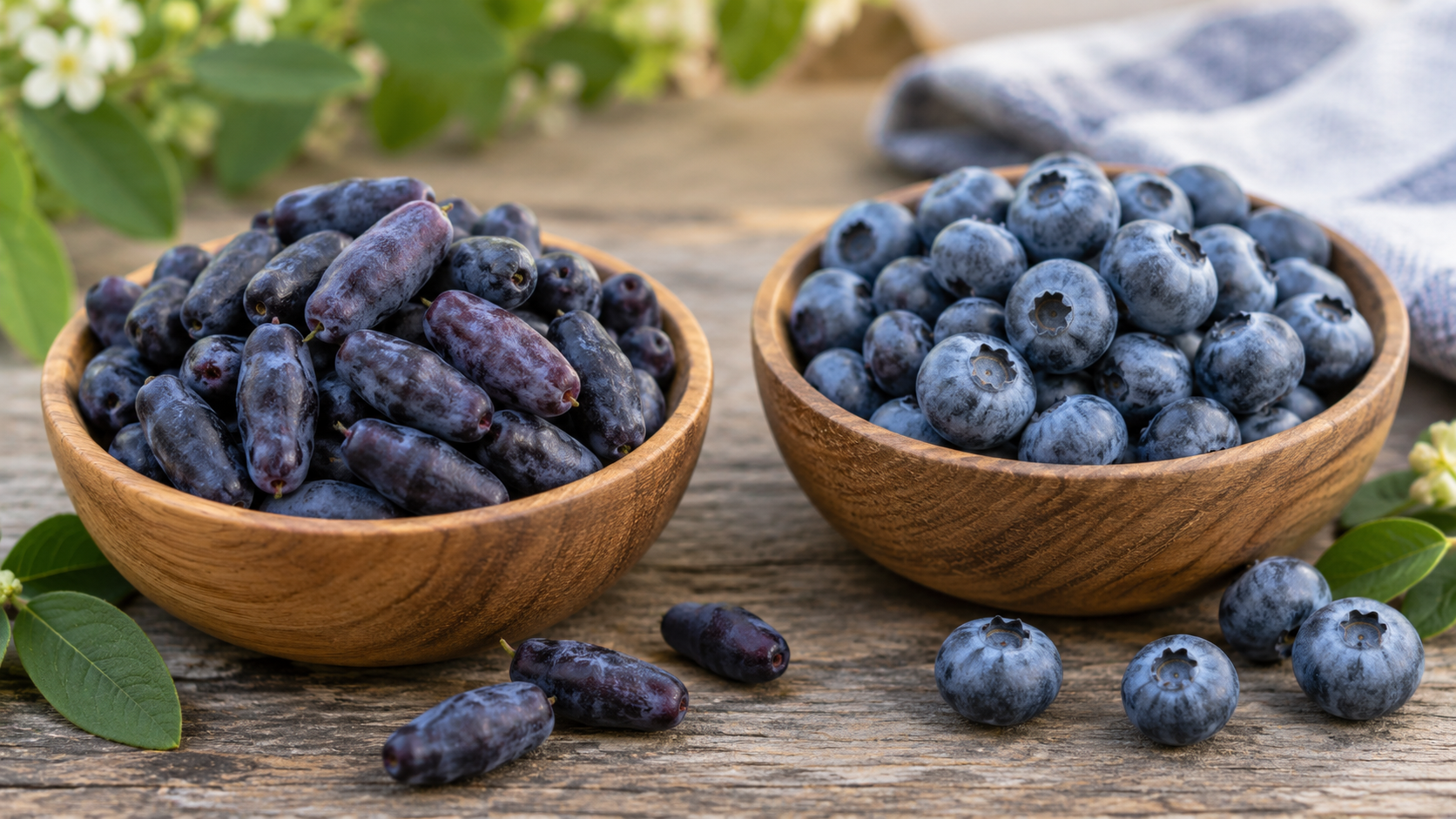 Fresh haskap berries and blueberries side by side, highlighting the haskap’s longer shape and deeper purple color compared with the rounder, lighter-blue blueberries.
How Should You Eat It?
Haskap varies by variety, but tends to be sweet-tart overall — sometimes noticeably more tart than blueberry.
You can eat it fresh or frozen, and it's also available as powder, juice, or jam.
For health purposes, less-processed forms — fresh fruit or unsweetened frozen — are the simplest option. If fresh or frozen haskap isn't easy to find near you, [a plant-based haskap berry powder like this one] is a reasonably simple alternative — closer to whole fruit than a concentrated extract, though still worth using in moderation rather than as a stand-alone cure (affiliate link — I may earn a small commission at no extra cost to you).
A handful in morning oatmeal, mixed into plain Greek yogurt, paired with blueberries, or blended into a smoothie all work well.
Jam or sweetened juice, on the other hand, are worth checking for added sugar content rather than focusing on the fruit itself.
What matters isn't "it's healthy, so I should eat a lot."
Fruit is one part of an overall diet.
The basic habit of eating a genuine variety of vegetables, whole grains, legumes, nuts, and fish in balance matters far more.
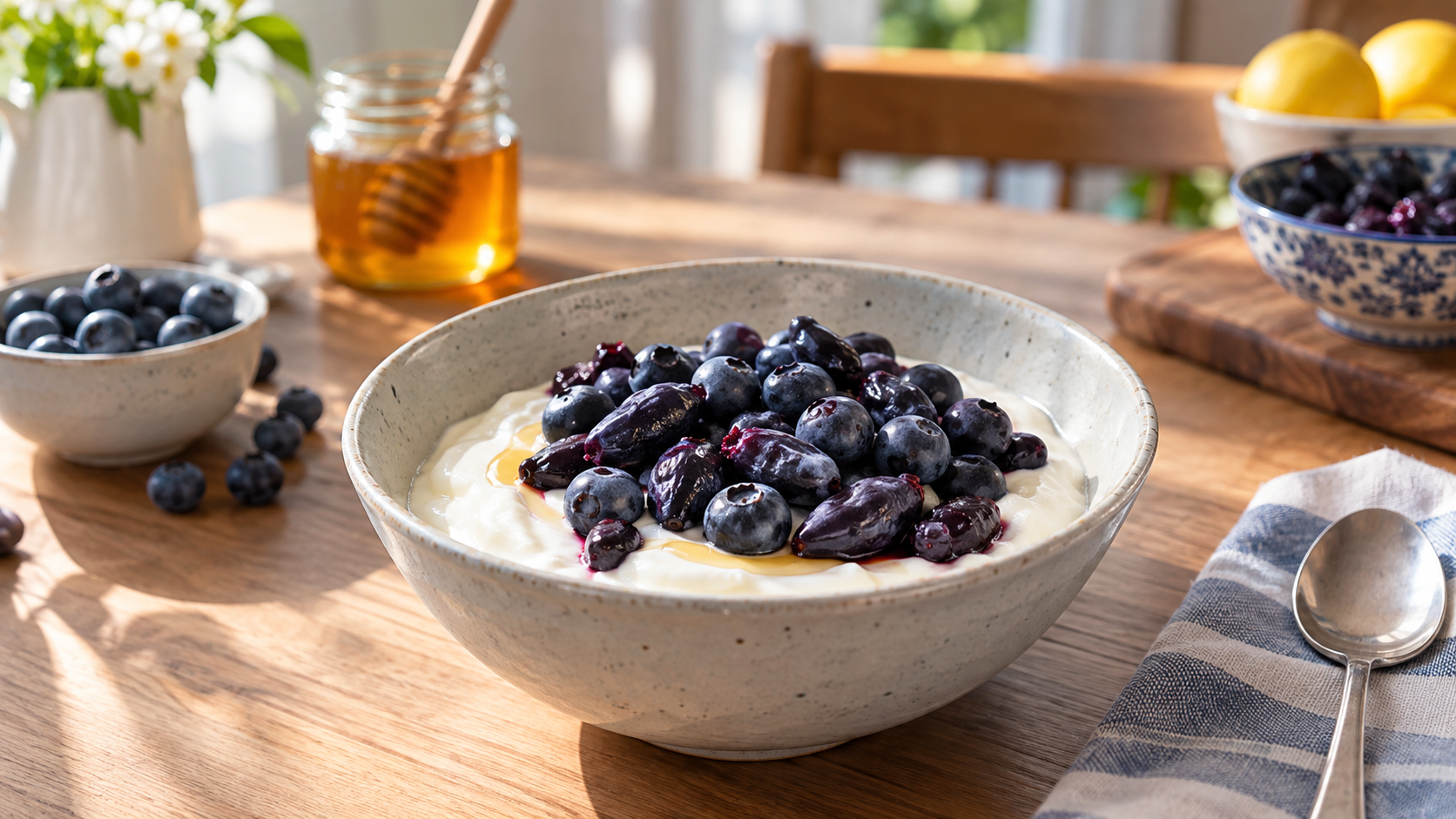 A simple breakfast bowl of plain Greek yogurt topped with haskap berries and blueberries, showing an easy and appetizing way to enjoy mixed berries in the morning.
Fresh Fruit and Extract Aren't the Same Thing
This is a detail that's easy to miss when reading health research.
Some haskap studies don't use the fresh fruit we'd normally eat — they use a haskap extract, concentrated to a specific compound level.
For example, using an extract standardized to a set amount of anthocyanins.
So a result observed using an extract can't simply be assumed to occur the same way from eating a handful of fresh haskap berries.
Freeze-dried powder is similar. It's closer to fresh fruit that's been frozen and dried, but equating a product's serving size directly with fresh fruit intake isn't straightforward either.
If you're considering a highly concentrated extract or supplement long-term in particular, and you have a chronic condition or take medication, it's worth checking with a doctor first.
Health, Too, Is About Caring Well for What God Has Entrusted to Us
A Christian view of health was never just about finding "how to live longer."
Scripture teaches a responsible posture toward our bodies too.
"Whether therefore ye eat, or drink, or whatsoever ye do, do all to the glory of God." (1 Corinthians 10:31, KJV)
What we eat and how we live can be part of the stewardship of caring for the body God has entrusted to us.
But that needs balance too.
Caring for your health matters, but health itself was never meant to be the ultimate purpose of life. Feeling anxious every time a new superfood appears, or expecting one food to solve your entire health picture, isn't a healthy posture either.
Eating good food with gratitude, exercising appropriately, resting enough, getting the treatment you need, and wisely caring for the body entrusted to you by God.
That may be the far more realistic, and genuinely biblical, approach to health management.
So, Is Haskap Berry Worth Eating?
Here's how I'd put it.
Yes, it's genuinely worth trying.
But not because it's some "special superfood that prevents disease."
Haskap is rich in anthocyanins and polyphenols, and early human studies have reported some interesting findings related to blood pressure, memory, and exercise performance.
But those studies remain small in scale, and long-term human evidence hasn't accumulated enough yet.
So rather than expecting haskap to prevent or treat a specific condition, it's better understood as one more good berry to enjoy alongside blueberries, strawberries, and raspberries.
Our health was never decided by one single food.
What matters more is what you eat consistently, how much you move, how you rest, and how responsibly you care for your own body.
If you happen to spot haskap berries somewhere, it's worth trying a taste with gratitude.
But rather than expecting "eat this and you'll be healthy," why not start with something smaller: gratefully enjoying the wide variety of food God has allowed us, and wisely managing your health, one small daily practice at a time?
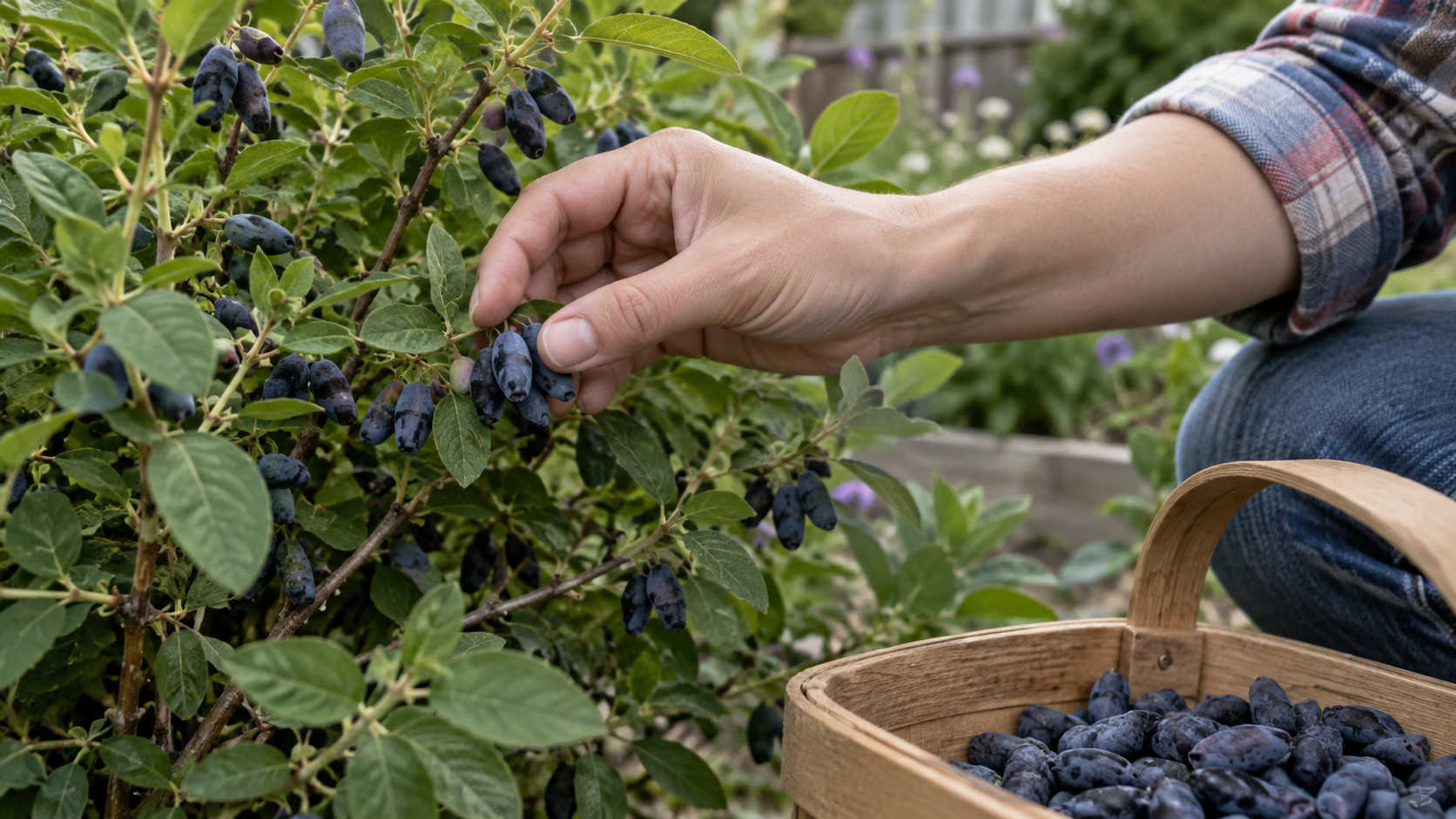 A calm harvest moment as ripe haskap berries are picked by hand from a garden bush, with a basket nearby ready to collect the fresh fruit.
This article is intended as general health and nutrition information. Haskap berries and related extracts are not medications for preventing or treating disease. If you are being treated for a chronic condition or taking medication, please consult a healthcare professional before taking a concentrated extract or supplement long-term.