Is Manuka Honey Really Good for You?
What the Research Says, What It Doesn't, and How Christians Can Think Wisely About Health Foods
 A woman enjoys a spoonful of manuka honey as part of a simple and peaceful morning routine.
If you pay any attention to health trends, you have probably come across Manuka honey. It often costs several times more than ordinary honey, and the jars carry numbers like MGO 400+ or UMF 10+. It is easy to assume that a bigger number means a stronger medicine.
Manuka honey does have some distinctive properties. Methylglyoxal (MGO) and several other compounds in it have been studied for years because of their antibacterial activity. But a good food and a medicine that cures disease are not the same thing.
Scripture does not teach us to neglect our bodies. Caring for the body God has given us is part of faithful stewardship. At the same time, we should be wary of placing our hope in any single food. This article looks at what research has reasonably established about Manuka honey, and what it has not.
What Makes Manuka Honey Different?
Manuka honey is made by bees that gather nectar from the flowers of the mānuka shrub (Leptospermum scoparium), native to New Zealand. Because of its high price, mislabeled and blended products became a problem. Since late 2017, New Zealand has required honey exported as "mānuka" to pass a scientific test of four nectar-derived chemical markers and one DNA marker from mānuka pollen.
All honey can slow microbial growth to some degree, thanks to its high sugar concentration and acidity. Manuka honey has drawn particular attention because it has an additional antibacterial activity linked to compounds such as MGO.
 A honeybee gathers nectar from blooming mānuka flowers on a sunlit hillside in New Zealand.
The Strongest Evidence: Medical-Grade Wound Dressings
The clearest real-world medical use of Manuka honey is wound care. In the United States, wound dressings made with Manuka honey have been cleared by the FDA as medical devices since 2007. Clinicians use them for pressure ulcers, chronic wounds, and burns, drawing on honey's ability to keep a wound moist and to inhibit bacterial growth.
Medical-grade honey and the honey in your pantry are different products. Medical dressings use honey that is standardized for antibacterial activity and sterilized. Grocery-store honey is not sterile and can occasionally contain bacterial spores. Spreading kitchen honey on a wound is not the same as using a medical dressing.
Deep wounds, infected wounds, wounds that will not heal, diabetic foot ulcers, and serious burns should always be seen by a medical professional. Faith is never a reason to refuse medical care. Using the means of healing God has provided is itself a way of caring for the body.
Lab Results Are Not the Same as Results in People
Articles about Manuka honey often claim that it "kills bacteria," "gets rid of H. pylori," or "fights aging with antioxidants." Most of these claims come from test-tube or animal studies.
In the laboratory, Manuka honey has repeatedly shown activity against Staphylococcus aureus and other bacteria. In August 2026, a study reported that it inhibited Helicobacter pylori in vitro and reduced bacterial load and inflammatory markers in an animal model. Its phenolic compounds and flavonoids have also been linked to antioxidant and anti-inflammatory changes in lab settings.
But honey placed directly on bacteria in a dish is very different from a spoonful of honey that is swallowed, digested, and absorbed. So far, clinical trials in humans have not shown that eating Manuka honey treats infections, eliminates H. pylori, or prevents cancer or aging.
In short, Manuka honey's antibacterial properties are a worthwhile area of research, but it is not an antibiotic you can eat. If you have been diagnosed with an H. pylori infection or gastritis, do not replace the treatment your doctor prescribed with honey.
Coughs and Gums: What Human Studies Show
Coughs are where research in people is most developed. Randomized controlled trials (RCTs) in children with colds suggest that honey may modestly ease nighttime coughing and improve sleep compared with no treatment. These studies were mostly short, often a single night, and the overall quality of evidence is not high. Most of them also used ordinary honey, not Manuka. There is no good evidence that expensive Manuka honey works better for a cough than regular honey.
Never give honey of any kind to a baby under 12 months old. Honey can contain spores of the bacteria that cause infant botulism.
For gum health, a few small clinical studies found that people who used Manuka honey products had less plaque and gum bleeding. These studies were too small to support claims that Manuka honey treats gum disease. Manuka honey is still mostly sugar, so it cannot replace brushing, flossing, and regular dental visits.
How to Read the Numbers: MGO and UMF
The MGO number tells you how many milligrams of methylglyoxal are in one kilogram of honey. MGO 400+ means at least 400 mg per kilogram.
UMF (Unique Mānuka Factor) is a private grading system run by a New Zealand industry association. It does not measure MGO alone. It tests four markers together: leptosperin (a marker of authenticity), MGO, DHA (which gradually converts into MGO), and HMF (which indicates whether the honey has been overheated or stored too long). It is separate from the government export standard described above.
This is where a common misunderstanding arises. Twice the MGO does not mean twice the health benefit. The number tells you the concentration of one compound, nothing more. No clinical study has shown that UMF 20+ prevents disease better than UMF 10+, or that MGO 500+ boosts immunity more than MGO 250+. If you simply want to enjoy Manuka honey as a food, there is little reason to buy the most expensive grade.
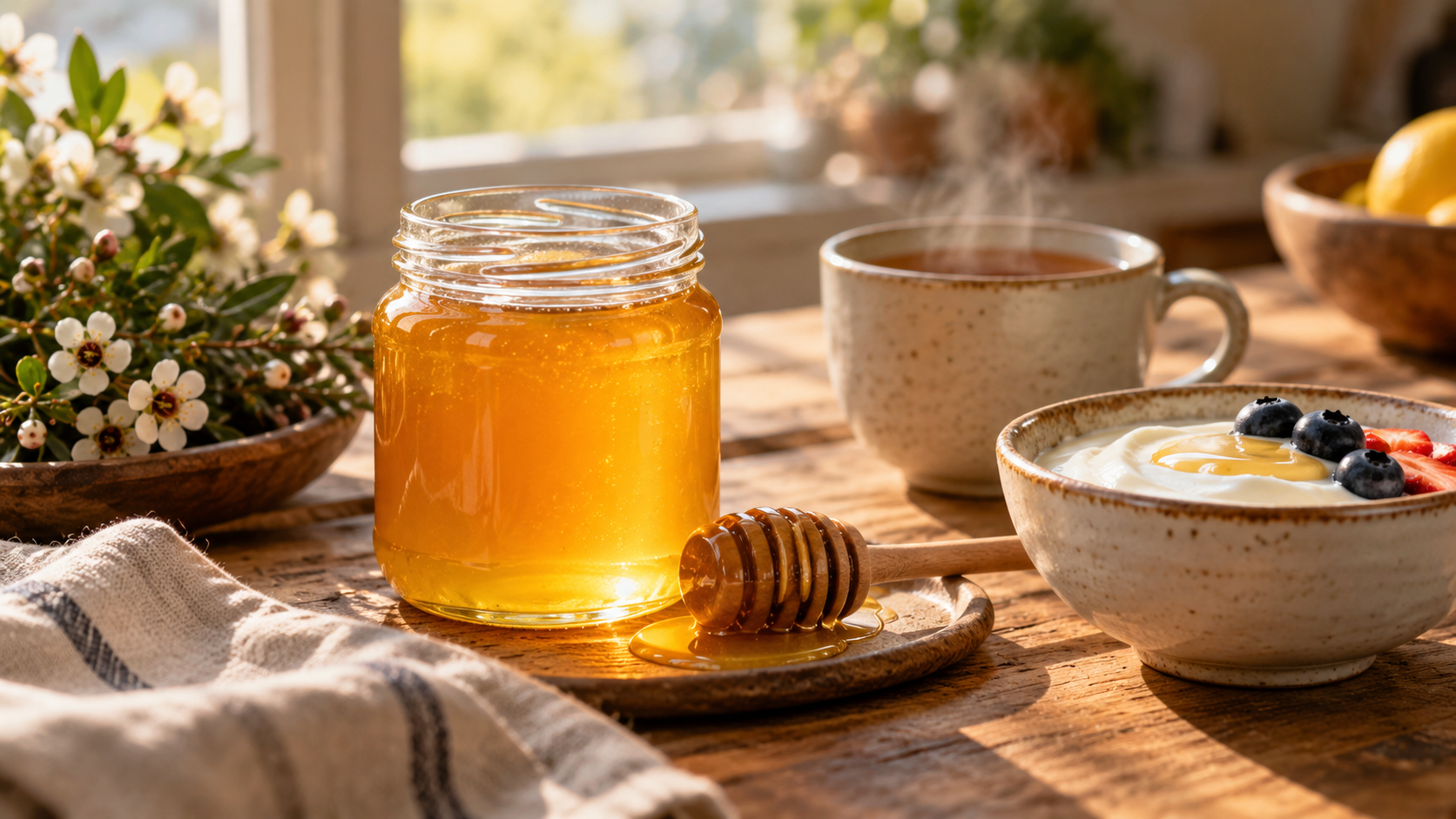 Golden manuka honey served with warm tea and plain yogurt in a cozy, sunlit kitchen setting.
How to Choose and How to Enjoy It
When choosing a product, look first at whether it is trustworthy, not at how big the number is. Check that it comes from New Zealand, that the manufacturer and packaging information are clear, and that it carries a recognized quality mark such as UMF. Then compare size and price. For everyday use, a mid-range grade is plenty.
For everyday enjoyment, a UMF-certified mid-range jar such as UMF 10+ (MGO 263+) is plenty. One example is the UMF 10+ 250g jar from Comvita, a New Zealand brand. (Affiliate link: the author may earn a small commission if you make a purchase. As an Amazon Associate I earn from qualifying purchases.)
There is no established medical dose of Manuka honey for preventing or treating disease. Enjoying a small amount as part of your diet is sensible, for example drizzled on plain yogurt or oatmeal, or stirred into warm tea. One tablespoon of honey (about 21 g) contains roughly 17 g of sugar and 64 calories. Adding several spoonfuls a day "for your health" mostly adds sugar.
You may also have heard that hot water destroys all of its benefits, or that you must never use a metal spoon. Prolonged boiling can change some compounds and quality markers, so there is no need to cook it. But there is little evidence that stirring it into a warm drink wipes out its value, or that briefly using a stainless steel spoon does any harm. Eating it in moderation matters far more than any special ritual.
Who Should Be Especially Careful
Infants under 12 months: Do not give them any kind of honey.
People managing blood sugar, including those with diabetes: Count Manuka honey toward your daily carbohydrate and sugar intake. If you take oral diabetes medication or insulin, talk with your doctor about how much is appropriate. No significant drug interactions with Manuka honey have been documented, but it can still affect blood sugar control.
Pregnant and breastfeeding women: Normal food amounts are generally considered fine. Taking larger "therapeutic" amounts is not recommended because there is little data. Infant botulism is a concern for a baby's gut, not for an adult mother.
People allergic to pollen, bees, or propolis: Reactions to honey are uncommon but possible. Seek care right away if you notice hives, swelling of the lips or throat, or difficulty breathing after eating it.
People being treated for chronic conditions: Do not use Manuka honey as a substitute for prescribed treatment.
Anyone thinking of using it on a wound: Use a medical-grade product under professional guidance, not food honey.
Receiving with Thanksgiving, Enjoying with Restraint
Manuka honey is not merely a marketing invention. Its unusual antibacterial properties have been studied, and medical-grade products are used in real wound care. But the current evidence does not support treating edible Manuka honey as a medicine that prevents or cures disease.
Paul writes, "For every creature of God is good, and nothing to be refused, if it be received with thanksgiving" (1 Timothy 4:4, KJV). Manuka honey can be enjoyed with gratitude as one of the good gifts of God's creation. Yet Proverbs speaks about honey itself to teach restraint: "Hast thou found honey? eat so much as is sufficient for thee, lest thou be filled therewith, and vomit it" (Proverbs 25:16, KJV). Even good things can do harm in excess.
The most reliable ways to care for our bodies are still the ordinary ones: balanced meals, regular exercise, enough sleep, routine checkups, and appropriate treatment when needed.
One more thing is worth remembering. Eating expensive honey does not make our faith deeper, and health itself is not a measure of faith. A believer who lives with illness is not less faithful, and a healthy one is not more devout. To care for the body we have been given with gratitude, without placing our hope in any food, is the kind of discernment Christians are called to bring to health products.
 An open Bible, honey, and a warm drink create a quiet moment of reflection and gratitude.
This article provides general health and nutrition information based on publicly available government sources and medical research as of October 2026. It is not a substitute for medical advice, diagnosis, or treatment. If you are being treated for a medical condition, need to manage your blood sugar, are pregnant or breastfeeding, or are considering a honey product for wound care, please consult a healthcare professional.