Mendelssohn’s String Octet in E-flat Major, Op. 20: When Musical Conversation Grows
What happens when more voices join a conversation?
There is more to hear and more to respond to. An idea may pass from one person to another, while several conversations briefly overlap. The challenge is not simply to speak clearly, but to remain attentive to the whole.
Felix Mendelssohn’s (1809–1847) String Octet in E-flat Major, Op. 20, invites us to hear a musical version of this conversation. Composed in 1825, when he was just sixteen, the work brings eight string players together in a lively exchange of melodies, rhythms, and musical ideas.
Listen to the Musical Conversation
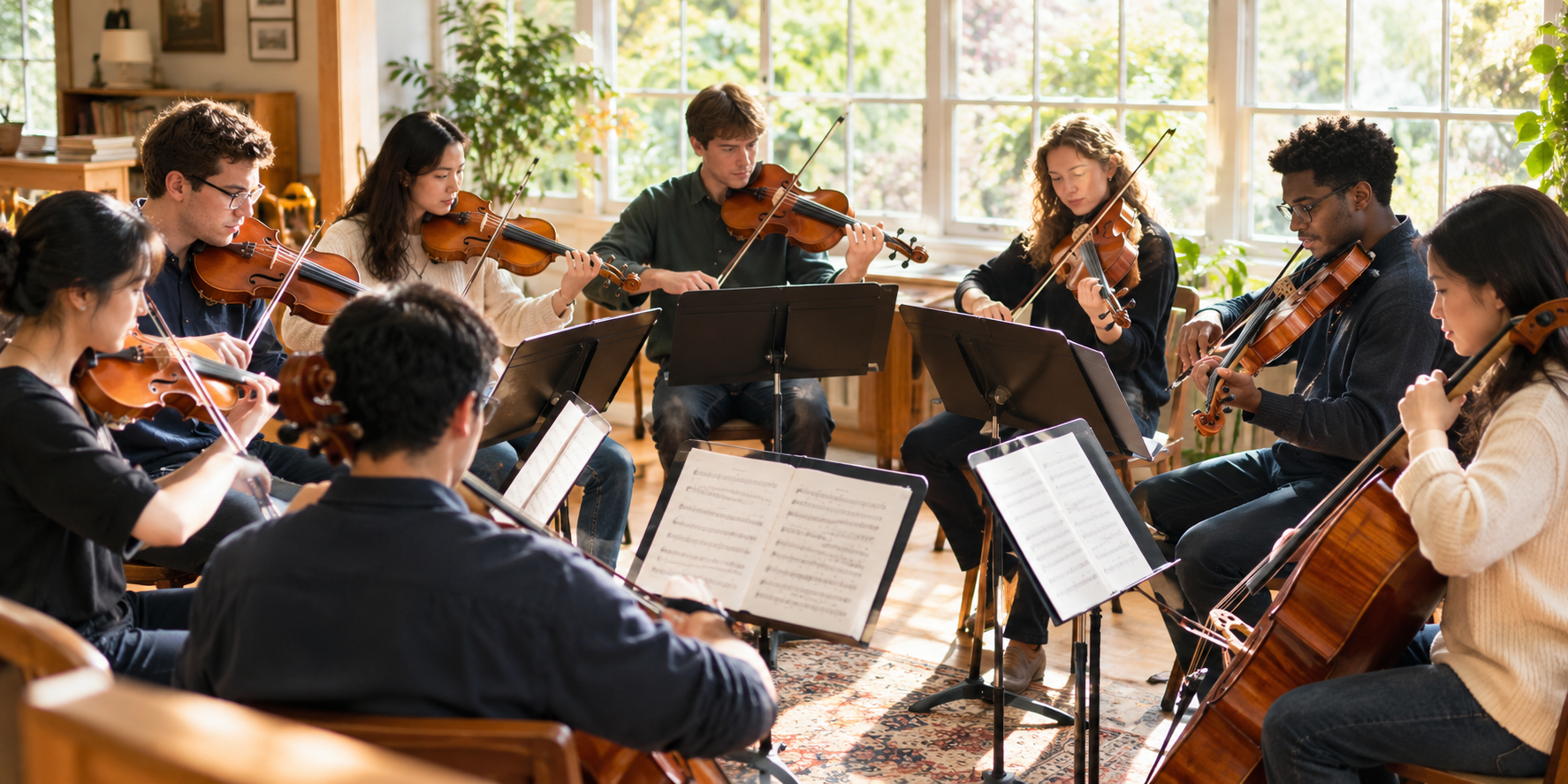
The octet is scored for four violins, two violas, and two cellos. Rather than simply making a string quartet sound bigger, Mendelssohn gives the eight instruments room to interact in different ways. A melody may move from one player to another, while other instruments add their own lines around it.
Sometimes a few instruments seem to exchange ideas before the others join in. At other moments, several melodies weave together, creating a rich texture without losing the individuality of each part. The music feels full of activity, yet the different voices remain carefully balanced.
Notice how the instruments take turns leading and responding, while their melodies come together to create a lively, unified whole.
When More Voices Must Find Harmony
Listening to Mendelssohn’s octet, we can appreciate how carefully each musician must listen to the others and understand how their part fits into the whole.

The same principle applies to any group. Different perspectives and strengths can enrich what people accomplish together, but cooperation takes patience, consideration, and a willingness to listen.
“Make every effort to keep the unity of the Spirit through the bond of peace.” — Ephesians 4:3
Paul’s words remind us that unity takes effort. It does not mean everyone must think alike or have the same role. Instead, it calls us to treat one another with care and to protect the peace that allows a community to grow together.
In Mendelssohn’s octet, eight distinct voices create something no single instrument could achieve alone. Their differences do not have to disappear for the music to work. The beauty comes from the way they listen, respond, and make room for one another.
Read previous: Dvořák’s “American” String Quartet: Four Voices, One Beautiful Whole