Olive Oil and the Steward's Table: A Christian Case for Eating with Intention
On food, faith, and the quiet theology of daily choices
I didn't grow up thinking much about what I ate. Food was fuel, mostly. Fast, convenient, abundant. It wasn't until a season of burnout — the kind where you're too tired to pray and too wired to sleep — that a doctor friend sat me down and asked a simple question: "What are you actually putting into your body every day?"
It was a medical question. But for me, it opened something deeper.
I started reading about food with the same curiosity I'd bring to a sermon. And somewhere in that process, I kept coming back to olive oil — its history, its science, its strange recurrence throughout Scripture. And I started to wonder whether the way I ate was its own kind of theology. Whether choosing well at the table was connected, somehow, to the faith I claimed to live by everywhere else.
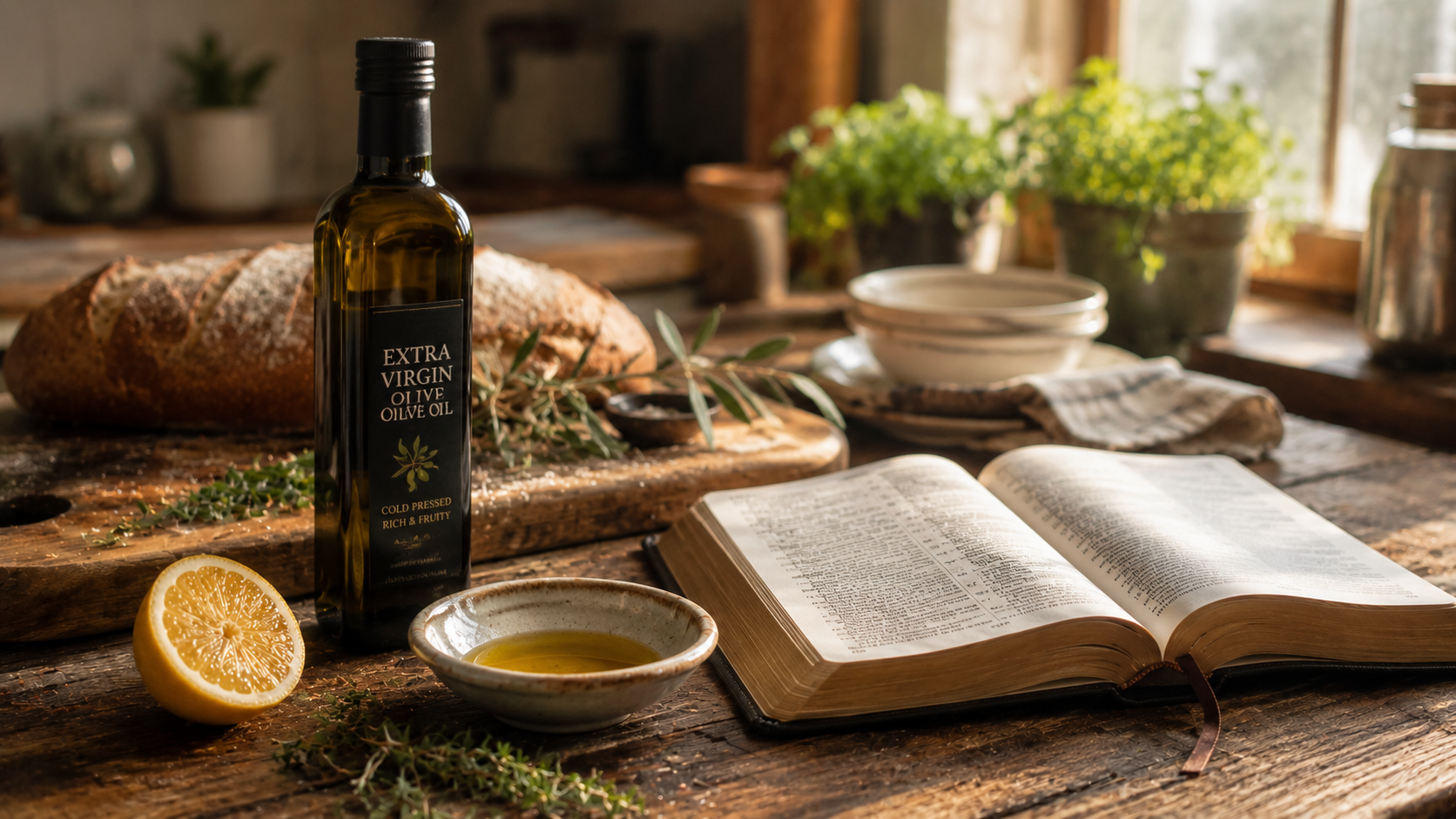 A quiet kitchen table bathed in golden morning light brings together olive oil, fresh ingredients, and an open Bible — a gentle reminder that faith is often lived out in the ordinary rhythms of daily life.
The Body Is Not Separate from the Soul
Modern Christianity has sometimes fallen into a quiet dualism — treating the spiritual life as the real life and the physical body as a temporary inconvenience we manage until eternity. We invest in our prayer lives, our Bible reading, our community. We sometimes forget the vessel that carries all of it through every ordinary day.
But Paul doesn't allow that separation.
"What? know ye not that your body is the temple of the Holy Ghost which is in you, which ye have of God, and ye are not your own? For ye are bought with a price: therefore glorify God in your body, and in your spirit, which are God's." — 1 Corinthians 6:19-20 (KJV)
The body is not a cage. It is a temple. And temples are meant to be cared for — not obsessively, not anxiously, but with the kind of steady, grateful attention that acknowledges whose they are.
This doesn't mean every meal becomes a religious act or that eating a cheeseburger is a spiritual failure. But it does mean that the cumulative pattern of how we nourish ourselves is worth taking seriously — not out of vanity or fear, but out of stewardship.
What Olive Oil Actually Is
Before we get to theology, a word about the thing itself.
Extra virgin olive oil — EVOO, as it's commonly abbreviated — is made by cold-pressing olives without chemical refinement. This matters because the pressing process preserves a remarkable range of naturally occurring compounds that heat and chemical extraction tend to destroy.
What survives in a good bottle of EVOO: oleic acid, a monounsaturated fat that makes up 70-80% of its content; polyphenols, which are plant-based antioxidant compounds; vitamin E; and oleocanthal, a naturally occurring compound that researchers have studied for its anti-inflammatory properties.
This is not marketing language. These compounds have been the subject of serious, peer-reviewed research over decades. And the findings are consistent enough to take seriously.
What the Science Suggests
Cardiovascular health. Oleic acid, the dominant fat in olive oil, has been linked in multiple studies to reductions in LDL cholesterol — the kind associated with arterial plaque — while supporting HDL levels. The landmark PREDIMED trial, conducted in Spain over several years with thousands of participants, found that a Mediterranean diet supplemented with extra virgin olive oil was associated with significantly lower rates of major cardiovascular events compared to a low-fat diet.
Inflammation. Chronic low-grade inflammation is increasingly understood as a driver of a wide range of modern diseases — from metabolic disorders to cognitive decline. The polyphenols in EVOO, particularly oleocanthal, have demonstrated anti-inflammatory properties in laboratory settings, functioning in some ways similarly to ibuprofen in their mechanism. Long-term, regular consumption appears to support reduced inflammatory markers.
Brain and cognitive health. The Mediterranean diet as a whole — of which olive oil is a cornerstone — has been studied in relation to cognitive aging. Some longitudinal research suggests associations between adherence to this dietary pattern and lower rates of cognitive decline, though the relationship is complex and diet is only one of many variables.
None of this is a cure. None of it is magic. And a spoonful of olive oil does not compensate for a life otherwise characterized by chronic stress, poor sleep, and processed food. But it is one part of a coherent, whole-life approach to stewarding the body well.
Olive Oil in the Biblical World
There's something fitting about the fact that olive oil has deep roots in Scripture — not as a health supplement, but as a living part of the world Jesus walked through.
Olives were everywhere in first-century Palestine. Olive oil lit the lamps. It was used in anointing — priests, kings, and the sick. The Garden of Gethsemane, where Jesus prayed the night before His crucifixion, takes its name from the Hebrew gat shemanim, meaning "oil press." The disciples met Him there regularly. It was a working place, a place of labor and pressing.
"He causeth the grass to grow for the cattle, and herb for the service of man: that he may bring forth food out of the earth." — Psalm 104:14 (KJV)
The Psalms don't distinguish between the sacred and the practical. Food from the earth is described as part of God's provision, woven into the fabric of His care for His creatures. The olive tree, slow-growing and extraordinarily long-lived, produces fruit that has sustained human life across millennia.
To eat from it is, in a small way, to receive from what God made.
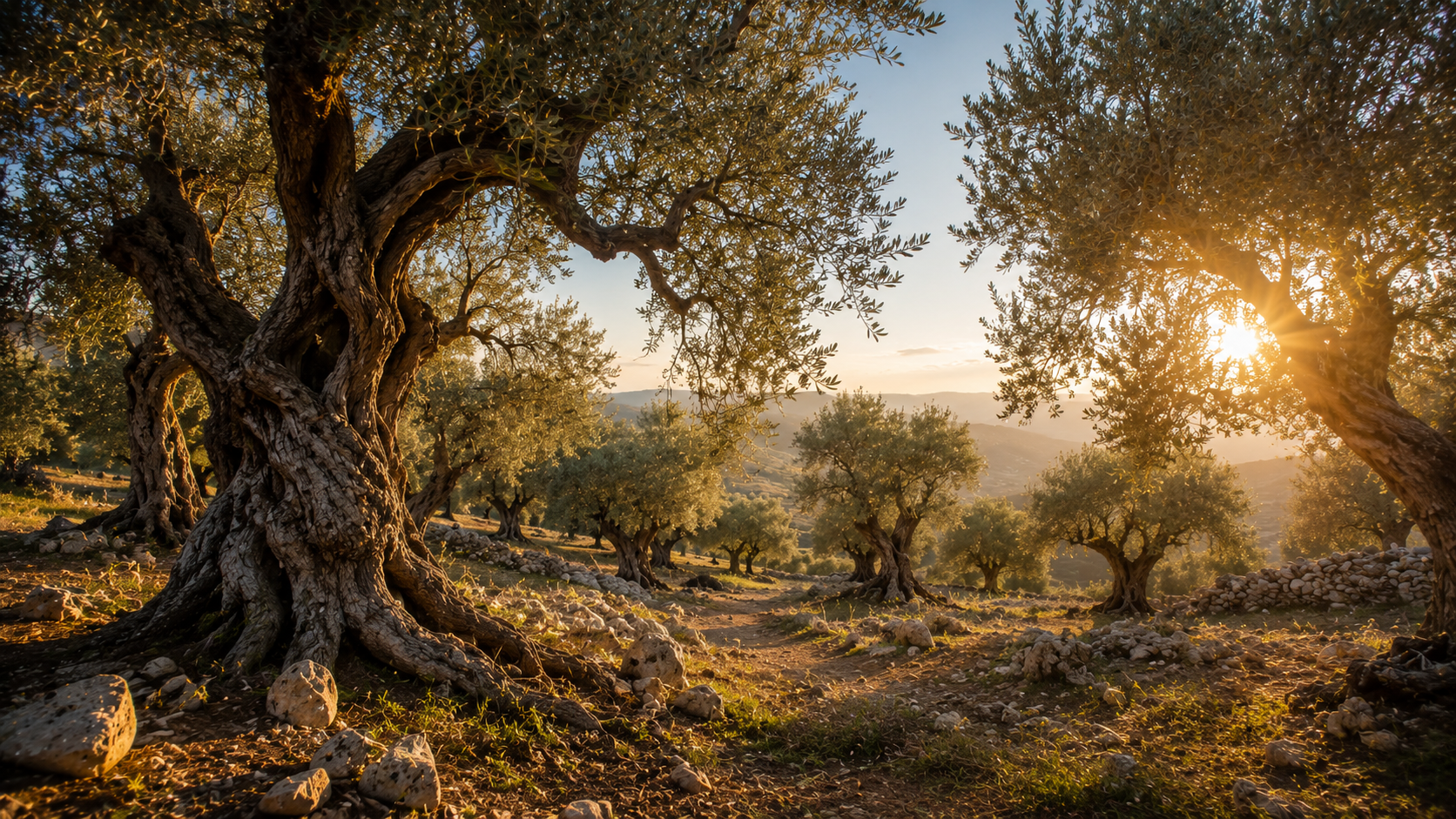 Ancient olive trees stand beneath warm Mediterranean light, their twisted branches and silver-green leaves glowing across the hillside — a timeless landscape that echoes the beauty of creation and the world of the Bible.
Eating as a Spiritual Practice — Without Making It a Religion
Here is where I want to be careful, because this is where wellness culture often goes wrong.
Food is not salvation. Dietary choices are not morality. People who eat perfectly do not thereby become better Christians or more beloved by God. The Pharisees were meticulous about ritual purity around food and missed the One standing in front of them at dinner.
Jesus ate with everyone. He turned water into wine at a party. He multiplied bread and fish for a hungry crowd. He broke bread at the Last Supper and at a lakeside breakfast after His resurrection. His relationship with food was celebratory and communal, not anxious or ascetic.
"Whether therefore ye eat, or drink, or whatsoever ye do, do all to the glory of God." — 1 Corinthians 10:31 (KJV)
This is the frame. Not: eat only the right things. Not: treat your body as a project to be perfected. But: let even eating be an act that honors the One who made you. Let the table be a place of gratitude, presence, and care — not performance or guilt.
Choosing olive oil over processed seed oils is not a righteous act. But doing it thoughtfully, as part of a larger pattern of taking the body seriously, can be a quiet expression of stewardship. That's all. It doesn't need to be more.
Practical Notes on Choosing Well
If you're going to use olive oil as a regular part of how you eat, a few things worth knowing:
Look for Extra Virgin on the label — this indicates cold-pressed, unrefined oil with the most intact nutritional profile. Opt for dark glass bottles, which protect the oil from light degradation. Store in a cool, dark place, not next to the stove. Use it for low to medium heat cooking, salad dressings, and finishing — its polyphenols degrade at very high temperatures.
Good olive oil should taste like something — peppery, slightly bitter, grassy. That's the polyphenols you're tasting. It should not taste flat or greasy.
The Theology of Small Choices
Faith is built in the dailies. Not just the dramatic moments of surrender or the peak experiences of worship — but the ten thousand small decisions that constitute a life. What we read. How we speak to the people who irritate us. How much sleep we allow ourselves. What we put on our plate.
None of these choices are salvation. But together they form the shape of a life. And the shape of a life matters.
"I beseech you therefore, brethren, by the mercies of God, that ye present your bodies a living sacrifice, holy, acceptable unto God, which is your reasonable service." — Romans 12:1 (KJV)
A living sacrifice. Not a dead religion of rules, but a living, breathing, ongoing offering — including the body, including the table, including what we reach for when we're tired and hungry and making dinner on a Tuesday.
Start there. That's enough.
A Prayer Before the Table
Lord, thank You for the earth that produces what my body needs. Forgive me for the times I've treated this body carelessly — as though it belonged only to me, as though it didn't matter. Teach me stewardship that begins at the table. Gratitude that starts with small things. Let even eating be an act of trust in You. Amen.
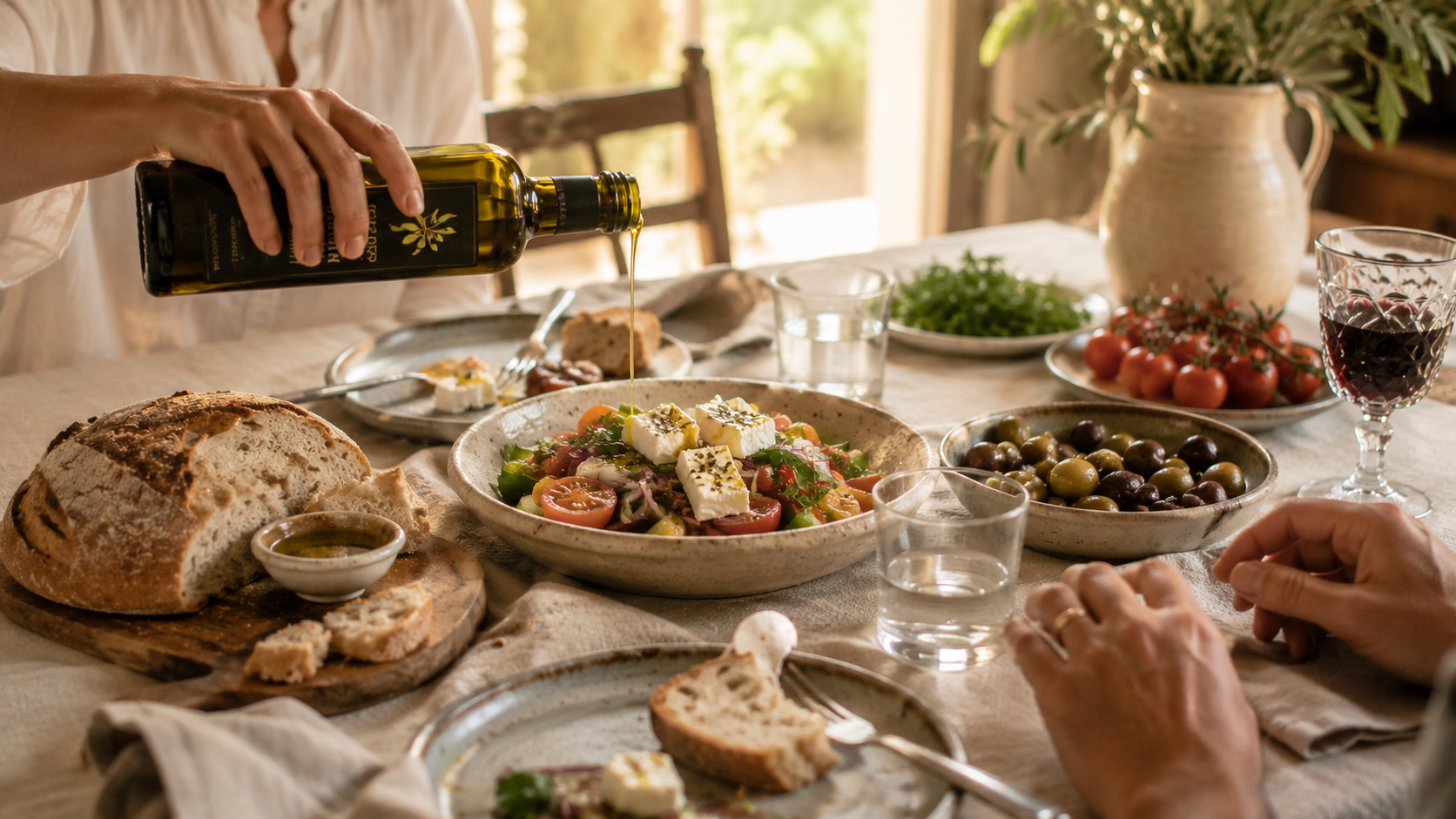 Fresh bread, olive oil, vegetables, and shared conversation gather around a simple Mediterranean table — a quiet reminder that gratitude, fellowship, and daily bread are gifts meant to be shared together.