The Architecture of Grace: What Barcelona’s 2011 Masterclass Teaches Us About Divine Order (Part 2)
When the final whistle blew at Wembley Stadium on May 28, 2011, the footballing world was in a state of shock. FC Barcelona had just defeated Manchester United 3-1, but the scoreline didn’t tell the whole story. As we explored in Part 1, Pep Guardiola’s team had subjected United to a suffocating, mathematically perfect system of Positional Play. They held 63% possession and completed nearly 800 passes.
Critics of this system often leveled one specific accusation against it: It is too cold. They argued that playing with such rigid geometric precision turns men into robots, stripping the game of its raw, unpredictable human soul.
But what happened in the minutes immediately following that final whistle completely shattered this critique. The greatest tactical machine in football history bypassed the standard victory celebrations to deliver one of the most breathtaking, tear-inducing acts of human empathy ever witnessed in sports.
1. The Shadow of Mortality: Eric Abidal’s Battle
To understand the emotional weight of this moment, we must rewind the clock just two months before the final.
In March 2011, Barcelona’s starting left-back, Eric Abidal, received devastating news. Doctors had discovered a tumor in his liver. In the hyper-focused, high-stakes world of elite football, a cancer diagnosis is a violent collision with mortality. Football instantly became irrelevant. Abidal underwent a grueling surgery to remove the tumor. The general consensus was that his season, and possibly his career, was over.
But Abidal fought a miraculous, grueling battle of rehabilitation. Driven by an unrelenting spirit and the unwavering support of his teammates, he defied every medical expectation. Just 71 days after having a tumor cut from his liver, Abidal not only returned to the squad but played the full 90 minutes of the Champions League Final.
The Spiritual Reflection: The Fragility of the Pitch Abidal’s story reminds us of a sobering truth found in James 4:14: “Why, you do not even know what will happen tomorrow. What is your life? You are a mist that appears for a little while and then vanishes.” Even at the absolute pinnacle of human achievement—surrounded by wealth, fame, and peak physical fitness—we are profoundly fragile. A single medical report can instantly remind us that we are not the masters of our own destiny. Yet, Abidal’s presence on that pitch is a testament to the theology of resurrection. God is in the business of bringing dead things back to life. When the world issues a terminal diagnosis on your career, your marriage, or your dreams, remember that the Great Physician still writes the final chapter.
2. The Captain’s Kenosis: Laying Down the Crown
As the Barcelona players walked up the iconic Wembley steps to the Royal Box to receive their medals, the world expected Carles Puyol to lead them. Puyol was the legendary captain, the heart, and the soul of the club. In football tradition, lifting the European Cup is the ultimate, immortalizing honor reserved strictly for the team captain. Every child who kicks a football dreams of that exact moment.
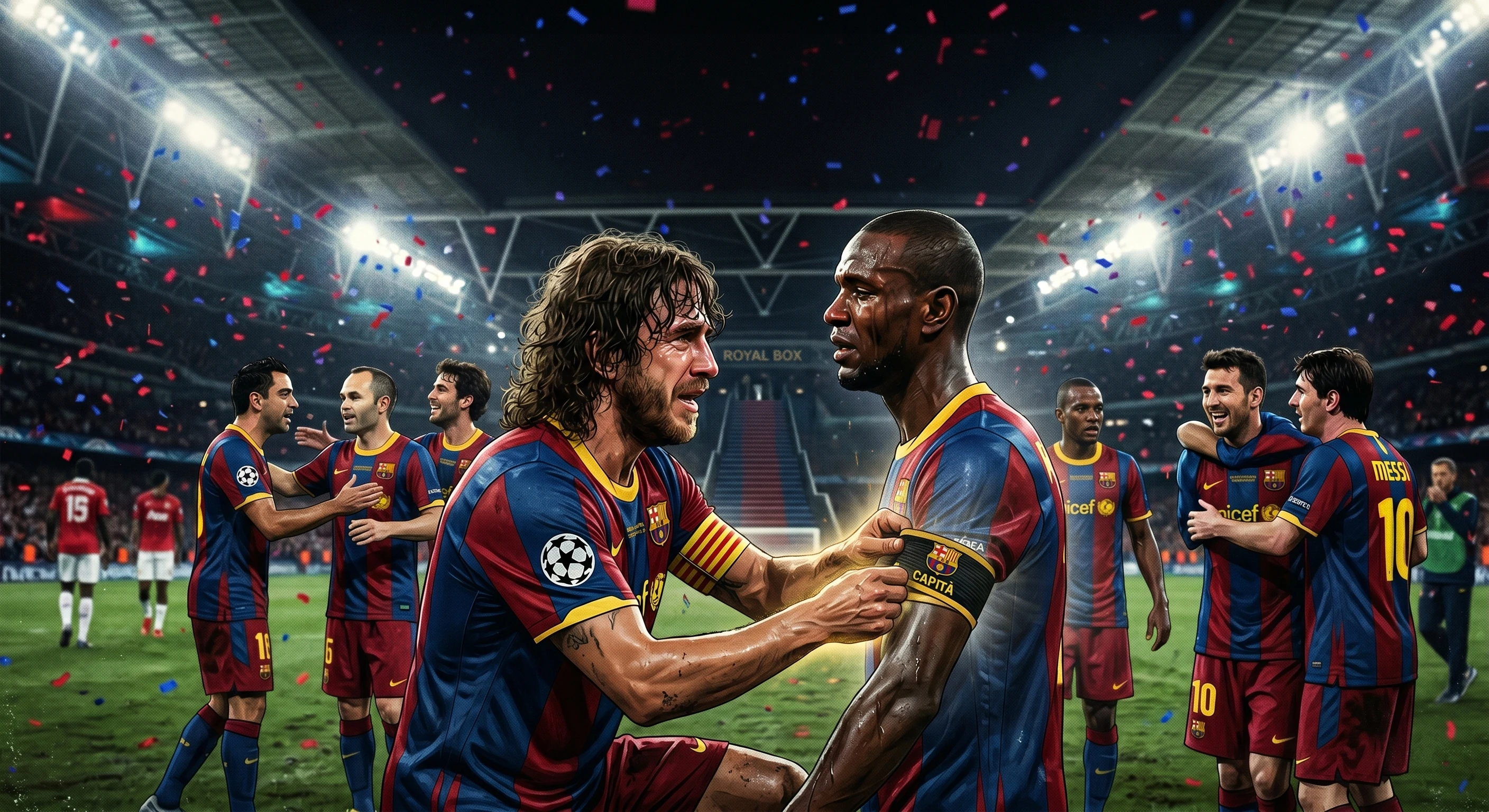
But as they approached the trophy, Puyol did something extraordinary. As detailed in The Guardian’s coverage of the team’s profound post-match gestures, Puyol stopped. He took the captain’s armband off his own arm and wrapped it around the arm of Eric Abidal.
He stepped aside. He pushed the man who had just survived cancer to the front of the line.
Eric Abidal, the survivor, was the first man to lift the “Big Ears” trophy into the London sky.
The Spiritual Reflection: The Theology of Self-Emptying What Carles Puyol did is the perfect, real-world illustration of a profound theological concept called Kenosis (self-emptying). In Philippians 2:3-4, the Apostle Paul commands: “Do nothing out of selfish ambition or vain conceit. Rather, in humility value others above yourselves, not looking to your own interests but each of you to the interests of the others.”
Puyol had every right to lift that trophy. He had earned it. But he recognized that true greatness is not found in grasping glory; it is found in giving it away. He laid down his “crown” to elevate a suffering brother.
In our churches, workplaces, and families, we are obsessed with getting the credit. We want our names on the project, our faces on the platform, and our hands on the trophy. But the Spirit of Christ calls us to step aside. Who is the “Eric Abidal” in your life right now? Who is the person recovering from a devastating loss, a failure, or an illness? Give them the armband. Push them to the front. The greatest victories are the ones we allow others to celebrate first.
The Final Whistle: The Legacy of 2011
In Part 1, we learned that Barcelona’s 2011 masterclass taught us the beauty of Divine Order and strict obedience. In Part 2, we see the beautiful fruit of that order.
A team without structure cannot care for its wounded. Chaos breeds selfishness. But because Barcelona operated with such perfect positional discipline and tactical harmony on the pitch, they created a culture safe enough to produce radical love off it.
The 2011 Barcelona team will be remembered in the history books for their 63% possession, their triangles, and the genius of Lionel Messi. But for those of us who look a little deeper, their true legacy was secured the moment Carles Puyol took off his armband.
They proved that the most perfectly ordered machine in the world is still capable of having a wildly beating, compassionate human heart.