The Billion-Dollar Empire Born in a Sunday School: The Forgotten Origin of Manchester City
1. The Glitz, The Glamour, and The Mud
When you look at Manchester City today, what do you see? You see a billion-dollar empire. You see Pep Guardiola’s tactical genius, Erling Haaland’s robotic finishing, and a stadium sponsored by an airline. Modern football is a highly sanitized, corporate, money-making machine.
But if you strip away the bright lights of the Etihad Stadium and travel back exactly 146 years, the origins of this footballing giant are found not in a corporate boardroom, but in the muddy, violent streets of Victorian England. And more importantly, it was born inside a church.
2. The Gangs of West Gorton
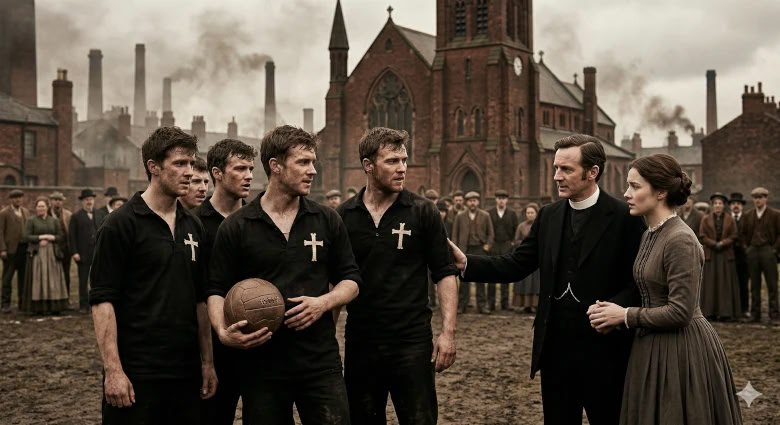
The year was 1880. Manchester was the beating heart of the Industrial Revolution, but the district of West Gorton was a living nightmare. Extreme poverty, horrific working conditions, and alcoholism plagued the area. The streets were ruled by violent, territorial youth gangs known as "Scuttlers," who fought brutal turf wars with heavy belts and knives.
Into this chaos walked the Reverend Arthur Connell, the new rector of St. Mark’s Church, and his 25-year-old daughter, Anna Connell.
Looking at the young men destroying their lives in pubs and gang fights, Anna didn't just stay inside her safe, quiet church building to pray for them. She realized that to save these men, the church had to meet them where their passions lay. In 1880, to give these rough, marginalized men an alternative to drinking and street violence, the church formed a football team: St. Mark’s (West Gorton) FC. That little church team, wearing simple black shirts with a white cross, eventually evolved into Manchester City Football Club.
3. Muscular Christianity: Stepping Out of the Pews
The birth of Manchester City was part of a powerful movement in the 19th-century British church known as "Muscular Christianity." The philosophy was simple: a strong, disciplined body helps build a strong, disciplined soul. Pastors and church leaders realized that you couldn't just preach theology to a starving, angry young man. You had to engage his physical reality.
St. Mark's FC wasn't created to win the Premier League or generate broadcasting revenue. It was created as a rescue mission. The football pitch became an extension of the sanctuary—a place where young men learned teamwork, discipline, respect, and ultimately, the love of Christ.
4. What is Your "Football"?
The history of Manchester City asks a piercing question to the modern church and to us as individual Christians. Anna Connell and her father looked at a broken, violent culture and didn't retreat. They didn't lock the church doors and hide. They used football as a cultural bridge to reach the unreachable.
What is the "football" in your life? What is the cultural tool, the hobby, or the shared passion you can use to step into the messy, complicated lives of the people around you?
We are not called to stay comfortably inside our Sunday routines. Like the founders of St. Mark’s, we are called to step onto the muddy pitches of our workplaces, our schools, and our communities. Modern Manchester City might be playing for trophies, but remember their roots: the original team played for souls.