The Brothers Karamazov by Fyodor Dostoyevsky — What Do You Do When God Stays Silent?
You've prayed the same prayer for so long you've stopped expecting an answer. Not because you've stopped believing — but because the silence has its own weight now, and you've learned to carry it.
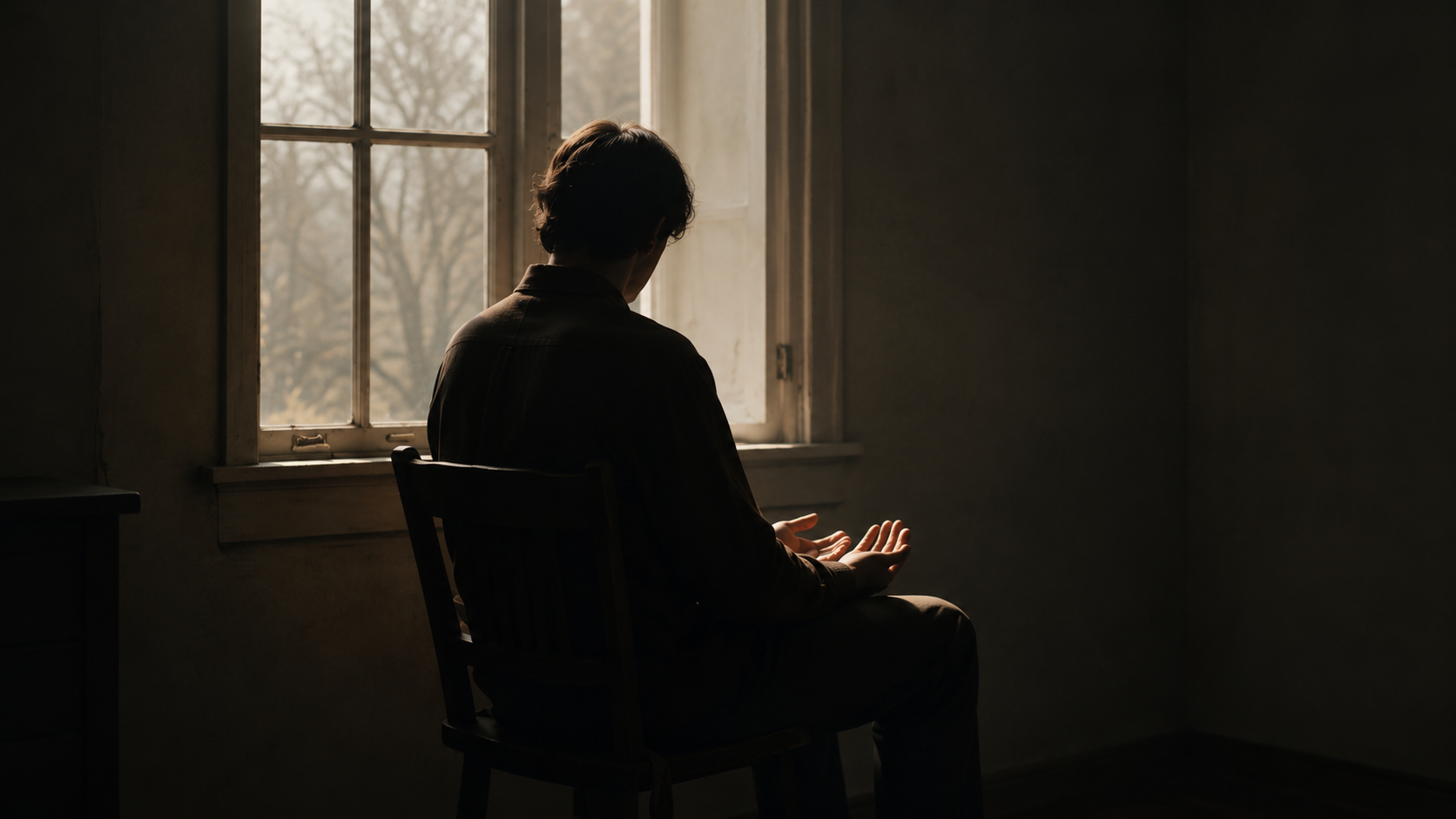 A figure seated alone — hands open, the window light falling on nothing held.
There's a particular kind of faith that isn't doubt exactly — it's something closer to exhaustion. You believe. You believe the way Ivan Karamazov believes: you know the sun exists, even on the days you cannot see it. But you have also stood at the edge of a child's suffering, or a friend's grave, or your own ruin, and asked the question that honest people have always asked in the dark: if God is good, then why this? And the ceiling stayed where it was. And morning still came. And you didn't know what to do with either thing.
"I can see the sun, but even if I cannot see the sun, I know that it exists. And to know that the sun is there — that is living." The man who wrote those words understood something about holding belief and grief in the same two hands.
It is December 1849. Fyodor Dostoevsky is twenty-seven years old, standing in a public square in Saint Petersburg with a blindfold over his eyes and rifles pointed at his chest.
He has been condemned to die — for the crime, essentially, of reading aloud a letter that criticized the Tsar. He stands in the snow with the other men. The first group is bound and blindfolded. Then a horseman arrives. A commutation. The sentence is changed to hard labor in Siberia. It was theater all along — a cruelty designed by the Tsar to break men's minds through the performance of their own deaths.
Dostoevsky wrote to his brother that same night: "I am being reborn in another form." He meant it theologically. He had faced annihilation and survived it, and something in him understood — not abstractly but in the marrow — that the question of God and suffering wasn't a philosopher's puzzle. It was the only question that mattered. He would spend the next thirty years writing toward an answer. The novel he died working on is that answer — or more precisely, it is that question held open with both hands.
In the book, there are three brothers. Dmitri, who burns with desire and guilt and cannot stop himself from either. Ivan, who is brilliant and who has constructed an airtight case against God — not against God's existence, but against his goodness. And Alyosha, youngest of the three, a novice monk who loves people the way most of us can only manage in our better moments. Their father is murdered. The question of who is responsible draws the novel forward. But that is almost beside the point. The novel is really about what Ivan says to Alyosha over dinner one night — a story Ivan has invented, set in sixteenth-century Seville, where Christ has returned and been promptly arrested by the Church.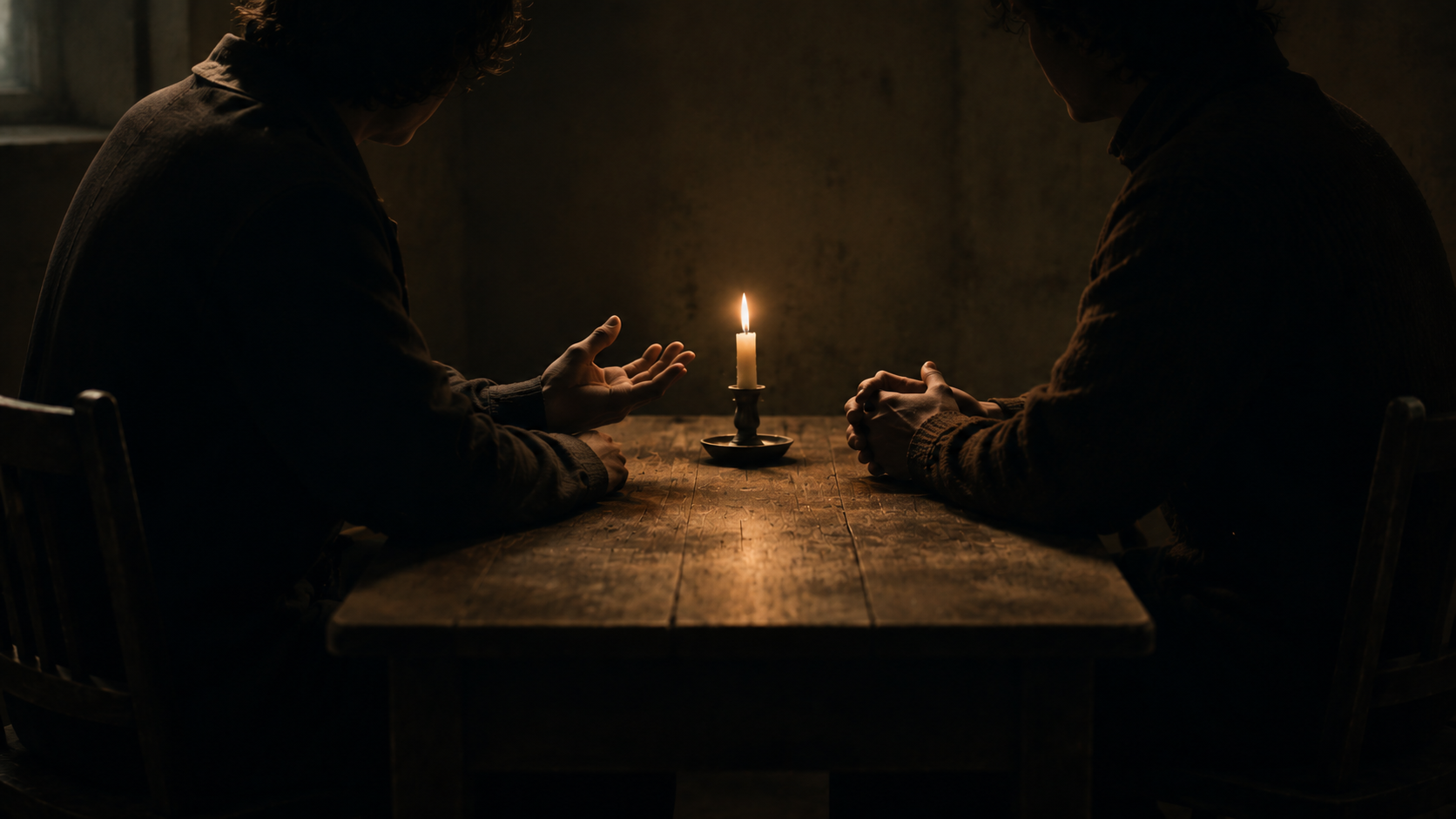 Two brothers at a table — the candle between them, the argument already in the air.
Christ returns to earth, not at the end of time, but in the middle of the Spanish Inquisition — the day after a hundred people have been burned as heretics. He walks quietly through the crowd. He heals the sick. He raises a child. The people recognize him immediately. And the Grand Inquisitor — ancient, shrewd, certain — has him arrested and thrown into a prison cell.
That night, the old man visits Christ in his cell. For the length of the chapter, the Inquisitor speaks. He builds an airtight case. Christ was wrong about human freedom, wrong to leave us with a choice we couldn't bear, wrong to refuse the devil's three temptations in the wilderness. The Church has corrected that mistake. Mankind needs bread and authority and miracle — not liberty. The argument is devastating. Ivan is convinced of it. The reader almost is.
When the Inquisitor finishes, Christ walks toward the old man and kisses him — gently, on his bloodless aged lips. The Inquisitor frees him and says: never come back. Christ goes out into the dark streets without a word.
"His poem is in praise of Jesus, not in blame of him."
— Alyosha's response to Ivan
What do you do with the argument you cannot answer — the one about the child who suffers, the God who does not seem to intervene — when the only thing left is whether you will still reach toward love in the silence?
I came to this book thinking Ivan was the problem. I finished it suspecting he was the most honest person in it — and that Dostoevsky loved him most because of it. What I didn't expect was to find myself, somewhere in those pages, holding both the argument and the kiss, unable to let go of either.
About the book
The novel is long — not long in the way that feels like endurance, but long in the way that a country is long, where you keep finding new rooms. It unfolds across twelve books and an epilogue, organized loosely around a murder trial, though the trial is really a container for everything else. It's part courtroom drama, part theological argument, part love story, part hagiography. Dostoevsky called it his life's work and died shortly after completing it. He intended a second volume that never came. What we have is already everything.
The novel keeps returning to the same few tensions: the freedom Christ gave humanity and whether it was a gift or a burden; the way guilt spreads like groundwater beneath a family, invisible until it ruins something; the question of whether love — active, costly, inconvenient love — is the only real answer to the problem of suffering. Father Zosima, the elder monk, teaches that each of us is guilty before everyone for everything, which sounds like nonsense until the story makes it feel like the only way the world holds together. Alyosha carries this teaching out into the world and keeps getting surprised by how it works. Ivan carries his argument into the world and keeps getting surprised by how it costs him. Dmitri carries his desires into the world and is surprised by nothing except grace, which arrives when he least deserves it.
Dostoevsky drew from the New Testament directly — the parable of the Grand Inquisitor echoes Christ's wilderness temptations in Matthew 4. He drew from his years in a Siberian prison camp, where he lived alongside murderers and came to believe in the soul's indestructibility. He drew from the Russian Orthodox monastic tradition, particularly the startsy, the spiritual elders whose wisdom came not from argument but from presence. The novel lives at the intersection of all three.
This tends to find people in the middle of a season when faith has stopped being simple — not people who have walked away, but people who are still walking and have begun to feel the weight of the road. The person who has asked the hard questions in good faith and found that the easy answers no longer hold. The person who loves God and also, in some hidden corner of themselves, understands Ivan Karamazov. Dostoevsky wrote it for that person specifically.
If any of this is the road you're on, there is a novel — written by a man who stood before a firing squad and came out the other side believing in grace — that has been waiting quietly on a shelf for you. It is called The Brothers Karamazov, and it was Fyodor Dostoevsky's last word on the only question that ever really mattered to him.
If you'd like to read it: The Brothers Karamazov -Pevear & Volokhonsky translation (Affiliate Link)
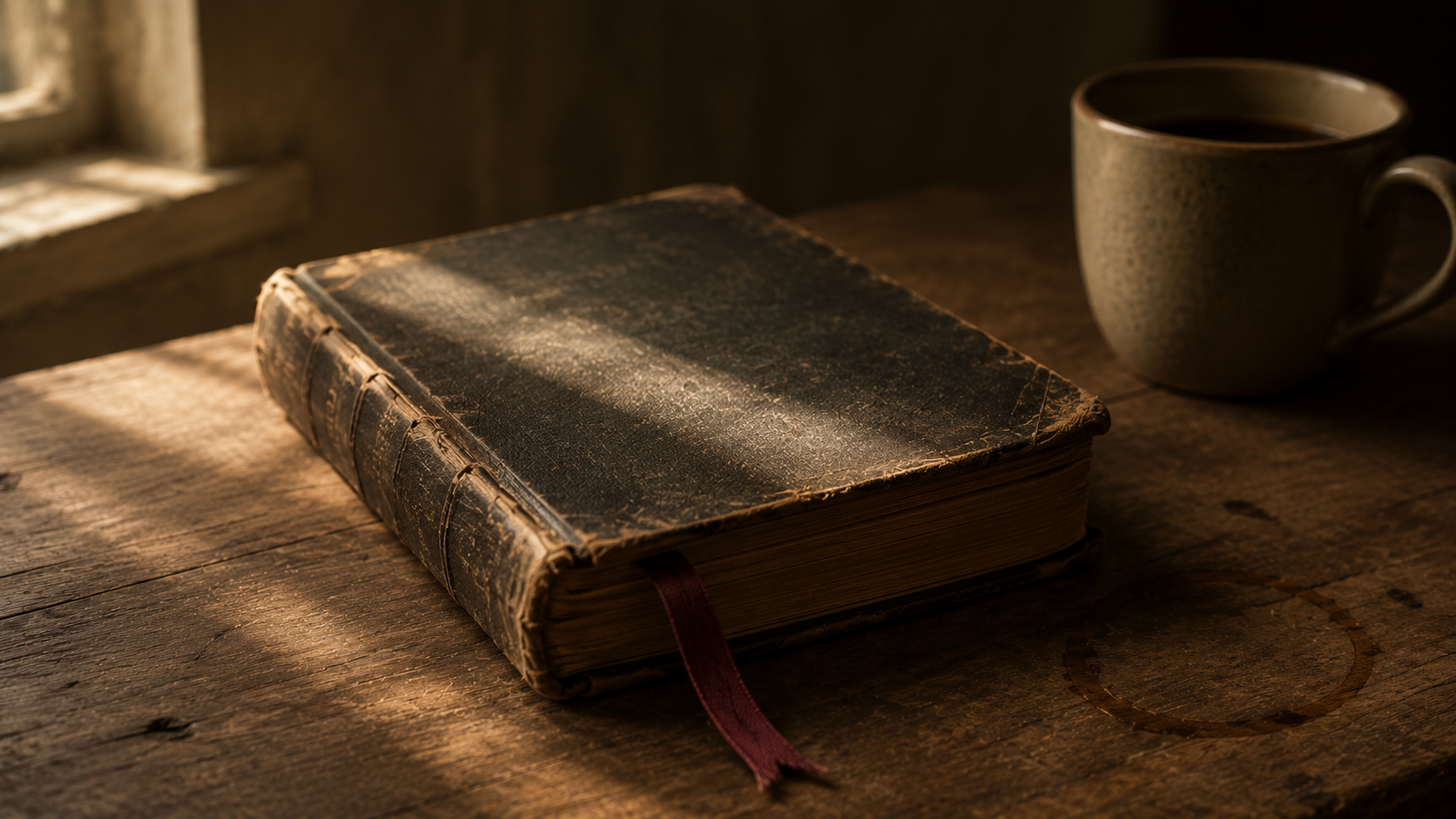 Well-worn, ribbon-marked, a little coffee-ringed — the kind of book that lives on a bedside table for years.
📚You Might Also Like
You Said All the Right Things. Nobody Moved. — Becoming a Person of Influence —
What If the Life You're Living Isn't the One You Were Made For? — The Pilgrim's Progress —
What If the Road You Refused Is Still Waiting for You? — The Pilgrim's Progress Part 2