The Pilgrim's Progress-What If the Life You're Living Isn't the One You Were Made For?
You've felt it before. That quiet, creeping sense that something is wrong — not with your circumstances, but with the place you're standing. Like you built a life in the right neighborhood but the wrong city. Like everything around you is fine, and yet.
Most of us don't have a name for it. We call it restlessness, or burnout, or a bad season. We make small adjustments — new routines, better habits, longer prayers. We keep moving, because stopping feels worse. But the weight doesn't lift. It just shifts. And somewhere underneath the busyness, a question sits unanswered: Is this really where I'm supposed to be?
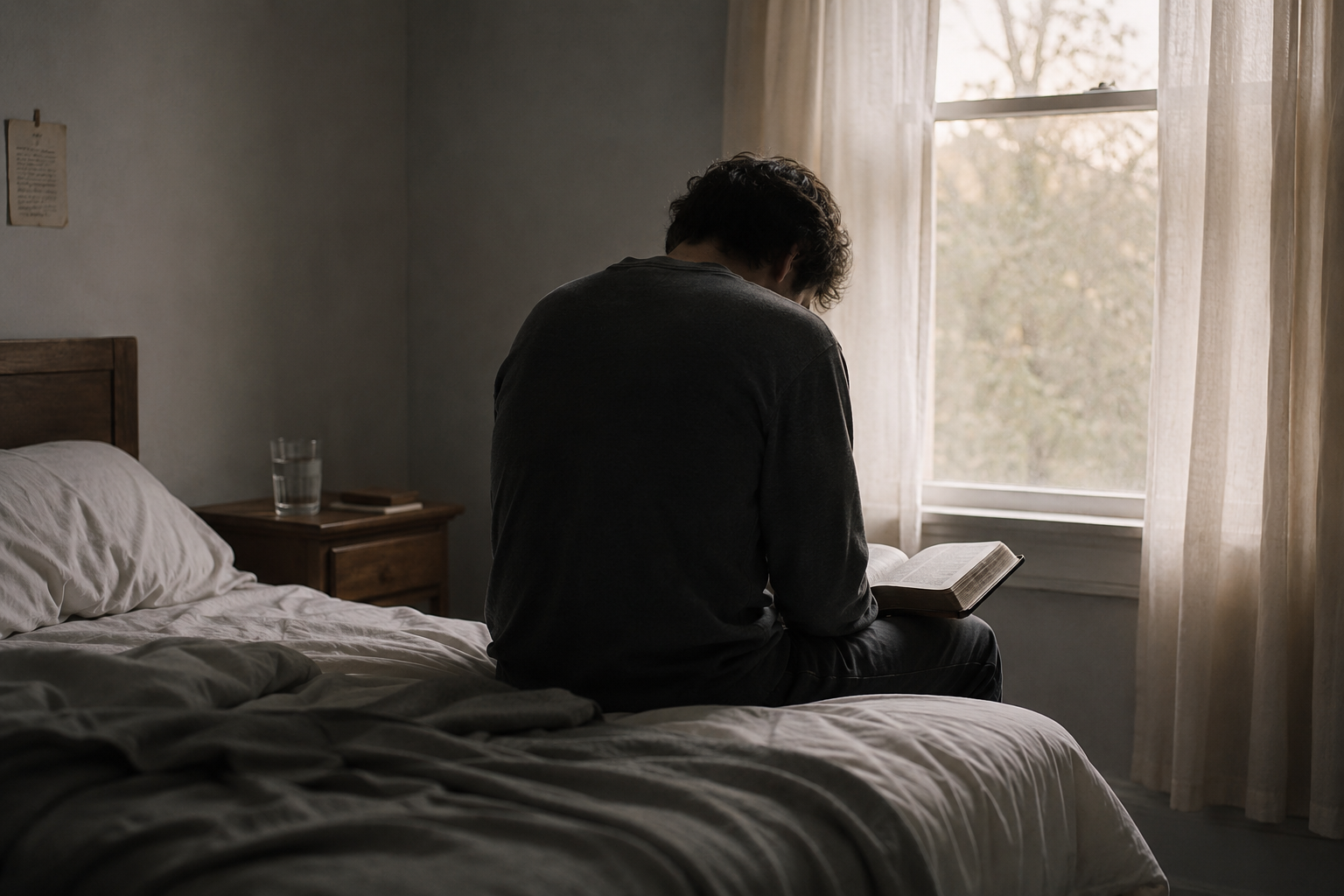
He found it in a book.
A man — a tinker, a nobody, a man who mended pots for a living — picked up a Bible one evening and couldn't put it down. Not because it comforted him. Because it terrified him. He read about a city built on wrong ground, about a destruction coming that no one around him seemed to believe, and he felt the words land not in his mind but in his chest, like a stone dropped into still water.
He told his wife. She worried about him. He told his neighbors. They thought he'd lost his mind. And slowly, quietly, he understood that he was going to have to leave — not because the road ahead was safe, but because staying was no longer possible. He could see the fire. He couldn't pretend he couldn't.
So he ran. With a burden on his back he hadn't chosen and couldn't remove, with no map except the finger of a stranger pointing toward a distant hill, he left everything he knew and stepped into a wilderness that had no clear path through it.
He would fall into a bog so deep he nearly drowned in it. He would be mocked by men who seemed far more reasonable than he was. He would be locked in a dungeon by a giant who wanted him to believe the key had never existed. And again and again, in the darkest stretches, he would meet companions — broken, doubting, limping companions — who somehow kept him moving.

There's a moment in the story where the burden falls.
Not because the man earns it. Not because he finally figures out the right spiritual equation. It falls at the foot of a cross he didn't build and can't explain, and it rolls into an empty tomb, and he stands there — lighter than he has ever been — and weeps. Three times he looks back. Three times.
"He saw the cross, and his burden loosed from off his shoulders, and fell from off his back, and began to tumble, and so continued to do, till it came to the mouth of the sepulchre, where it fell in, and I saw it no more."
The burden you've been carrying — the guilt, the striving, the gnawing sense that you've never quite done enough — what would it mean if it was never meant to stay?
I didn't expect this story to find me where it did. I thought I knew it. I thought it was a children's book, or a theology lesson dressed up in costume. I wasn't prepared for how much of my own interior life I would recognize in the road it describes.
About the Book
The Pilgrim's Progress moves in two parts — the first following Christian himself, a man running toward salvation; the second following his wife Christiana, who makes the same journey with her children and a company of companions, revealing that the road looks different when walked together. It's not really a novel in the modern sense — it was written as a dream, a vision, the kind of story that refuses to stay inside the covers.
What the book keeps returning to is the question of what we're actually carrying and why we can't seem to set it down. It circles around the reality that the road to life is rarely where the crowd is walking, that despair is a dungeon with a key that's easy to miss, and that the companions we pick up along the way — flawed, faithful, sometimes cowardly, sometimes brave — are part of what God uses to keep us on the path. Bunyan understood that the Christian life is not a solo journey, even when it feels like one. He knew what it was to press forward while doubting whether forward was real.
Bunyan draws almost entirely from Scripture — he saturated himself in it during twelve years in a Bedford jail cell — and from the raw material of his own spiritual crisis. He had been a man who cursed and danced and rang church bells on a dare, and then been undone by grace he couldn't explain. Every valley, every monster, every tempting shortcut in the allegory came from somewhere he had actually been.
This tends to reach people in a particular kind of season: the ones who have been walking long enough to be tired, who have started to wonder whether the faith they began with still means what they thought it meant. People who have survived something — a loss, a doubt, a season that nearly broke them — and are still not entirely sure they made it through.
At the very end, after everything, there is still a river to cross. There is no bridge. You have to walk through it.
If you're ready for a road that doesn't pretend to be easier than it is — The Pilgrim's Progress by John Bunyan has been waiting for you for three hundred years.
 If you'd like to read it: The Pilgrim's Progress (Affiliate Link)
📚You Might Also Like
What If the Road You Refused Is Still Waiting for You? — The Pilgrim's Progress Part 2
How Many Times Did You Lose Yourself Today? — The Screwtape Letters
What Do You Do When God Stays Silent? — The Brothers Karamazov