The danger you cannot feel — until it's too late
On carotid artery plaque, silent health risks, and why caring for our vessels is an act of faithful stewardship
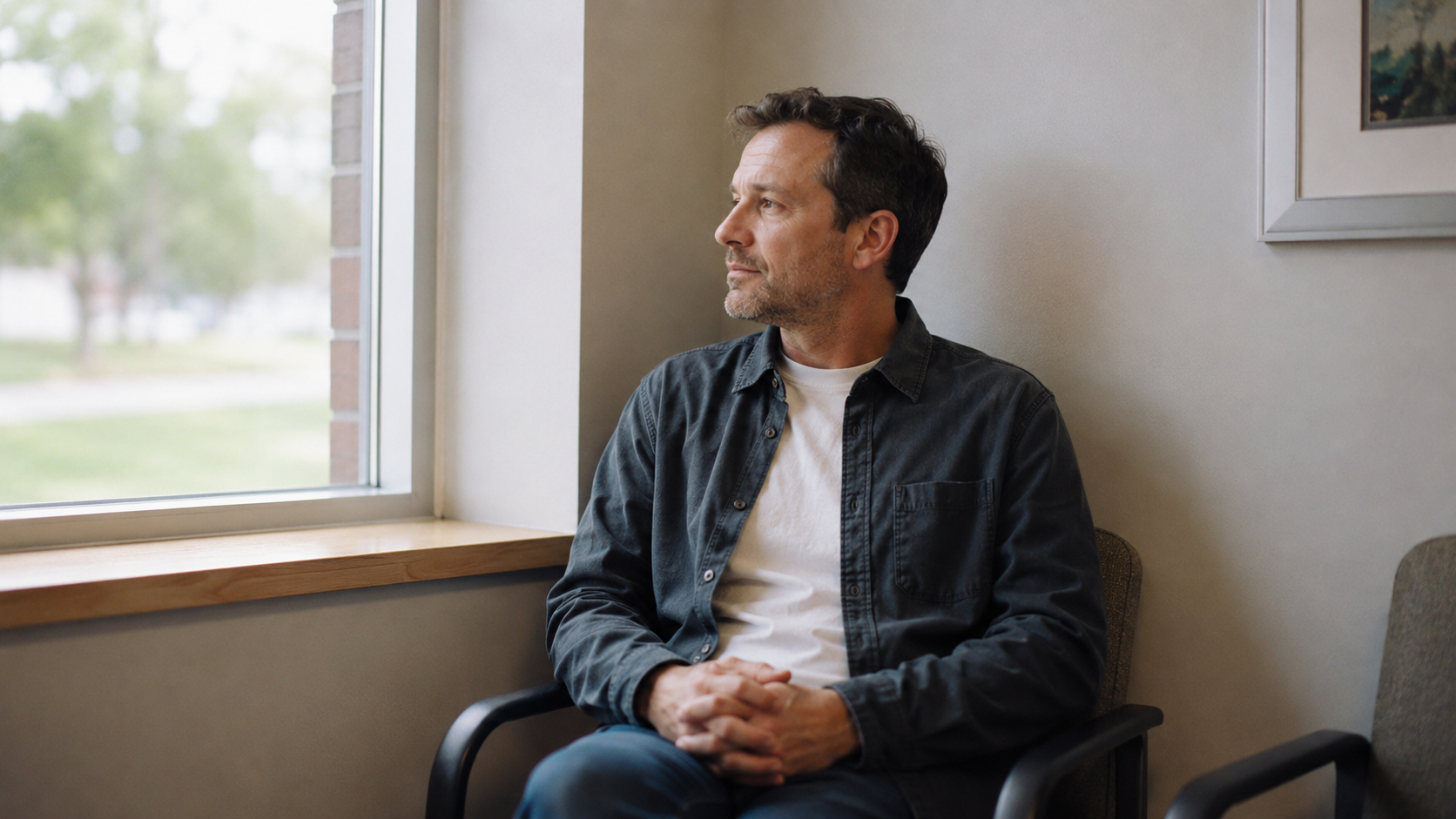 A middle-aged man sits quietly in a doctor’s office, looking out the window in reflective silence. Soft natural light and a simple clinical setting create a calm, contemplative atmosphere rather than one of fear or urgency.
There is a particular kind of medical story that never stops being sobering. A person in their fifties, apparently healthy. Regular check-ups coming back clean. Life moving forward at full speed. And then, without warning, a stroke — leaving a family stunned, asking the question that has no comfortable answer: "How could this have happened with no signs?"
Often, there were signs. They were simply invisible to ordinary testing and unfelt by the person carrying them. One of the most significant silent threats in midlife cardiovascular health is carotid artery plaque — a condition that can quietly narrow the blood vessels supplying the brain for years before making itself known in the most devastating way possible.
This is a health conversation worth having. And for those of us who understand our bodies as something given to us in trust, it is also a stewardship conversation.
"Know ye not that your body is the temple of the Holy Ghost which is in you, which ye have of God, and ye are not your own? For ye are bought with a price: therefore glorify God in your body, and in your spirit, which are God's."
1 Corinthians 6:19–20, KJV
The body, in the biblical understanding, is not simply a vehicle we operate until it breaks down. It is a dwelling place — something received, not self-constructed — and caring for it faithfully is part of what it means to honor the One who gave it.
What carotid artery plaque actually is
The carotid arteries run on both sides of the neck. Their job is critical and singular: they carry oxygen-rich blood from the heart to the brain. When plaque — a buildup of fat, cholesterol, calcium, and other substances — accumulates on the inner walls of these arteries, the passage narrows. This is called carotid artery stenosis.
Atherosclerosis — the hardening and narrowing of arteries — is often associated in people's minds with heart attacks. But it is a systemic process, occurring throughout the body's vascular network. The carotid arteries are among its most dangerous targets, precisely because what they supply is the brain.
The most alarming characteristic of carotid plaque is its silence. In the early and intermediate stages, most people feel nothing. There is no pain. No obvious warning. Life continues exactly as before — while the passage narrows and the risk accumulates.
 A middle-aged couple walks side by side along a quiet tree-lined path on a peaceful May morning. Soft golden sunlight filters through fresh green leaves, creating a calm atmosphere of companionship, reflection, and steady purpose.
The moment of greatest danger
The critical event is not gradual narrowing alone. It is plaque rupture — when a build-up that has been stable suddenly breaks open, triggering the formation of a blood clot. If that clot travels to the brain, a stroke can occur within minutes. This is why the condition is sometimes called a "silent danger": the warning and the crisis can arrive at the same time.
Why Scripture's wisdom about unseen things is relevant here
There is something in this medical reality that connects to a broader spiritual truth: that the most dangerous things are often the things we cannot see. The Proverbs understood this long before cardiology did.
"Keep thy heart with all diligence; for out of it are the issues of life."
Proverbs 4:23, KJV
The Hebrew word translated "heart" here encompasses the whole inner person — mind, will, emotion, and in the ancient understanding, the physical heart itself. "Issues of life" — the flows and outgoings of life — emerge from it. Guard it, the text insists, with all diligence. Not occasionally. Not when it becomes convenient. Diligently, as a consistent practice.
Carotid plaque does not develop suddenly. It accumulates over years of small choices — what we eat, how much we move, whether we manage the pressures that drive blood pressure upward, whether we address the cholesterol numbers that have been trending in the wrong direction. By the time it becomes visible on a scan, it has typically been building for a long time.
This is the nature of neglect. It rarely announces itself. It simply accumulates — quietly, invisibly — until the consequences arrive all at once.
The most dangerous things are often the things we cannot see. Faithful stewardship means attending to what is accumulating beneath the surface — in our bodies and in our lives.
How medicine is changing — and what remains constant
Medical approaches to carotid artery disease have evolved. For years, the primary question was binary: surgery or medication? Increasingly, the answer is: it depends — on the specific patient, the nature of the plaque, and the degree of stenosis. Newer imaging technology now allows clinicians to assess not just how narrow an artery is, but how unstable a particular plaque deposit is — a meaningfully more precise basis for treatment decisions.
For many patients, carefully managed medication combined with lifestyle change remains the most appropriate path. For others, surgical intervention — either carotid endarterectomy or carotid artery stenting — may be indicated. The right answer requires a conversation with a physician who knows your individual situation. This article is not a substitute for that conversation. It is an invitation to have it.
 Hands carefully prepare a simple healthy meal in the quiet light of a home kitchen. The slow, deliberate movements and natural ingredients reflect a calm rhythm of everyday care and mindful living.
What does not change: the power of daily habit
Across the entire landscape of cardiovascular medicine, one finding is more consistent than any other: lifestyle habits are the most powerful force acting on vascular health, in both directions. The same habits that build plaque over decades can also slow its progression or stabilize its character — when changed consistently and early enough.
Regular physical movement. A diet built around vegetables, whole grains, lean proteins, and healthy fats — the pattern sometimes called Mediterranean, though it is simply what nutritionally attentive people in many cultures have always eaten. Management of blood pressure, cholesterol, and blood sugar, through lifestyle first and medication where necessary. These are not exotic prescriptions. They are the disciplined care of a body that belongs, ultimately, not to us but to the One who formed it.
"Whether therefore ye eat, or drink, or whatsoever ye do, do all to the glory of God."
1 Corinthians 10:31, KJV
This verse is sometimes read as a call to spiritual mindfulness in abstract activities. But it is also, quite literally, about eating and drinking. The choices made at the table — the foods selected, the portions taken, the meals skipped or shared — are included in the scope of what can be done to the glory of God. That is not a burden. It is a reframe that gives ordinary daily choices a significance they would otherwise lack.
On anxiety versus attentiveness
A health article about silent cardiovascular risk can easily produce anxiety rather than action — which is not the goal. Fear is not a reliable guide. It tends either to paralyze or to produce frantic short-term responses that don't last. What the body needs, and what faithful stewardship looks like, is something quieter and more durable: attentiveness.
Attentiveness means going to regular check-ups, not avoiding them. It means asking your doctor about your carotid arteries if you are in midlife with other cardiovascular risk factors — high blood pressure, elevated cholesterol, a smoking history, diabetes, or a family history of stroke. It means making the small, consistent changes that rarely feel significant in the moment but compound meaningfully over time. And it means receiving the body's signals — persistent fatigue, unexplained changes in sensation, brief episodes of dizziness or vision change — as information worth reporting, not inconveniences to push through.
"A prudent man foreseeth the evil, and hideth himself: but the simple pass on, and are punished."
Proverbs 22:3, KJV
Wisdom, in the biblical sense, is not primarily intellectual. It is the practiced capacity to see what is coming — to read the trajectory of present choices and respond before consequences become irreversible. Applied to physical health, it looks like the person who gets the scan, takes the medication, changes the diet, and keeps the appointment — not because they are afraid, but because they understand that the life they are living belongs to someone greater than themselves, and they want to steward it well.
 An open Bible, a glass of water, and a small pill organizer rest quietly on a wooden table in the morning light. The simple arrangement reflects an ordinary rhythm of faith, health, and daily perseverance.
A prayer
Lord, You formed this body with intention and care. You know every vessel in it — every place where something has been accumulating that I cannot see or feel. Give me wisdom to attend to what You have given me, and the humility to seek help before crisis demands it. Where I have been negligent, give me grace to begin again. Where I have been fearful, give me the settled confidence of someone who knows that their life is held in hands more capable than their own. May I tend to this body as the gift it is — faithfully, gratefully, and for Your glory. Amen.