The Emperor Walks In
The first time I walked into a basilica, I didn't know what I was walking into.
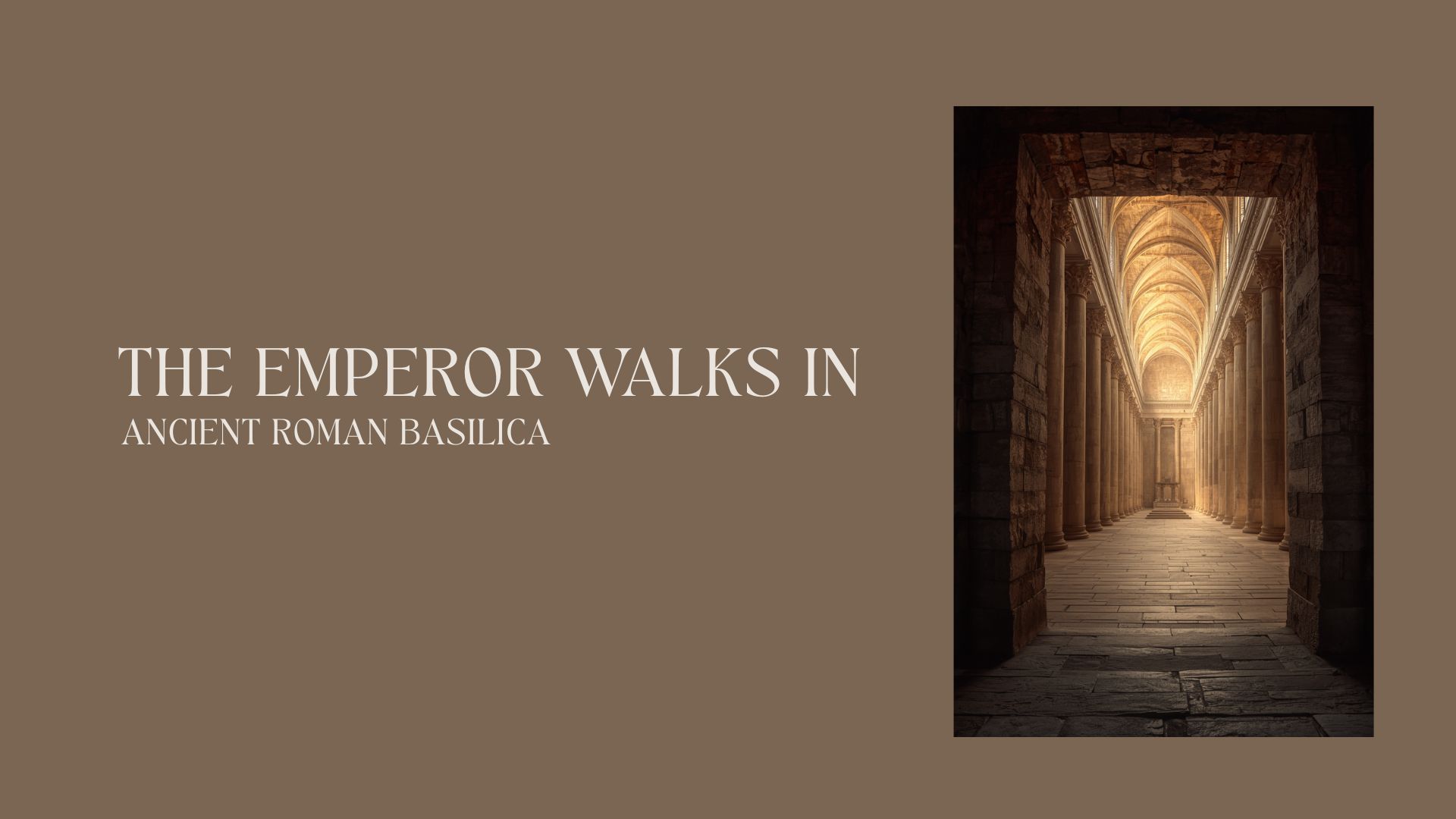
I was in my late twenties, on a research trip through Rome, more interested in the acoustics than the architecture. I remember standing just inside the entrance — a long, high central nave, columns running the length of the room, light coming down from windows near the ceiling — and feeling something settle into place. A kind of order I hadn't expected. The room was built to hold something large.
What I didn't know at the time was that I was standing in a shape that Christians borrowed from the empire. The basilica wasn't a Christian invention. It was a Roman civic building — a hall for commerce, legal proceedings, public business. When Constantine made Christianity legal in 313, and then favored, the church suddenly needed buildings it had never needed before. And Rome had a template ready.
The room I was standing in — high ceiling, long nave, apse (the rounded recess at the far end) — was a government building that became a church. The shape of much of Christian worship for centuries to come started somewhere in imperial bureaucracy.
That's the kind of thing that should probably make you stop and think for a minute.
Before 313, the question of where Christians met was mostly answered by whoever had a house large enough to hold people.
We know some of their names. Priscilla and Aquila hosted a church in their home — Paul mentions it in Romans. So did Philemon, Nympha, and Lydia. These were not buildings. They were living rooms, courtyards, dining spaces — whatever could be cleared and crowded. Most house churches held thirty to fifty people, sometimes fewer. The Lord's Supper happened around an actual table because there was an actual table in the room. Worship was close. You could hear the person next to you singing off-key.
And it was, for most of the first three centuries, illegal. Not always actively persecuted — the intensity varied enormously by region and emperor — but carrying real risk. You didn't advertise where you met. You didn't build anything that announced itself. The faith spread the way small, quiet things spread: person to person, household to household, across trade routes and family networks.
Then everything changed in a decade.
Constantine and his co-emperor Licinius jointly issued the Edict of Milan in 313 — it didn't make Christianity the empire's official religion (that would come later, under Theodosius, in 380), but it ended the persecution. Christians could meet openly. Property that had been confiscated was returned. Suddenly, for the first time in nearly three centuries, the church could exhale.
And Constantine did something more than exhale. He started building.
He commissioned basilicas in Rome, Jerusalem, Bethlehem, Constantinople. He poured imperial resources into the church in a way that transformed everything — the architecture, who led the gathering, how large it could get, what music it could carry. The Bishop of Rome moved out of somebody's dining room and into a building that could hold a thousand people. The intimacy of the house church became, almost overnight, a logistical impossibility.
I've thought a lot about what that shift must have felt like from the inside.
Imagine spending your whole life gathering in small rooms, keeping your faith quiet, knowing that someone in your circle might face real consequences for it. The secrecy was part of the fabric of your community. Then one morning the emperor declares your faith legal, your confiscated property is returned, and the thing you had been quietly guarding becomes something the empire is publicly endorsing.
Was that good news? I think it must have felt complicated, even to people who were relieved.
The basilica changed more than the square footage.
When you move from twenty people in a dining room to eight hundred in a nave, the nature of participation changes. Someone has to lead who is loud enough to be heard. Someone has to organize what happens and in what order. The Lord's Supper — which had been an actual shared meal around an actual table — gradually became something more formal, more presided over. The clergy moved to the apse at the front. The congregation moved toward the back.
This is not a story about corruption. It's a story about scale doing what scale does. Some of it was inevitable. Some of it was probably good — structure has its own gifts, especially in worship. But some of what was lost was also real: the informality, the sense of mutual participation, the feeling that worship was something everyone was doing together rather than something happening in front of them.
I was moved by the beauty of that Roman basilica when I stood in it. I still am when I think about it. But I've come to wonder, more than I did then, what we were moving away from when we moved in.
Constantine didn't invent the tendency to dress Christianity in the clothing of whatever culture holds power. He was just the first emperor to offer the clothes. Every generation of the church since has faced the same offer in different forms.
What the emperor gives, it turns out, is rarely just a building.