The Rise of the Worship Leader
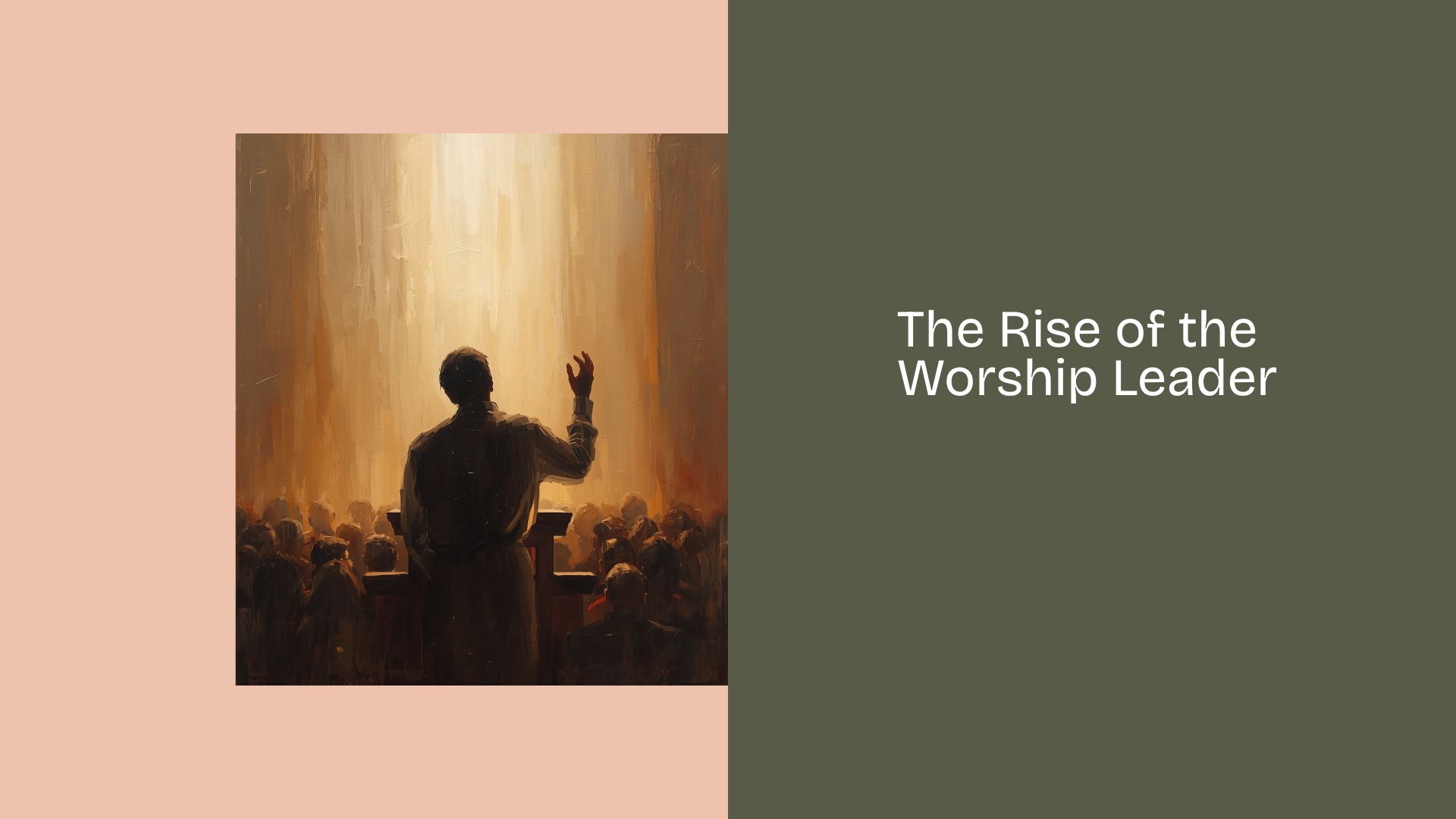
I have been a worship leader for more than twenty years. And I still find it strange that the role has a name.
Not that the name is wrong. It describes something real — the person at the front of the gathered congregation, choosing the songs, holding the microphone. But when I stop and ask where that person came from — that specific role, with that specific title and that specific weight attached to it — the answer is surprising. The worship leader, as we now understand the position, didn't exist a hundred years ago. It was invented. And most of us who do this work have never thought about who invented it, or why, or what they built into it that we inherited without asking.
For most of church history, the person leading congregational singing didn't have a separate identity or a separate calling. In the early church, song was everyone's responsibility — Paul writes to the Ephesians about "speaking to one another in psalms and hymns and spiritual songs" as a communal instruction, not a job description. Through the medieval period, trained cantors handled the music, their role primarily liturgical — not the pastoral-musical hybrid the modern worship leader inhabits. After the Reformation, someone still had to stand at the front and cue the opening pitch, but that person was usually the pastor, or simply whoever knew the tunes.
What I didn't understand when I first stepped into this role was how recently the thing I was stepping into had been created. The worship leader as a designated, full-time calling emerged from a very specific moment: the Jesus Movement, the wave of evangelical-charismatic revival that swept American youth culture in the late 1960s and '70s. Maranatha! Music, Vineyard, Calvary Chapel — labels, churches, and movements all tangled together — produced a generation of Christian musicians who built something that felt less like a liturgical function and more like a concert pointed toward God. By the 1980s, as the worship wars picked up heat, the role had solidified. You needed someone who could navigate the new repertoire, run sound, and read the room emotionally. That was no longer the pastor's job.
Once the role had a title, it attracted a particular kind of person — musicians who felt genuinely called, people who found in congregational leading a fusion of their gifts and their faith. They were often the most spiritually serious people in the building. But the role also attracted something else: the hunger that comes with standing in front of a room and being the one who sets the tone.
I know that hunger. I'm not above it. There is a pull in this work that is hard to name honestly — the sense that what happens in the room has something to do with you. That if the congregation lifts their hands, if the singing grows fuller, if something tangible seems to shift — that you participated in that. Caused it, even. You just wake up one day and notice that your identity has quietly attached itself to the atmosphere you produce.
In the late 1980s and '90s, a worship industry formed around this. By the time Hillsong rose to global prominence through the late 1990s — and the movements centered around Passion, Jesus Culture, and Bethel through the 2000s — the worship leader had become a category of Christian celebrity. The songs they wrote went into millions of rooms they would never set foot in, carrying their theological intuitions and aesthetic preferences with them.
There's a genuine gift in what that movement produced. Songs like "In Christ Alone" and "Blessed Be Your Name" carried real theology and real weight. I want to say that honestly before saying what comes next.
But the role also generated problems we've been slow to name.
The distance came first, and it came quietly. I've been in rooms where the worship leader seemed more focused on the camera than on the people — where the music was aimed at a livestream rather than at the gathered community. The congregation feels that shift before they can articulate it.
Then there's a loneliness that nobody warned me about when I started. You stand at the front and carry something for the room, and then it's over, and you walk off and nobody quite knows how to talk to you about what just happened. The worship leader is simultaneously the most visible person in the service and one of the most alone. The platform creates distance that isn't theological — it's just human.
And underneath both of those, there's a question I keep returning to. When I read the New Testament, I don't find a worship leader. I find a people who sing and pray and eat together. The person at the front, in that picture, is a servant of something corporate — not the source of it. When we elevated the worship leader into a specialized, platform-shaped role, we built in assumptions about where worship comes from that sit uneasily against that picture.
I'm still working out what to do with all of this. Twenty years in this role, and I love it — and I think we built some things into it that need to be dismantled carefully.
The role isn't the problem. The misunderstanding of the role is the problem. When the worship leader becomes the generator — the one whose spiritual condition determines whether the congregation meets God today — something has gone wrong at the level of identity, not just technique.
The person at the front is a pointer. Pointing toward what was already happening before they ever walked there.
That's what the role was invented for. The question is whether we've forgotten it.
If you've been shaped by a worship leader — someone whose leading changed how you encounter God — what was it about them that made the difference?