When a Student Goes Beyond the Teacher: Rimsky-Korsakov, Stravinsky, and Petrushka
A good teacher does more than pass on knowledge. We may spend years helping a student develop, hoping they will eventually take what they have learned and make it their own—even in ways we never expected.
The relationship between Russian composers Nikolai Rimsky-Korsakov (1844–1908) and Igor Stravinsky (1882–1971) offers an interesting example of this kind of growth.
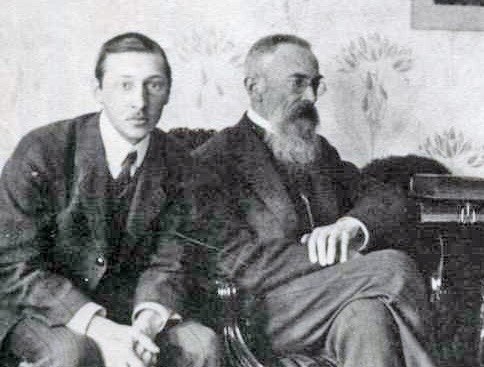 Igor Stravinsky and Nikolai Rimsky-Korsakov, 1908.
Rimsky-Korsakov played an important role in Stravinsky's early musical education, particularly in orchestration. But Stravinsky eventually developed a musical language that was unmistakably his own.
His ballet Petrushka, premiered in 1911, gives us a glimpse of that transformation.
Learning from a Teacher
Stravinsky was still a young composer when he came into contact with Rimsky-Korsakov, who played an important role in his musical development. Under his guidance, Stravinsky learned practical skills, especially in writing for orchestra and using instrumental color effectively.
Learning often begins with imitation. A student listens, follows, and studies a teacher’s choices. But imitation is not the final destination. A good teacher provides a foundation for growth.
Finding a Different Sound
Rimsky-Korsakov’s influence can be heard in Stravinsky’s early music. But in Petrushka, Stravinsky transformed what he had learned into something distinctly his own. It does not simply sound like Rimsky-Korsakov’s music continued by another composer. It sounds like Stravinsky.
The title Petrushka refers to a traditional Russian puppet character. In Stravinsky’s ballet, Petrushka is a puppet brought to life, experiencing love, jealousy, and a longing for freedom.
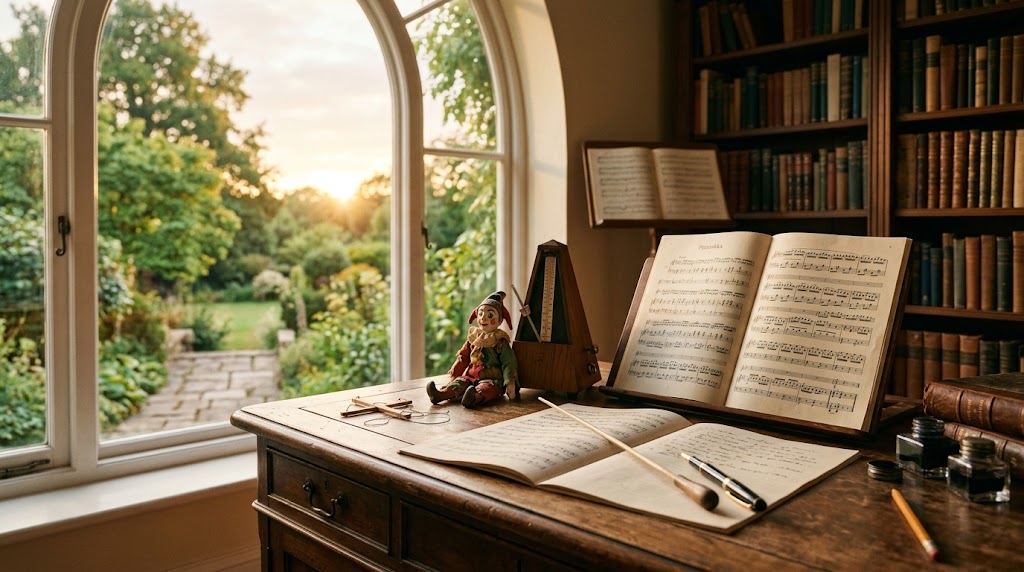
The piano is also part of the orchestra, adding another distinctive color to the music. You can hear the piano at 8:48 in the video above. Stravinsky’s unusual combination of instruments helps create a sound that can be playful, dramatic, and unsettling.
Stravinsky was shaped by Rimsky-Korsakov without becoming a copy of him. He carried his teacher’s influence with him, but transformed it into his own musical language.
When a Student Goes Beyond the Teacher
For teachers, this kind of growth requires humility. It can be difficult when a student begins making choices we would not make ourselves. But teaching is not about keeping a student dependent. We hope that, eventually, they can think and decide for themselves.
They may interpret a phrase differently, choose different repertoire, or develop a style very different from their teacher’s. That does not mean the teacher has failed. Sometimes, it means the teacher has done their job: helping a student gain the knowledge and confidence to find their own way.
This applies far beyond music. Parents, mentors, and teachers all invest in people who will eventually take what they have learned and make it their own. Sometimes, letting them grow beyond us is part of the gift we give them.
Planting and Letting God Grow
This is where the role of a teacher connects naturally with a biblical perspective.
“I planted, Apollos watered, but God has been making it grow.” — 1 Corinthians 3:6
Paul used these words to explain that he and Apollos had different roles in helping the Corinthian church grow. One planted, another watered, but the growth itself came from God.
We can teach, encourage, correct, and provide a strong foundation. But we cannot control what another person will ultimately become. That growth belongs to God. This is an important reminder for teachers and parents, because the path we imagine for someone may look very different from where they eventually go.
Rimsky-Korsakov died in 1908, several years before Petrushka was completed and premiered in Paris in 1911. He never had the opportunity to hear the finished ballet or see how far Stravinsky’s career would develop. Yet his teaching remained part of the foundation from which Stravinsky grew.
Perhaps that is one of the quiet rewards of teaching. We may not always see the result, but what we give can continue to grow in someone else. A good teacher gives a student roots, room, and the freedom to grow. The goal is not for the student to sound like the teacher, but to become fully themselves.
Read previous: J.S. Bach, C.P.E. Bach, and Solfeggietto: What Do We Pass On?