When Obedience Feels Too Small to Matter — Brother Andrew's God's Smuggler
You're sitting in the car outside the place you're supposed to go into. Engine off. Keys still in your hand. You've rehearsed what you'll say, and it still doesn't feel like enough, and some part of you is hoping something — anything — will happen so you don't have to walk in.
That's not weakness. That's just what it feels like to stand at the edge of something you can't control the outcome of. You want a guarantee before you'll move. You want to know it'll work before you're willing to try. So you sit there, engine off, telling yourself you're waiting for the right moment, when really you're waiting to feel brave enough — and that feeling never quite arrives on schedule.
Trusting God with the Next Step, Not the Whole Road
There was a young Dutchman who spent most of his twenties without much direction. He'd been a soldier, then wounded, then a factory worker punching a clock in a job that asked nothing of him. He wasn't looking for a mission. He was looking for something to make the ordinary feel less flat.
Then he read about a youth festival happening behind the Iron Curtain, in a part of the world where owning a Bible could get you watched, questioned, or worse. He didn't have a strategy. He had a car, a little money, and a conviction that wouldn't leave him alone — that if the church there was cut off, someone needed to go find out what was left of it.
So he went. No plan for what came after the first border. He packed what Scripture he could carry and drove toward a checkpoint where a guard would either wave him through or not.
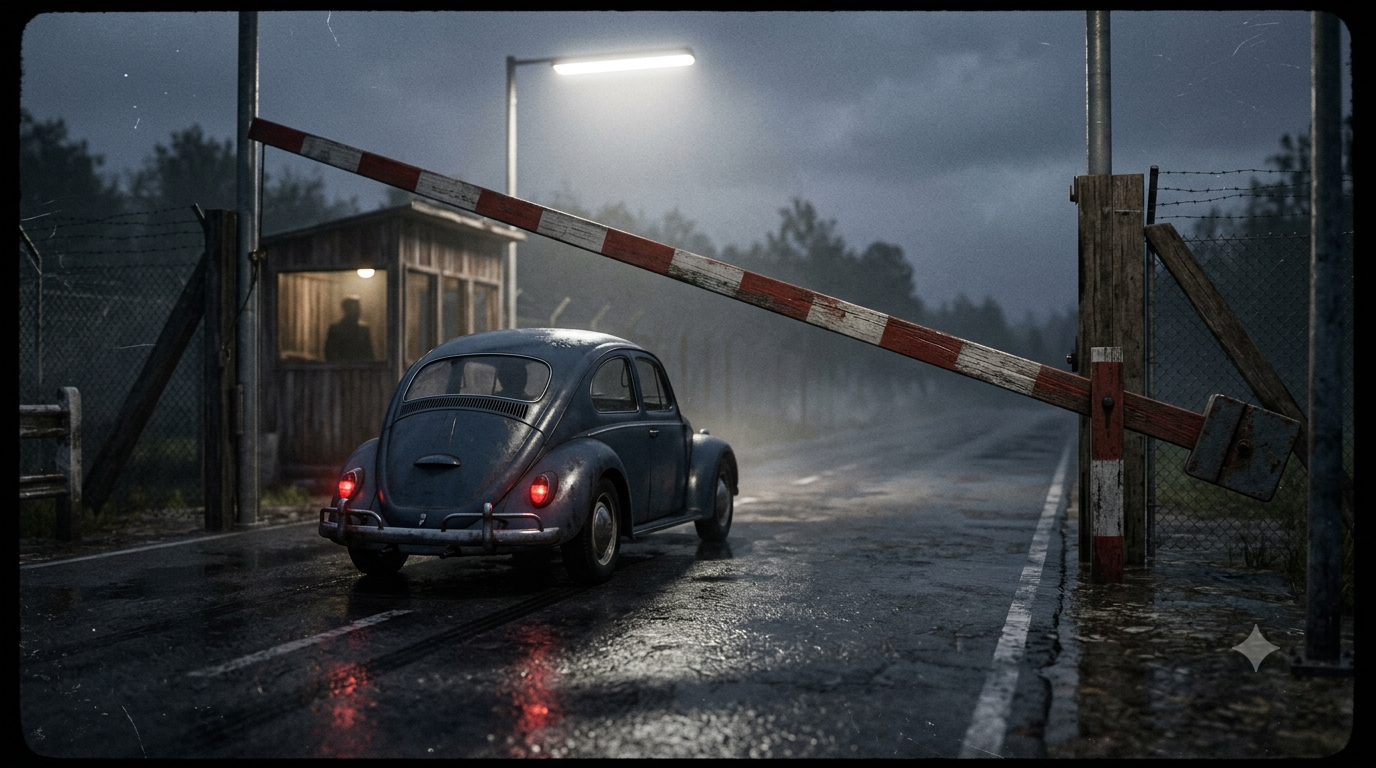 A car waits at a border crossing much like the ones Brother Andrew approached carrying Bibles for churches he'd never met.
He didn't know what he'd say if they searched the trunk. He hadn't figured that part out. He'd only figured out the part in front of him — start the car, drive to the border, see what happens. Everything past that belonged to God, and he'd decided, somewhere on the road, that he was going to let it stay there instead of trying to hold it himself.
Walking by Faith, Not by Sight, at an Actual Border
This is the part of the book that reframes everything: obedience doesn't require you to see the whole outcome first. It only requires the next honest step. Brother Andrew didn't smuggle Bibles because he was fearless. He did it because he'd stopped demanding certainty before he'd move — he simply asked God to do the part only God could do, and then he drove forward anyway. At one crossing, as guards inspected the car, he prayed something close to this: that the eyes which might notice what he carried would, for this one moment, be made blind to it.
What would it look like to actually do the next small thing you've been asked to do, before you feel ready for it?
What Everyday Courage in Ordinary Obedience Actually Looks Like
I keep a list of things I've been meaning to do that require almost nothing — an email, a phone call, a conversation I've rehearsed a hundred times in the shower and never had. None of them involve a border guard. All of them have sat there anyway, untouched, because I was waiting to feel ready. Reading about a man who drove toward danger without knowing the ending made me look at my own stalled, harmless list and feel a little embarrassed by how much certainty I'd been demanding for so little risk.
A Little More About the Book
The book unfolds the way a long conversation with someone older and steadier than you might — not in tidy chapters building an argument, but as one true story after another, each crossing and each close call laid down in the order it happened. What it keeps circling back to isn't strategy or heroics; it's the strange peace of doing the next right thing without needing to see how the whole story ends, and the quiet discovery that fear and obedience can occupy the same car at the same time. Brother Andrew draws less from theological argument than from Scripture read plainly and taken at its word, from years of watching prayers answered in ways too specific to explain away, and from the believers he met behind closed borders who'd kept their faith with almost nothing to hold it up. God's Smuggler tends to land in the hands of people who already know what they're supposed to do next and haven't done it yet — the ones circling the decision, waiting for the fear to leave before they'll move, who need to hear from someone who moved while the fear was still sitting right next to him.
The book is called God's Smuggler, and Brother Andrew wrote it the way he seems to have lived — without waiting to feel ready first.
If you're curious, it's the kind of story worth having on your shelf — find it here.
What is the book God's Smuggler about?
It's Brother Andrew's own account of driving Bibles across Cold War borders into countries where owning Scripture was dangerous, and of the faith that kept him moving forward one crossing at a time. It's not a strategy manual. It reads more like a friend telling you, plainly, what it cost and what he learned.
Is God's Smuggler a true story?
Yes — it's a memoir, not a novel. Brother Andrew, born Andrew van der Bijl in the Netherlands, really did make these trips, and the organization that grew out of his work, Open Doors, still exists today.
What can God's Smuggler teach us about faith and fear?
For me, it's that fear and faith aren't opposites you wait to resolve before acting — you can carry both into the same moment. I've started asking myself, when I'm stalling on something small, whether I'm actually waiting for wisdom or just waiting to stop feeling afraid.
Why did Brother Andrew smuggle Bibles into communist countries?
Because he'd read that believers there were cut off from Scripture and decided someone needed to find out what was true, in person, instead of staying safely uncertain. He didn't have a five-year plan. He had one trip in front of him, and he .took it.
📚You Might Also Like
The Paradox of Love: Why a "No" is the Kindest "Yes" — Boundaries —
The Spear You Don’t Throw Back: A Masterclass in Radical Silence — A Tale of Three
You're Not Too Busy. You're Just Hurrying — The Ruthless Elimination of Hurry —