Why Legumes Are Good for Heart Health — A Small Table Choice That Cares for the Body God Gave Us
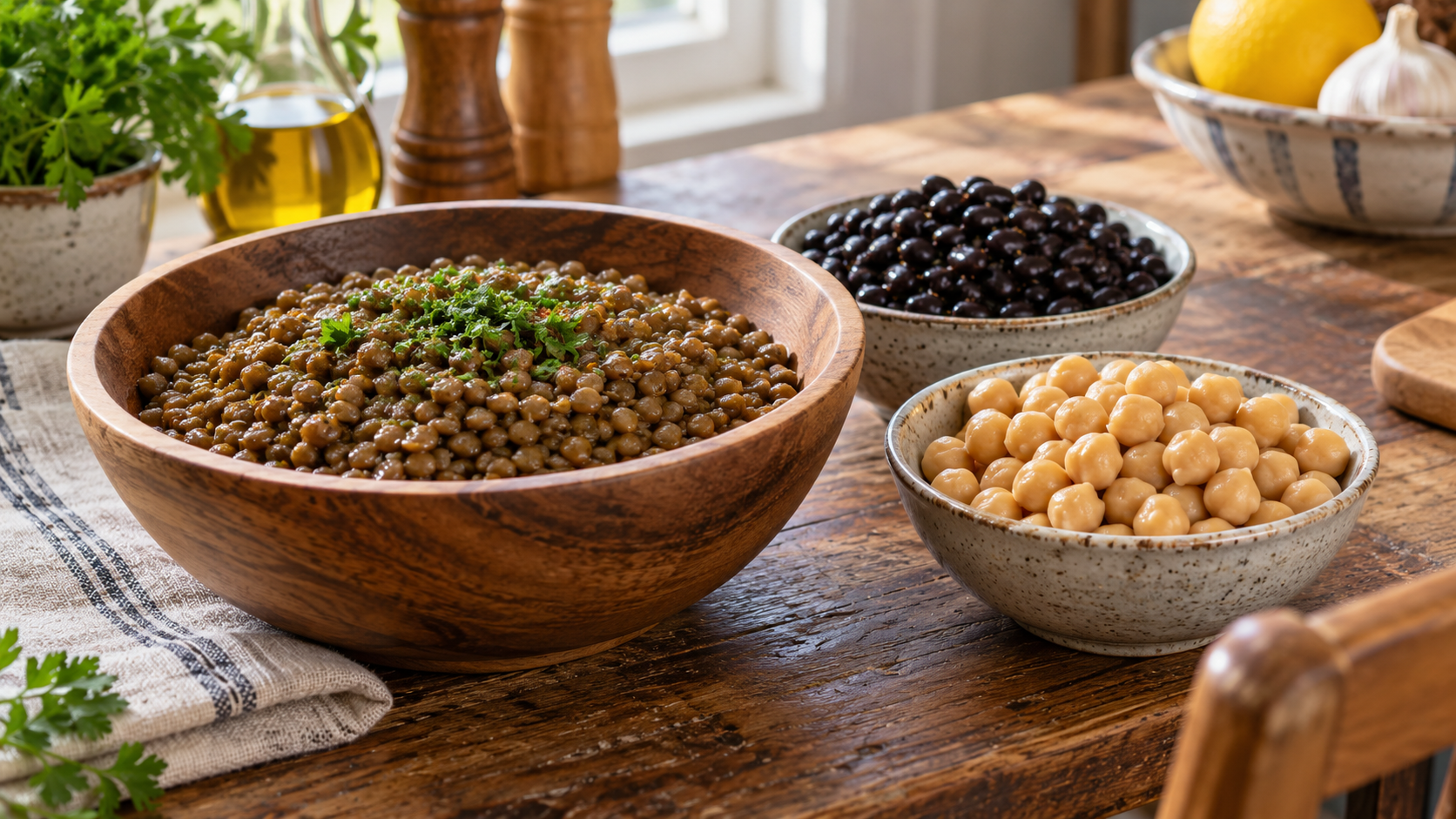 Cooked lentils, black beans, and chickpeas offer a versatile source of plant-based protein, fiber, and complex carbohydrates that can be easily added to a heart-healthy diet.
When we think about health, we usually start with what we should stop eating.
Cut back on greasy food. Cut back on salt. Avoid sweets.
That kind of restraint genuinely matters.
But a healthy diet needs another question too.
"So what should I replace it with?"
That's where legumes — beans, lentils, chickpeas, peas — earn their place at an everyday table.
Legumes carry plant protein, fiber, complex carbohydrates, and a range of vitamins and minerals. They're relatively low in saturated fat while genuinely filling, which makes them a useful stand-in for part of your meat or refined-carb intake.
This matters especially past midlife, when cholesterol, blood pressure, blood sugar, and weight often all need attention at once.
That doesn't mean overhauling your diet overnight, though.
Caring for the body God has entrusted to us can start not with a dramatic resolution, but with one small choice at today's meal.
Caring for Your Body Is Also a Life of Stewardship
Scripture doesn't tell us to treat our bodies carelessly.
The apostle Paul reminds us in 1 Corinthians 6:19-20 (KJV) that our bodies are the temple of the Holy Ghost, and urges us to glorify God with them.
This doesn't mean eating a specific food makes you more spiritual.
But for a Christian, caring for your health may never have been simply about self-management for a longer life.
Caring well for the body God has entrusted to us, serving family and neighbors, and responsibly managing our habits so we can carry out what's been given us to do — all of that can be understood as an expression of stewardship.
That's really why choosing healthy food matters.
Not to build a flawless body, but to live out today's given life with gratitude.
Legumes Fill You Up While Improving the Quality of Your Meal
Legumes are more satisfying than you'd expect.
That's because they carry protein and fiber together.
That combination helps maintain fullness, which can, in turn, help reduce excessive snacking between meals or overeating in one sitting.
Especially past 40, simply cutting portion size to manage weight often isn't sustainable long-term.
Instead, it's worth asking not "how much less should I eat," but "what should I fill up on."
Fiber- and protein-rich foods like lentils, chickpeas, and black beans can help maintain satisfaction at a meal while genuinely improving the overall quality of your diet.
In the life of faith, too, self-control isn't simply about denying yourself.
It's closer to wisely choosing what you actually need, cutting back on excess, and being grateful for what God has provided.
The same holds true at the table.
Why Legumes Help With Cholesterol and Blood Sugar
One of the main reasons legumes come up so often in cardiovascular health discussions is fiber.
Soluble fiber in particular affects bile acid and cholesterol metabolism during digestion, which can help manage LDL cholesterol.
Another compound worth knowing about is resistant starch.
Resistant starch isn't fully digested in the small intestine — it travels down to the large intestine, where it feeds gut bacteria.
The short-chain fatty acids produced in that process are being studied not just for gut health, but for a range of metabolic processes too.
Because legumes combine protein and fiber and digest relatively slowly, they tend to produce a gentler rise in blood sugar after a meal compared to refined carbohydrates.
Blood sugar management matters because diabetes and cardiovascular disease risk are closely linked.
That said, while the evidence for legumes improving risk factors like cholesterol and blood sugar is fairly solid, research is more mixed on how much legume consumption alone actually reduces cardiovascular disease itself. So it's more accurate to think of legumes not as a "heart disease prevention pill," but as a genuinely good food that helps manage your risk factors.
If you're already being treated for diabetes or taking blood sugar medication, legumes still need to be factored into your total carbohydrate intake, so adjusting your meals to fit your own situation matters.
What Matters More Than "Eating More Beans" Is "What You Swap Out"
Adding a lot of beans on top of an otherwise unchanged diet doesn't solve everything just because beans are good for you.
What matters more is what you actually swap for beans.
If you regularly eat red meat or protein foods high in saturated fat, try replacing part of that with lentils, chickpeas, or black beans.
That helps increase plant protein and fiber while reducing saturated fat intake.
Replacing part of your refined carbs — white rice, white bread — with legumes is another option, since legumes carry complex carbohydrates and fiber together.
In the end, the real strength of legumes isn't found in one "miracle nutrient" — it's that they help shift your whole diet in a slightly better direction.
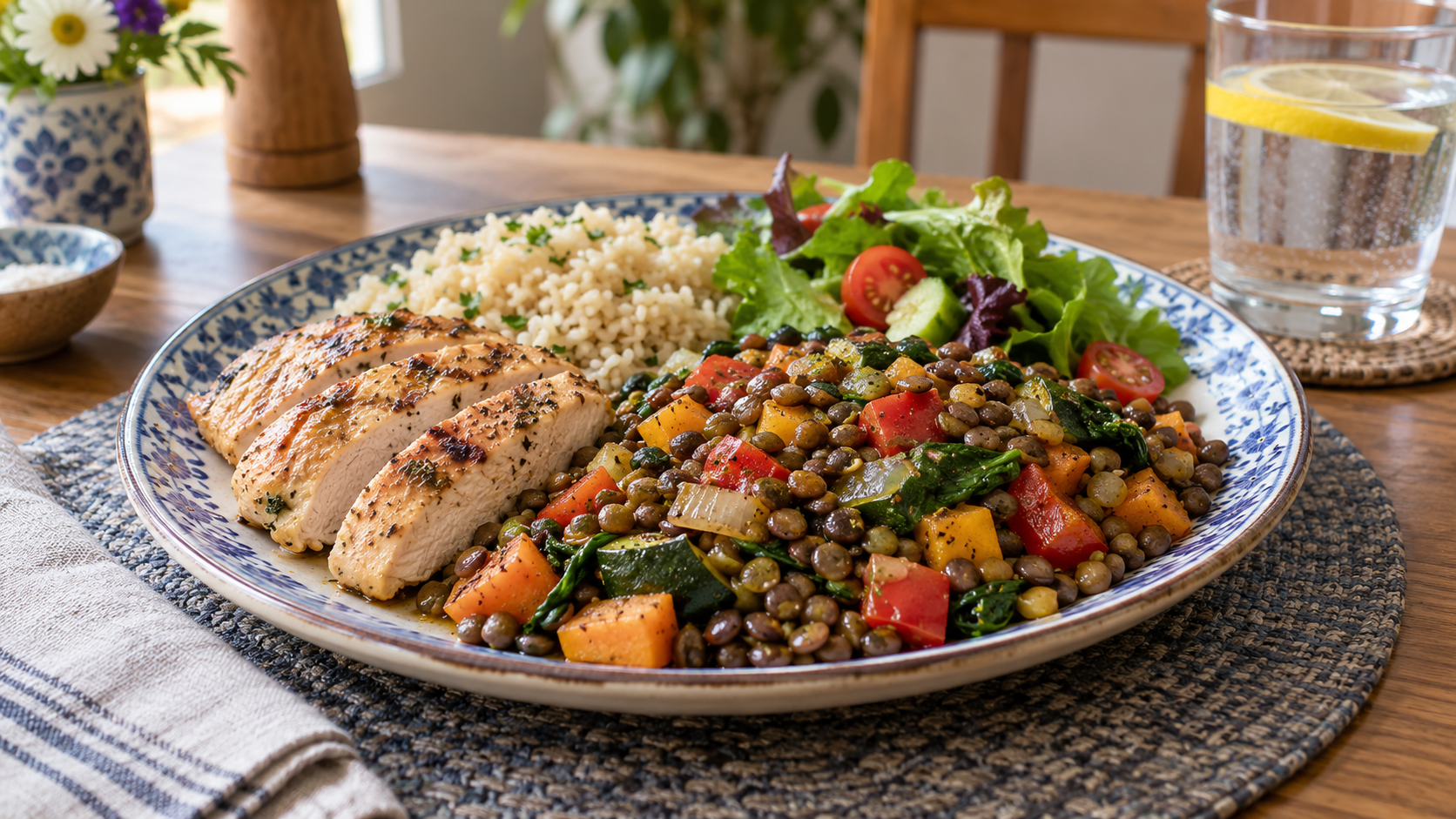 Replacing part of a meat-centered meal with lentils and vegetables can increase fiber and plant-based protein while helping reduce reliance on higher-saturated-fat protein sources.
God Gave Us a Genuinely Diverse Table
Reading through Genesis, you'll find God allowing humanity a wide variety of plants as food.
There's no need to read that as a command for a specific modern diet.
What's worth remembering instead is simply this: the creation God allowed us contains an enormous variety of food.
Modern eating sometimes leans too heavily on just a few things — meat, refined grains, and processed food repeated over and over.
In that context, bringing beans, vegetables, whole grains, and nuts back to the table is a genuinely good nutritional choice too.
And there's spiritual significance in approaching even an ordinary ingredient with gratitude.
1 Timothy 4:4 (KJV) says: "For every creature of God is good, and nothing to be refused, if it be received with thanksgiving."
The starting point for healthy eating, too, can be gratitude and wise self-control rather than fear.
Why Do Beans Cause Gas?
Some people feel discomfort after eating legumes.
Bloating and gas are the most common complaints.
If you're not used to eating much fiber and suddenly eat a large amount of beans, increased fermentation in your gut can produce gas.
That can easily lead to thinking, "I guess beans just don't agree with me, even though they're supposed to be healthy."
That's not necessarily the case, though.
It's better to start with a small amount and gradually increase it.
Your gut bacteria and digestive system need time to adjust to a change in fiber intake.
That said, if abdominal pain or serious digestive discomfort continues, there's no need to push through it.
Healthy eating isn't about forcing yourself to follow whatever everyone else says is good — it's about paying attention to your own body and adjusting wisely.
If Dried Beans Feel Like Too Much Work, Canned Is Fine Too
"Healthy eating" can sound like it requires making everything from scratch.
But realistically, it needs to be sustainable.
Dried beans require soaking and cooking time, which can genuinely be inconvenient for a busy household.
Canned beans are a perfectly good alternative in that case.
Where possible, choose a low-sodium or no-salt-added option, and if you're using regular canned beans, draining and rinsing them under running water helps cut down on sodium.
A healthy life isn't about living perfectly — it's closer to repeating good, sustainable choices.
That's true in the life of faith too.
It's not one grand resolution, but small, daily acts of obedience that shape a life.
 Rinsing canned beans under running water is a simple way to remove some of the sodium from the packing liquid, making canned beans a convenient option for everyday healthy meals.
The Easiest Ways to Add Legumes to Your Table
You don't need to overhaul your whole diet at once.
Just add a little to what you're already eating.
Swap part of the meat in a pasta sauce or stir-fry for black beans or kidney beans.
Mix a bit of beans or lentils into rice as it cooks.
Add chickpeas or kidney beans to a salad.
Use peas or edamame as a simple snack or side dish.
Lentils cook faster than most other dried legumes, making them a convenient starting point.
Chickpeas work well blended into hummus with vegetables, or added to soup, curry, or salad.
What matters isn't building a whole new health diet — it's swapping just one thing in your current meals for a slightly better choice.
If You'd Like to Start With Lentils
If legumes aren't familiar to you yet, starting with lentils is a good option.
Brown lentils hold their shape well after cooking, making them convenient for rice dishes, salads, and soups.
When choosing a product, it's worth checking more than just the brand — origin, storage condition, packaging, and how to prepare it all matter too. [Brown lentils tested for glyphosate herbicide residue, like this one], are a good example of a product with transparent sourcing and quality information (affiliate link — I may earn a small commission at no extra cost to you).
Past 40, Start With "Swapping a Little," Not "Cutting Out Meat"
Reading health information can easily push you toward extremes.
So does that mean I can't eat meat anymore?
Not at all.
The point of adding legumes to your diet was never eliminating all animal protein.
It's gradually increasing the share of meals that include plant protein and fiber.
If you eat meat-centered meals several times a week, try swapping one or two of those for a meal built around beans or lentils.
Cutting your meat portion in half and filling the rest with beans is another option.
A change this modest is easy to sustain consistently without dramatically altering your family's eating habits.
The self-control Scripture speaks of is connected less to strict prohibition and more to wisely governing yourself.
The same is true of healthy eating.
For Heart Health, the Whole Table Matters More Than One Bowl of Beans
Legumes are a genuinely excellent food for supporting heart health.
But eating beans doesn't cancel out every other eating habit.
What matters more is the overall pattern — a genuine variety of vegetables, fruit, whole grains, nuts, and fish, kept in balance, with saturated fat, sodium, and refined carbs kept in check.
Exercise, sleep, and stress management matter alongside that too.
And for a Christian, there's one more perspective worth adding.
Health itself was never meant to be our ultimate goal.
However carefully we manage our health, the human body eventually weakens.
That's exactly why, instead of clinging to health like an idol, gratefully using the body and time God has allowed us today matters more.
We manage our health not to build a flawless body, but to love our family, serve our neighbors, carry out what's entrusted to us, and faithfully live out the day God has given us.
Start With One Meal Today
There's no need to overhaul this week's whole table.
Just change one meal.
Swap part of the meat for lentils. Mix a little bean into your rice. Add a spoonful of chickpeas to your salad.
It looks like a small change, but choices like this, repeated over time, can shift your whole eating pattern.
Faith works the same way.
Small daily choices and small acts of obedience, stacked together, shape a life.
A healthy table, too, doesn't start with a grand plan — it can start with gratefully and wisely choosing the one meal in front of you today.
Caring for the body God has entrusted to you, choosing gratitude and self-control over fear even in what you eat — why not give it a try?
Health and Faith Note: This article reframes general nutritional information about legumes and cardiovascular health through a Christian stewardship lens. Scripture is quoted not to prove the medical efficacy of a specific food, but as a faith-based reflection on gratitude and responsibility toward the body and its food. If you are being treated for a cardiovascular condition, kidney disease, diabetes, or require a specific dietary restriction, please consult a healthcare professional or registered dietitian.