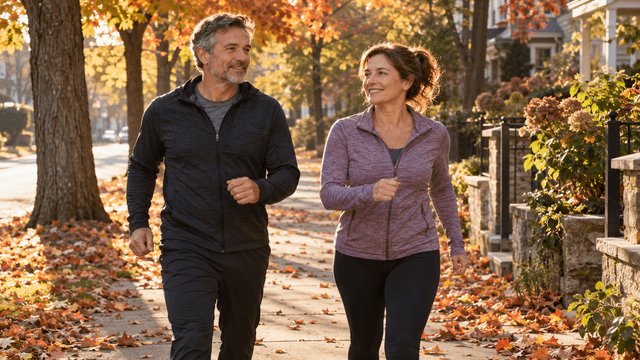
Your Body Was Made to Move — A Christian Reflection on Walking and Daily Faithfulness...(B)
What a simple daily walk taught me about stewardship, grace, and showing up.
I'll be honest with you: for a long time, I didn't count walking as real exercise. It felt like something you did on the way to real exercise — the warm-up before the warm-up. Running counted. Cycling counted. Lifting counted. Walking was just… getting from one place to another.
Then came a season of life that changed my thinking. Work piled up, the schedule collapsed, and every plan to do something more rigorous quietly fell apart. The only movement I could manage was walking — to the coffee shop in the morning, around the block after dinner, up the stairs when I felt too tired to care. I did it without much thought, not as a fitness strategy but simply because I was too worn down for anything else.
What surprised me was what happened next. I started feeling steadier. Clearer. A little more like myself. And somewhere in the middle of all that, I started thinking about what Scripture says about bodies, stewardship, and the faithfulness of small things.
I don't think that's a coincidence.
 사진: Unsplash의 Sincerely Media
The body is not incidental
Christian theology has always taught that the body matters. We are not souls trapped in physical shells, waiting to escape. We are embodied beings, created that way on purpose, and Scripture consistently treats the body with dignity and care.
"Do you not know that your bodies are temples of the Holy Spirit, who is in you, whom you have received from God? You are not your own; you were bought at a price. Therefore honor God with your bodies." (1 Corinthians 6:19–20)
1 Corinthians 6:19-20 — "Do you not know that your bodies are temples of the Holy Spirit... Therefore honor God with your bodies."
This isn't primarily about fitness goals or body image. It's about stewardship. The same principle that shapes how we think about our time, our money, and our relationships also applies to our physical selves. We are caretakers, not owners. And basic care for the body — movement, rest, nourishment — is part of that faithful stewardship.
I find it meaningful that God chose to take on a human body. Jesus walked. He got tired. He sat by wells and shared meals and moved through villages on foot. The incarnation, among other things, tells us that physical, embodied existence is not something to escape but something God himself entered willingly.
What the research actually shows
Let me step back from theology for a moment and talk about what we actually know about walking and health — because the findings are more compelling than most people realize.
Studies consistently show that the most meaningful health benefits from walking appear somewhere between 6,000 and 8,000 steps per day. Below that range, benefits drop off. Above 10,000, gains continue but level off. The famous 10,000-step goal, by the way, didn't come from research — it originated from a Japanese pedometer marketing campaign in the 1960s. The actual science points to a lower, more achievable number for most people.
What those steps do over time is significant. Regular walking lowers resting heart rate and blood pressure. It improves insulin sensitivity, meaning the body handles blood sugar more efficiently — a quiet but important benefit, especially for people who sit at desks for long stretches. It reduces symptoms of depression and anxiety, improves sleep quality, and is associated with lower rates of cardiovascular disease and all-cause mortality.
There's also something specific about breaking up long periods of sitting. After about thirty minutes of continuous sitting, blood flow slows and muscle activity drops close to zero. A ten-minute walk after lunch actively blunts the blood sugar spike that follows a meal. These aren't dramatic interventions. They're small, consistent choices that compound over time.
You don't need to walk for an hour. You don't need to hit 10,000 steps. You need to walk regularly and keep walking — even on the days it's only fifteen minutes around the block.
Faithfulness in small things
This is where, for me, the health research and the Christian life start to speak the same language.
Jesus taught about faithfulness in small things. In the parable of the talents, the commendation wasn't for the servant who accomplished the most — it was for the one who was faithful with what they'd been given. "Well done, good and faithful servant. You have been faithful with a few things; I will put you in charge of many things." (Matthew 25:23)
Matthew 25:23 — "Well done, good and faithful servant. You have been faithful with a few things; I will put you in charge of many things."
The research on walking reflects the same logic. Studies show that the biggest health gains don't come from walking your most steps on your best days. They come from not stopping on your worst ones. People who average 7,000 steps consistently — not perfectly, just consistently — show significantly better health outcomes than those who hit 12,000 occasionally and 1,500 the rest of the week.
Consistency over intensity. The daily floor matters more than the occasional ceiling. This is, almost exactly, what faithfulness looks like in the spiritual life too.
Most of us don't need more dramatic spiritual experiences. We need to keep showing up — to prayer, to Scripture, to community, to service — even on the days it feels unremarkable. Especially on those days. The unglamorous consistency is the thing.
 Step by step, the journey unfolds—where quiet paths and golden light guide both the feet and the heart.
The walk as a spiritual practice
I don't want to over-spiritualize something as simple as putting one foot in front of the other. But I do think there's something worth naming about what a regular walk can offer that goes beyond the physical.
There's a reason so many contemplative traditions have treated walking as a form of prayer. The rhythm of footsteps. The gentle, repetitive physical demand that is low enough to leave the mind free but present enough to quiet the noise. The way the body moving through space naturally invites a kind of attentiveness — to the light, to the air, to what's around you — that sitting in a chair staring at a screen rarely produces.
I've had some of my clearest moments of what I'd describe as spiritual awareness on walks. Nothing dramatic. Just a kind of settling, a willingness to notice what I usually move too fast to see. Gratitude surfaces more easily. Worries, while not disappearing, become more proportionate. There's space to pray in a way that doesn't feel like performance.
Brother Lawrence, the 17th-century monk famous for finding God in the kitchen tasks of the monastery, talked about practicing the presence of God in the middle of ordinary work. I think a daily walk can function the same way — not as a sacred ritual in competition with prayer, but as one of the small rhythms of ordinary life in which God is just as present as anywhere else.
What a longer walk gives you
Short walks, accumulated across the day, are genuinely valuable — especially for people with desk jobs. But a sustained thirty or forty-minute walk does something different, and it's worth doing when you can.
Somewhere around the fifteen-minute mark of a longer walk, something shifts. The mental chatter starts to quiet. Breathing settles. You begin to notice things. Your nervous system has a chance to actually downshift — not just pause, but genuinely slow. The research consistently shows that longer, uninterrupted walks have more pronounced effects on anxiety and stress reduction than shorter ones.
In a life that is often too full, too fast, and too loud, a long walk is one of the few things that asks nothing of you except that you keep moving. No input required. No decisions to make. Just you, your body, and wherever the path goes.
That kind of unstructured, unhurried movement is increasingly rare. I think it's worth protecting.
The grace in "good enough"
One of the gifts of walking as a practice — physical or spiritual — is that it doesn't require you to be at your best to do it. You can walk in dress shoes. You can walk while on a phone call. You can walk for eight minutes when you only had twenty planned, and it still counts for something.
We live with a lot of all-or-nothing thinking about health: either you're doing it properly or you're not really doing it. The research doesn't support this. A day where you walked 4,500 steps is not a failure. It's a day where you moved. The habit stayed alive. The pattern continued.
There is, I think, a theological grace in that framing. We are not saved by perfect performance. We are invited into faithfulness — imperfect, sometimes halting, often uneven faithfulness — and grace meets us in the gaps.
The body God gave you is not waiting for you to deserve it before it benefits from care. Every walk matters. Every flight of stairs. Every loop around the block after dinner. These aren't consolation prizes. They're the actual work, done faithfully, day after day, in whatever measure the day allows.
A closing thought
Honoring God with our bodies doesn't require a gym membership, a rigorous plan, or an unbroken streak. It requires the same thing that honoring God in any area of life requires: showing up, consistently, with what we have.
Tomorrow, try to walk a little more than you did today. Not dramatically more — just a little. Take the longer route to the car. Choose the stairs. Add one extra block to the evening loop. Do it again the next day, and the day after that.
Your body, which is not incidental and not accidental but fearfully and wonderfully made, is keeping track.
Psalm 139:14 — "I praise you because I am fearfully and wonderfully made; your works are wonderful, I know that full well."
And God, who noticed every sparrow that falls, notices every faithful step you take in his direction.
 사진: Unsplash의 Emma Simpson