Alexander Borodin the Chemist: A Life Between Science and Music — String Quartet No. 2
Even if you have never heard of Alexander Borodin (1833–1887), you may have heard the beautiful Nocturne from his String Quartet No. 2.
What makes Borodin especially interesting is that music was not his only work. He was a chemist, professor, and researcher who composed music alongside a demanding scientific career.
His life gives us an interesting picture of someone whose gifts reached beyond a single profession.
A Chemist Who Composed
Borodin was born in St. Petersburg, Russia, and studied medicine and chemistry. He eventually became a professor of chemistry at the Medical-Surgical Academy, where he conducted research and trained generations of students. He also helped establish a medical school for women.
His scientific career was demanding, but music had been part of his life from an early age. He began composing at an early age and sustained his passion for music throughout his academic career.
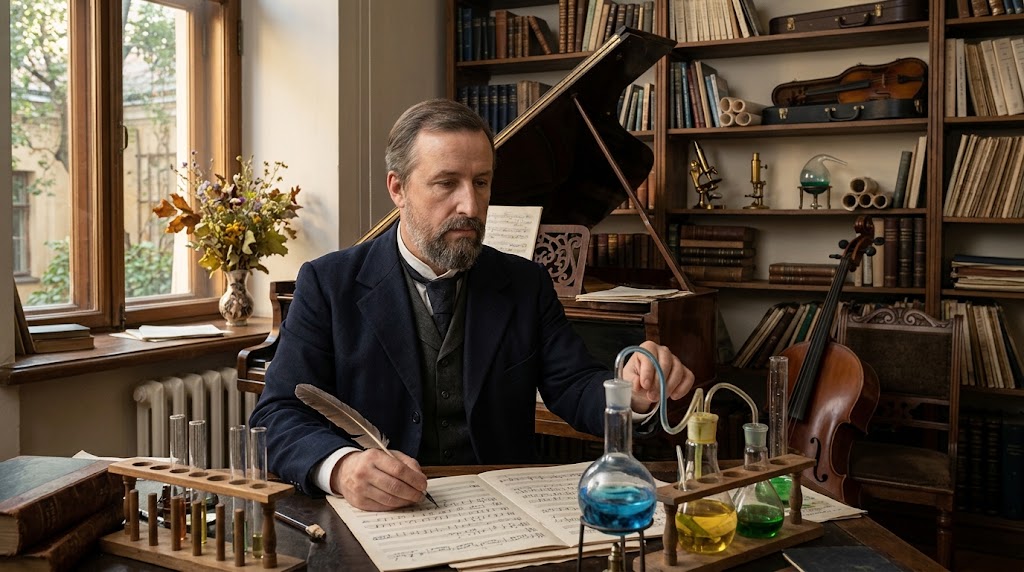
He often composed in the gaps—on weekends, in the evenings, and even when illness kept him at home. His friends reportedly joked that they hoped he would catch a cold, because a sick Borodin meant new music.
He was also part of “The Five,” a group of Russian composers who sought to develop a distinctly Russian musical style. Although he left behind a relatively small body of work, music remained an important creative outlet alongside his scientific career. His String Quartet No. 2 is one of his most memorable works.
A Melody That Sings
Written in 1881, the quartet features a luminous Nocturne, its third movement and one of Borodin’s best-known pieces.
It opens with a long, singing theme in the cello, soon taken up by the first violin, making the quartet feel more like a conversation than a soloist with accompaniment. As you listen, notice how naturally the music unfolds, with phrases that breathe and linger, giving the piece warmth and space.
Borodin could hardly have known how far his creations would travel. More than seventy years after his death, the soaring line of the Nocturne was adapted for the 1953 Broadway musical Kismet, becoming the song “And This Is My Beloved.
When One Life Holds More Than One Thing
Borodin’s story invites us to consider how easily we put people into categories. We may think of someone as a teacher, scientist, parent, artist, or musician—as though one word could explain the whole person. But most lives are more complex than that.
Our lives can hold more than one calling, and some gifts emerge in unexpected ways. Borodin shows that we do not have to choose between being a scientist and a composer for both to matter.
“Whatever you do, work at it with all your heart, as working for the Lord.” — Colossians 3:23
Our work may take many forms, and not every gift will become our profession. But God can use the different parts of our lives in ways we may not see at the time.
Faithfulness is not always about finding one perfect calling, but about bringing our whole selves to the responsibilities and gifts God has placed before us.
Read previous: Charles Ives the Insurance Executive: Music Beside an Ordinary Life — The Unanswered Question