Every Season, Another Cold — What Recurring Illness Taught Me About Stewardship
A Christian reflection on immune health, practical supplements, and the theology of taking care of yourself
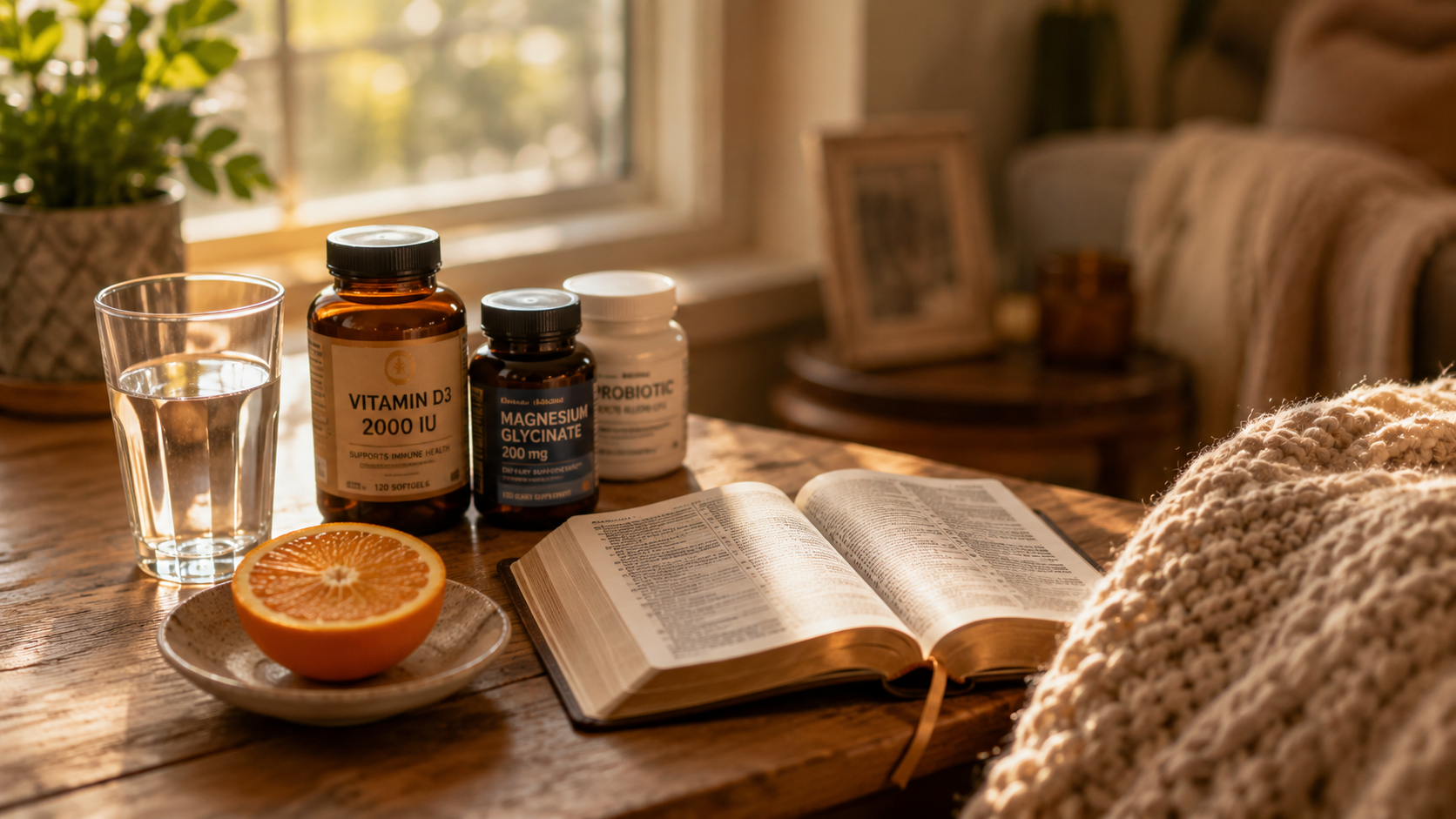 Healing often begins in quiet, ordinary places. In the warmth of home, simple acts of care—rest, nourishment, and time in God’s Word—become part of the gentle work of recovery.
I have a friend who jokes that she doesn't have four seasons — she has four colds. One for each transition: the dry heat of summer air conditioning, the first bite of autumn wind, the deep chill of winter, the tree pollen of spring. Every change in weather finds her searching for tissues.
I used to laugh with her. Then I realized I was basically describing myself.
There's something almost comically humbling about getting sick. No matter how productive or capable or spiritually disciplined you feel, a head cold strips you down to your most basic state — horizontal, foggy, dependent. And in that state, it's hard not to wonder whether you could have done something differently. Slept more. Taken your vitamins. Listened to the signal your body was sending two days before the sore throat announced itself.
I've come to believe that the recurring cold — the one that visits like an unwanted houseguest every few months — is sometimes the body's most honest form of communication. It's telling you something about how you've been living. And for those of us who follow Christ, that communication is worth paying attention to.
The Temple That Keeps Getting Drafty
"What? know ye not that your body is the temple of the Holy Ghost which is in you, which ye have of God, and ye are not your own? For ye are bought with a price: therefore glorify God in your body, and in your spirit, which are God's." — 1 Corinthians 6:19-20 (KJV)
I've heard this verse preached many times. It usually appears in conversations about sexual purity or addiction — both entirely appropriate contexts. But its logic extends further. The body is described here not as something we own and manage according to our preferences, but as something entrusted to us. A stewardship. And stewardship, by definition, implies responsibility.
We would never treat a borrowed home carelessly. We would not leave a loaned car running on empty, ignore its warning lights, and simply shrug when it broke down. Yet many of us — especially those whose lives are full of good work, ministry, family, and service — do exactly this with our bodies. We push through exhaustion as a virtue. We skip sleep to meet deadlines and call it dedication. We eat poorly and compensate with caffeine and call it a busy season.
And then we wonder why we keep getting sick.
I'm not suggesting that illness is a punishment for poor stewardship, or that healthy people are spiritually superior. Life is not that simple, and neither is the body. But I do think there's a real connection between how we tend the physical life God has given us and our capacity to do the things He has called us to do.
The drafty temple may need more than prayer. It may need a bedtime.
What the Research Actually Says About Common Supplements
Let me be straightforward: supplements are not magic. They are not a substitute for sleep, hydration, movement, and whole food. But used wisely, a few have enough research behind them to be worth considering as part of a consistent approach to immune health.
Vitamin C — the familiar one. Almost everyone has a bottle somewhere. Vitamin C is involved in multiple aspects of immune function, and it remains one of the most studied nutrients in the context of respiratory illness. The honest summary of that research is this: consistent supplementation probably doesn't prevent you from catching a cold, but it may modestly reduce how long the cold lasts and how severe it feels. Think of it less as armor and more as a recovery assistant. For most healthy adults, 500–1000mg daily is a reasonable range. Going far beyond that doesn't add proportional benefit and can cause digestive discomfort. You can also simply eat more — bell peppers, citrus, kiwi, and broccoli are all excellent sources.
Zinc — small but significant. Zinc is a trace mineral involved in immune signaling, wound healing, and cellular repair. The most consistent finding in cold-related research involves zinc lozenges taken within the first 24 hours of symptom onset — some studies suggest this can reduce the duration of a cold by a day or more. Zinc supplements taken preventively are less clearly supported, but maintaining adequate zinc through diet (meat, legumes, nuts, seeds) is genuinely important for immune resilience. Overconsumption of zinc supplements can cause nausea and, over time, interfere with copper absorption, so more is not better here.
Echinacea — the herbal option. Echinacea has been used for centuries and remains one of the most popular herbal supplements for cold and flu season. The research is genuinely mixed — some trials show modest benefit in reducing cold duration or frequency, others show little effect. The variability likely comes from differences in the plant species, preparation methods, and individual responses. If you find it helpful and have no allergies or drug interactions to consider, it's a reasonable short-term option when you feel a cold coming on. It's not a treatment, and it's not for everyone.
Vitamin D — the sunshine problem. This may be the most broadly relevant deficiency in the modern world. Vitamin D is produced in the skin through sun exposure, but the reality of contemporary life — indoor work, northern latitudes, sunscreen, limited time outdoors — means that a significant portion of the population is chronically deficient without knowing it. Vitamin D receptors are found throughout the immune system, and low levels have been associated with increased susceptibility to respiratory infections in multiple studies. The fix is straightforward: get a blood test to know where you stand, and supplement accordingly if levels are low. Most adults who are deficient benefit from 1000–2000 IU daily, though those with significant deficiency may need more under medical guidance.
 Caring for the body can be a quiet act of faith. Simple nourishment, clean water, and daily gratitude remind us to tend the temple God has entrusted to us.
But the Basics Still Come First
Here is the part that nobody wants to hear, because it doesn't involve ordering anything online: the most effective immune support is not in a supplement bottle.
It is in consistent, adequate sleep. It is in drinking enough water. It is in regular movement — not necessarily intense exercise, but the kind of daily physical activity that keeps the lymphatic system flowing and stress hormones from accumulating. It is in managing chronic stress, because cortisol, over time, directly suppresses immune function. It is in washing your hands — still, after everything, one of the single most effective tools we have for preventing the transmission of respiratory viruses.
These things are not exciting. They don't come in capsule form. They can't be ordered and delivered in two days. They require something harder: consistency, intention, and the willingness to treat your body as something worth attending to before it forces you to stop and pay attention.
"She looketh well to the ways of her household, and eateth not the bread of idleness." — Proverbs 31:27 (KJV)
The Proverbs 31 portrait of faithful, whole-life stewardship includes attending to the household — which begins, practically speaking, with the home of the Holy Spirit that we carry around with us every day.
The Spiritual Discipline Nobody Talks About
I want to suggest something that may sound strange: going to bed on time is a spiritual discipline.
So is eating a real meal instead of skipping it. So is choosing to rest on a Saturday instead of grinding through another to-do list. So is recognizing the early signs of illness and slowing down rather than pushing through and making yourself sicker for three weeks.
"He giveth power to the faint; and to them that have no might he increaseth strength." — Isaiah 40:29 (KJV)
God gives strength to the weary. But there is a difference between the weakness that comes from faithful expenditure in God's service — which He meets with renewed strength — and the depletion that comes from chronic self-neglect dressed up as dedication. One is sacrifice. The other is poor stewardship.
Jesus withdrew. Repeatedly. He went to desert places, to hillsides, to the other side of the lake. He slept in a boat during a storm. The God who holds the universe was not too busy to rest. He modeled something for us in that, and we would do well to take the lesson seriously.
A Practical Note Before You Go
If you're thinking about adding supplements to support immune health, here are a few grounded suggestions.
Start with Vitamin D — get a blood test first if you can, and supplement to reach a healthy range rather than guessing. Add Vitamin C as a consistent daily baseline, preferably from food where possible. Consider zinc lozenges to have on hand for the first sign of a cold. Approach Echinacea as a short-term option if you find it useful, not as a daily staple. And if you are pregnant, nursing, managing a chronic condition, or taking prescription medications, please speak with your doctor before starting anything new.
Supplements are tools, not miracles. Use them wisely, as part of a larger commitment to the whole-life health that God has entrusted to your care.
 Sometimes caring for the body begins with the simplest gifts: sunlight, stillness, and a grateful heart. In the quiet warmth of an autumn morning, rest becomes a small act of stewardship before God.
A Prayer for the Perpetually Tired
Lord, I have not always treated this body as something that belongs to You.
I've run it hard and rested it rarely and then been surprised when it gave out on me. I've called exhaustion faithfulness and called burnout dedication, and I'm not sure You were convinced by either.
Teach me to steward this life with the same care I'd give to something sacred — because it is.
Give me wisdom about what this body needs. Give me the humility to actually provide it. And when illness comes anyway — as it sometimes will — let me find even in that a reminder of my dependence on You.
Thank You for the body You gave me. Help me not to waste it.
Amen.
This article is for general informational and devotional purposes only. It is not medical advice and does not replace consultation with a qualified healthcare provider. If you have underlying health conditions or take prescription medications, please speak with your doctor before using any supplements.