Is My Faith Just Wishful Thinking? — William Lane Craig's Reasonable Faith
Isn't faith just believing something you can't actually prove?
It's the question that shows up uninvited — not in a classroom, but at 2am, staring at the ceiling, or across a table from someone you love who's stopped believing and wants to know why you haven't. You say the word "faith" out loud and it sounds, even to your own ears, like a nicer word for guessing. You've prayed the same prayer for years without proof it landed anywhere. You've defended what you believe in conversations where the other person had footnotes and you had a feeling. Somewhere along the way it starts to feel like the adults in the room get evidence, and you get a leap in the dark.
That unease doesn't come from weak faith. It comes from a real, fair question — one most people are never given permission to actually sit with, because the standard church answer arrives too fast: just believe. But "just believe" was never going to satisfy a mind that was built to ask why.
Why Faith and Reason Kept Him Up at Night
Long before he was known as one of the most recognized defenders of Christianity alive, William Lane Craig was a philosophy student who took the objection seriously — because he wasn't naturally inclined to take much on faith at all. He came to Christian belief as a teenager, but the conviction didn't settle the intellectual account. It opened one.
He went on to study philosophy formally, eventually earning doctorates in both philosophy and theology in England and Germany, in fields where doubt isn't discouraged — it's the whole method. He sat across from professors and peers who assumed serious thinkers had already left religious belief behind, and instead of retreating from that room, he stayed in it.
What Craig didn't do was lower the bar for himself. He didn't settle for private certainty that couldn't survive a public conversation. He wanted an answer he could give a philosopher, not just a congregation — arguments for God's existence that held up under cross-examination, a case for the resurrection built the way a historian builds a case, not the way a sermon does. He spent decades in cosmology, probability theory, and ancient history, not to escape the question but to actually answer it.
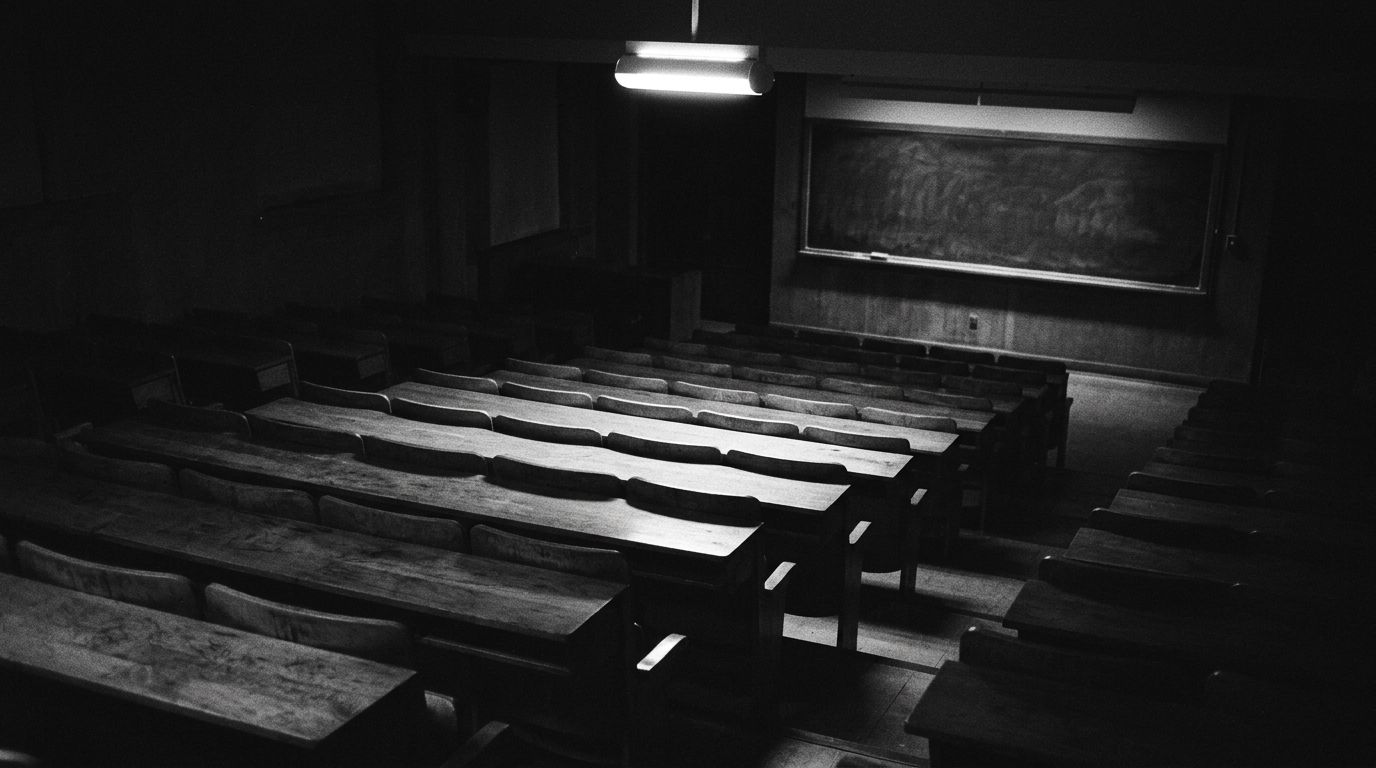 An empty lecture hall at night, the kind of quiet room where faith and reason have always had to answer to each other.
Faith Isn't the Absence of Reasons
What Craig arrived at isn't a trick or a debate-winning maneuver. It's a reframe of the question itself: faith was never meant to be belief without reasons — it's trust that rests on reasons, the way you trust a bridge because it's engineered, not because you've turned off your brain to walk across it. He calls his approach "positive apologetics" — building a case strong enough that it doesn't need to spend all its energy fighting off every other worldview one at a time. As Craig puts it, a case that's genuinely sound and persuasive tends to outweigh the competition on its own, without you having to become an expert in every alternative first.
Sit with that for a second. What would change in your own doubt — not erase it, but change it — if you let yourself believe the question deserved an actual answer instead of a hush?
I came to faith as a teenager, in the middle of a season hard enough that it felt less like a decision and more like a gift I was given. But somewhere in the years after, that faith went quiet — not gone, just numb — and I didn't have the words for what was missing until I realized I'd never let it be questioned. This book was the first place that showed me doubt and reasoning weren't threats to that faith; they were actually how it could hold.
Reasonable Faith isn't built like a devotional you drift through — it moves the way a lawyer builds a case, one supporting argument at a time, each chapter picking up where the last one set its foundation. What it keeps circling back to is deceptively simple: that belief in God isn't a retreat from thinking clearly, that the universe having a beginning still asks a real question about a cause, that the historical evidence surrounding Jesus's resurrection can be weighed the same way any other ancient event gets weighed — and that Christianity holds up when it's examined rather than simply asserted. Craig draws from an unusually wide table — cosmology and the origins of the universe, the philosophy of religion, ancient historical method, and his own years of formal debate with skeptics who weren't interested in being polite. It tends to find people at a specific moment: the semester their faith got challenged in a lecture hall, the argument with a brother-in-law that ended in silence, the quiet realization that they've never actually examined what they claim to believe.
If you're curious, it's the kind of book worth keeping close by for the next hard conversation — find Reasonable Faith here (Affiliate Link).
Is Reasonable Faith by William Lane Craig hard to read for beginners?
Honestly, yes, in places — I won't pretend otherwise. Some chapters lean academic, especially the ones on cosmological argument or historical method, and I found myself rereading paragraphs. But it's written for someone willing to work, not someone with a philosophy degree already in hand.
What is William Lane Craig's main argument for God's existence?
He builds several, but the one that stuck with me most is the case that the universe had a beginning — which raises the real question of what could cause something to begin without itself needing a beginning. He walks through the reasoning slowly enough that you don't need a science background to follow it.
Does Reasonable Faith address the resurrection of Jesus?
Yes, and it's one of the strongest sections in the book for me personally. Craig treats the resurrection as a historical claim to be weighed with historical evidence, not just a doctrine to be affirmed, which changed how I talk about it with people who don't share my faith.
Is it normal to doubt your faith even if you're a committed Christian?
In my experience, more normal than anyone talks about openly. I've had seasons where doubt felt like betrayal, and this book was one of the first things that helped me see doubt as an invitation to look closer, not a sign I was failing.
📚You Might Also Like
I Thought It Was My Faith. It Never Was. — Basic Christianity
Have You Ever Wanted to Believe But Just… Couldn't? — The Reason for God
You Already Know Right from Wrong. Have You Ever Asked Why? — Mere Christianity