Putting On the Full Armor of God, Piece by Piece
Paul does not say put on some of the armor. He says all of it.
That word matters. When he writes "put on the full armor of God," he is warning against a piecemeal approach — grabbing the pieces you like and leaving the rest in the tent. A soldier with a shield but no breastplate is still exposed. A soldier with a sword but no belt watches his gear come loose mid-fight. The armor is a set, designed to work together, and the protection comes from wearing the whole thing.
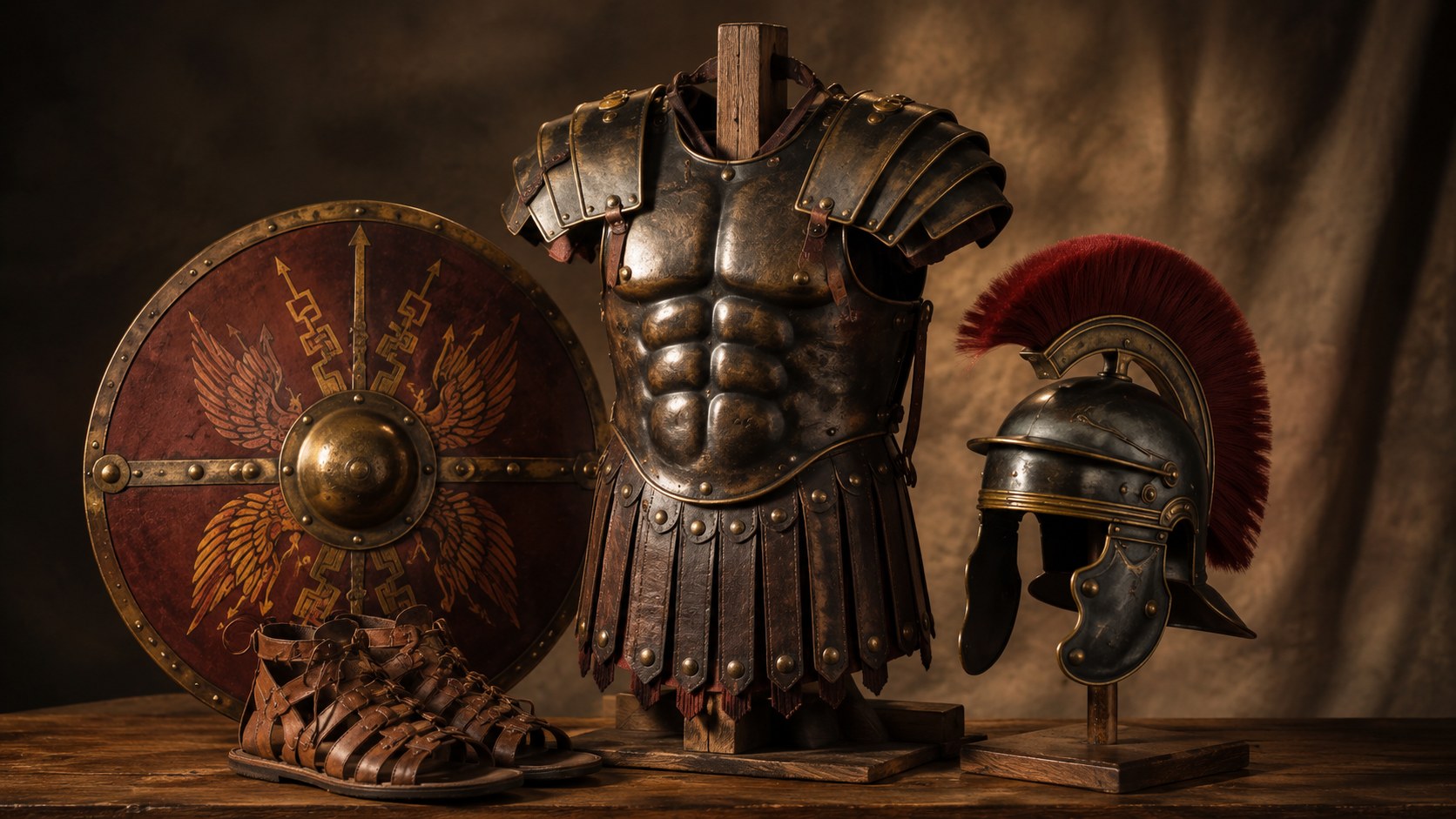
So let's put it on the way Paul lays it out — in order, piece by piece, with an eye on what each one is actually for.
The command behind the full armor of God
The instruction comes twice, like bookends:
"Put on the full armor of God, so that you can take your stand against the devil's schemes." (Ephesians 6:11)
"Therefore put on the full armor of God, so that when the day of evil comes, you may be able to stand your ground." (Ephesians 6:13)
Notice the goal both times: to stand. The full armor exists so you can hold your ground. If you want the wider picture and the history behind it, work through the armor of God as a whole. Here, the focus is the assembly — putting each piece on, in turn.
Piece 1: the belt of truth
You start with the belt, because everything else fastens to it. "Stand firm then, with the belt of truth buckled around your waist" (Ephesians 6:14). Putting on the belt means anchoring your day in what is real — about God, about yourself, about your situation — and refusing the lies that try to loosen everything else. There is more to this load-bearing first piece than it seems; here is the belt of truth on its own.
Piece 2: the breastplate of righteousness
Next comes the breastplate, over the heart. Putting it on means resting in the righteousness Christ gives and choosing to live rightly today. It guards the place every other thing flows from. When accusation comes for your heart, the breastplate is what it strikes instead of you.
Piece 3: feet fitted with the gospel of peace
"And with your feet fitted with the readiness that comes from the gospel of peace" (Ephesians 6:15). Roman soldiers wore studded sandals that gripped the ground. Putting on the shoes of peace means standing on the settled fact that you are at peace with God, so you do not lose your footing when things get slippery. Peace under your feet is what keeps you upright in the push and shove of a hard day.
Piece 4: the shield of faith
"Take up the shield of faith, with which you can extinguish all the flaming arrows of the evil one" (Ephesians 6:16). The large Roman shield could be locked together with others or soaked in water to quench fire-arrows. Putting on the shield means actively trusting God in the face of incoming doubt, fear, and accusation. It is not a feeling that arrives on its own; it is a thing you "take up," deliberately, when the arrows start to fly.
Piece 5: the helmet of salvation
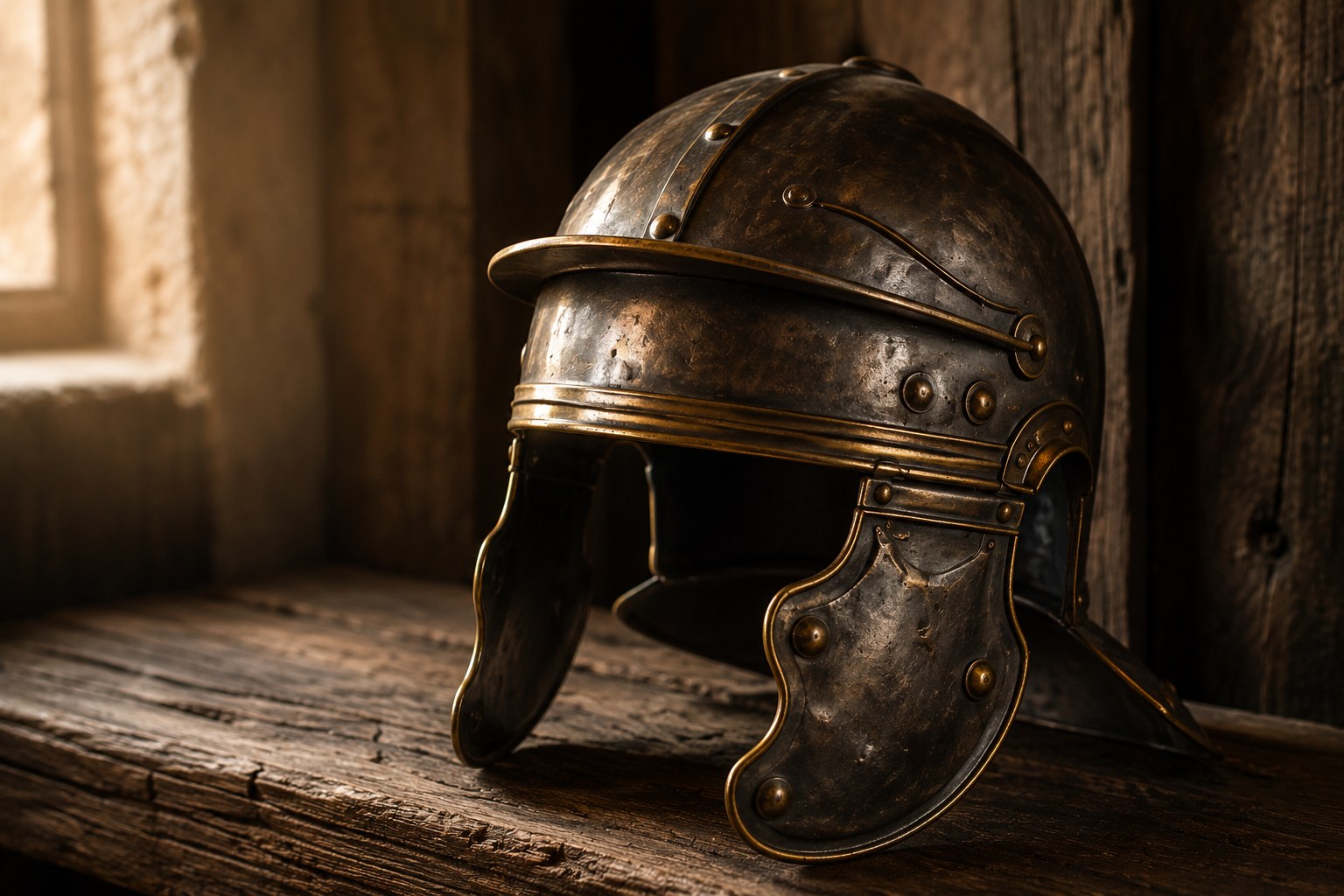
The helmet guards the head — the mind. "Take the helmet of salvation" (Ephesians 6:17). Putting it on means letting the certainty of your salvation govern your thinking, especially when despair tries to take the wheel. When you know whose you are and where you are headed, hopelessness has a much harder time getting a grip on your mind.
Piece 6: the sword of the Spirit
Finally, the only offensive piece: "the sword of the Spirit, which is the word of God" (Ephesians 6:17). Putting on the sword means keeping Scripture close enough to use — read, remembered, ready — so you can answer a lie with the truth, the way Jesus did in the wilderness. The full treatment of the sword of the Spirit is worth your time, because it is the piece most of us pick up the least.
And then: stand
Here is what Paul does not say after the sword. He does not say "now charge." He says pray, and stand. The armor is assembled so that you can hold your ground "and after you have done everything, to stand" (Ephesians 6:13). The whole kit serves that one verb. You put it all on not to conquer the world by force but to remain standing when the day of evil tries to knock you down.
What a gap in the armor looks like
Paul's insistence on the full armor makes more sense when you picture what happens without it. A gap is not abstract. It shows up as a specific, predictable vulnerability.
Take the believer who loves the sword but neglects the belt — strong on Scripture, loose with honesty. They can quote verses all day, but a thread of self-deception runs through their life, and sooner or later it pulls everything loose. Or the one who trusts God genuinely but tolerates a private compromise, breastplate set aside; they survive the easy seasons and get wounded in the heart the moment real pressure comes. Or the person with truth and righteousness in place who never picks up the shield — solid character, but undone by fear, because they keep absorbing arrows they were equipped to extinguish.
In each case the gap is exactly where the missing piece would have gone. That is not coincidence; it is the whole logic of armor. Protection is only as complete as its weakest point. This is why "put on the full armor" is not perfectionism — it is realism. The enemy does not attack you where you are strong. He looks for the piece you left in the tent.
The encouraging flip side: you usually know your own gap. The piece you are tempted to skip, the area you would rather not examine — that is precisely where to start putting the armor on with intention.
What putting on the full armor teaches
1. You can't pick and choose
The pieces protect different things. Skip one and you leave a gap exactly there. The believer who loves truth but neglects faith, or trusts God but tolerates dishonesty, has armor with a hole in it. The strength is in the whole set.
2. Putting on is an action, repeated
Every piece in Paul's list is something you actively do — buckle, take up, take. None of it happens by drifting. You put the armor on the way you get dressed: on purpose, each day, before you head out.
3. The aim is to stand, not to win by force
For anyone worn out by the idea of constant spiritual combat, this is rest. You are not asked to defeat the powers; Christ already did. You are asked to stay on your feet, in his strength.
4. Borrowed strength holds when yours runs out
The armor is God's before it is yours. On the day your own resolve fails — and it will — the pieces are still made of something stronger than you. That is the point of wearing armor instead of relying on skin.
A prayer for putting on the full armor
Lord, I don't want to wear just the pieces I like. Clothe me in the whole armor today. Buckle truth around me, cover my heart with Christ's righteousness, steady my feet with your peace. Put the shield of faith in my hand against every flaming arrow, guard my mind with salvation, and ready your word on my lips. I'm not assembling this to conquer; I'm putting it on so I can stand. When the day of evil comes, hold me upright in your strength. In Jesus' name, Amen.
Frequently asked questions about the full armor of God
What is the full armor of God?
It is the complete set of six spiritual protections Paul describes in Ephesians 6:10-18 — the belt of truth, breastplate of righteousness, shoes of peace, shield of faith, helmet of salvation, and the sword of the Spirit. "Full" stresses that believers are to put on all of it, not select pieces.
What order do you put the armor on?
Paul lists it roughly head to toe and in the order a Roman soldier would dress: belt, breastplate, shoes, shield, helmet, then the sword. The order isn't a rigid rule, but starting with the belt of truth makes sense because the other pieces depend on it.
Why does Paul say "full" armor?
Because the pieces protect different areas and work as a set. Leaving one off creates an exposed gap. The completeness is the point — partial armor leaves you partially defended.
What is the goal of putting on the full armor?
To "stand firm." Paul repeats the word "stand" throughout the passage. The armor is for holding your ground against evil, not for launching attacks — the Christian's main task is to remain standing in God's strength.
How often should I put on the armor?
Daily, as an ongoing practice. Each piece is something you actively "put on," which suggests a deliberate, repeated habit rather than a one-time event — most naturally done through morning prayer.
Read the full passage at Bible Hub or compare translations at Bible Gateway.