Rachmaninoff’s Prelude in C-sharp Minor: From the Practice Room to the Playing Field

A pianist returns to the same few measures. A basketball player practices free throws again and again. Progress may be hard to see, but each attempt offers another chance to improve.
Sergei Rachmaninoff’s Prelude in C-sharp Minor, Op. 3, No. 2, offers a way to explore how music, like sports, calls for more than technical skill. Control, careful listening, and expressive judgment develop through patience and practice.
The Music Behind the Practice
Rachmaninoff was just nineteen when he composed the prelude in 1892. It became one of his best-known early works, beginning with solemn, bell-like chords before moving into a faster, more energetic middle section. The powerful opening theme returns later with greater intensity.
Each section presents a different challenge, from producing rich, resonant chords to maintaining control in the faster passages. Beyond playing the right notes, the pianist must shape the phrases to bring out the music’s character and emotion.
What Musicians and Athletes Have in Common
A pianist working through a difficult passage and an athlete refining a movement face a similar task. Both must recognize what needs improvement, break a complex skill into manageable parts, and practice with attention.
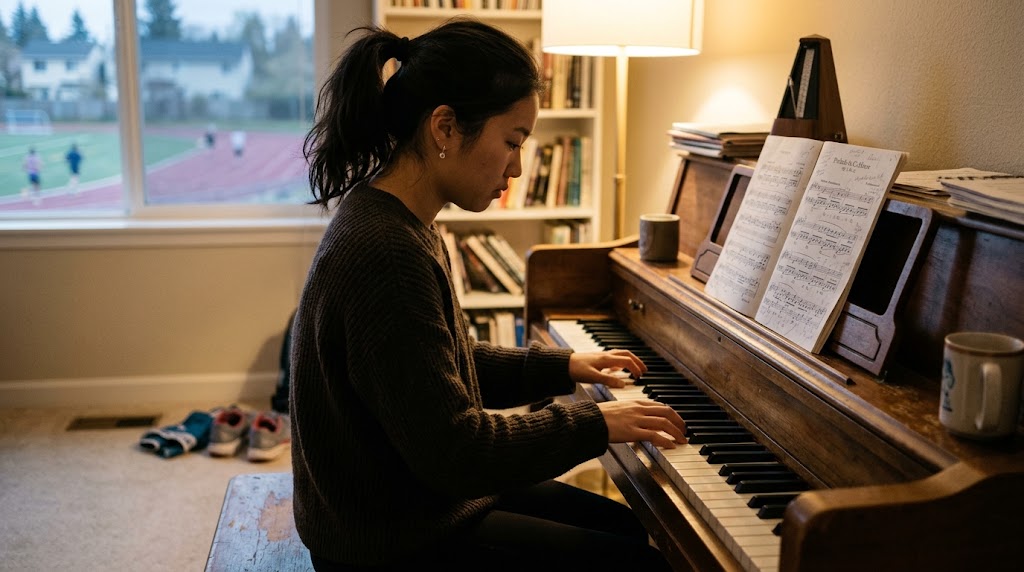
Progress rarely happens all at once. A passage that feels awkward today may become more comfortable after several days of work. A swimmer may need many practice sessions to refine a stroke and improve efficiency. In both cases, improvement depends on noticing small details and making adjustments.
Repetition alone, however, is not enough. Musicians and athletes need to pay attention to what is working, recognize mistakes, and change their approach when necessary. Over time, these small corrections can add up to meaningful progress.
The Value of Steady Effort
It is easy to measure our efforts by visible results, especially when progress seems slow or others appear to advance more quickly. Yet growth often begins long before it becomes obvious. Each careful attempt can build understanding, control, and patience, even when the results are not immediately apparent.
“Let us run with perseverance the race marked out for us.” — Hebrews 12:1
The writer of Hebrews uses the image of a race to describe the Christian life, emphasizing the perseverance needed to keep going. Whether learning a musical passage or developing an athletic skill, progress takes time, continued effort, and a willingness to keep learning.
Rachmaninoff’s prelude shows how practice can turn technique into expression. In music and sports alike, progress takes patience and persistence.
Explore Rachmaninoff’s complete piano preludes here. (affiliate link)
Read previous: Richard Strauss’s Don Juan, Op. 20: How an Orchestra Tells a Story