The Architecture of Grace: What Barcelona’s 2011 Masterclass Teaches Us About Divine Order (Part 1)
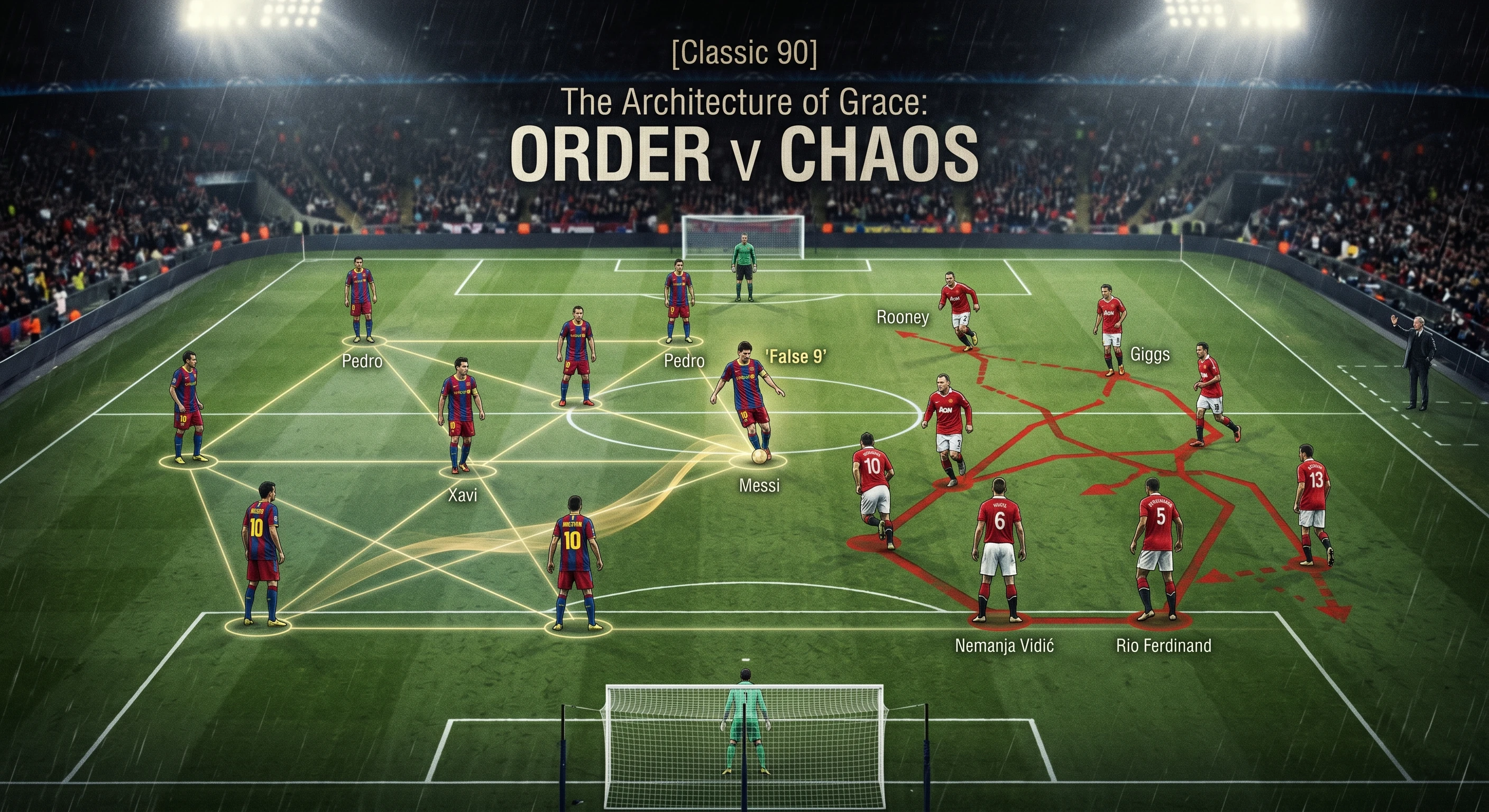
Wembley Stadium. May 28, 2011. The Champions League Final.
When Manchester United and FC Barcelona walked onto the pitch, it wasn't just a football match; it was a collision of two vastly different ideologies. Manchester United, led by Sir Alex Ferguson, represented the ultimate triumph of human will. They were built on relentless grit, history, and a furious desire to win.
But Pep Guardiola’s Barcelona brought something entirely different to London. They brought a philosophy. They didn't come to fight United; they came to subject them to a flawless mathematical and spatial system known as Juego de Posición (Positional Play).
Over the next 90 minutes, Barcelona dismantled one of the greatest English teams in history, winning 3-1. It was a performance so dominant that it left the footballing world in awe. But beyond the beautiful passing, Barcelona’s 2011 masterclass offers a breathtaking spiritual metaphor for how we understand Divine Order, Obedience, and True Freedom.
1. The Discipline of Staying in Your Position
To understand why Barcelona was so terrifying, you have to understand the core rule of Positional Play. In most football teams, when a player has the ball, his teammates frantically run toward him to help. It looks like hard work, but it creates chaos and drags defenders into the space.
Guardiola taught his players the exact opposite. He drew imaginary lines on the training pitch and gave them a strict command: Do not chase the ball. Trust the system, stay in your assigned zone, and the ball will find you. Players like Xavi, Iniesta, and Pedro were heavily disciplined to maintain their specific coordinates on the pitch. They formed perfect triangles. They stretched the pitch as wide as possible. They didn't run around trying to be the hero everywhere; they humbly submitted to the architect's design.
The Spiritual Reflection: The Beauty of Divine Order
How often do we live our spiritual lives like a chaotic football team? When a crisis hits, or when we desperately want a blessing, we abandon our "position." We run around frantically, trying to force doors open, trying to do someone else's job, or stepping outside of the boundaries God has drawn for us. We think that exhausting ourselves is proof of our faith.
But 1 Corinthians 14:33 reminds us, "For God is not a God of disorder but of peace." Barcelona's dominance was built on the theology of order. When you submit to the Architect's design—when you faithfully stay in the specific lane, career, or ministry God has called you to, even when it feels like you aren't touching the ball—you stretch the "pitch" of your life. You create space for God to work. Obedience to your position is what allows the grace (the ball) to eventually flow directly to your feet.
2. The Paradox of the "False 9": Submission Creates Freedom
Because ten Barcelona players strictly obeyed their positional boundaries, it created an astonishing phenomenon. It unlocked absolute, terrifying freedom for one man: Lionel Messi.
Messi played as a "False 9." Instead of standing up front with the bruising Manchester United defenders (Nemanja Vidić and Rio Ferdinand), Messi would drop deep into the midfield. Because the other Barcelona players stayed wide in their exact positions, the United defenders couldn't follow Messi without leaving massive holes in their defense. Messi was granted the freedom to roam the pitch, finding the exact pockets of space to orchestrate the destruction of United. He scored a brilliant goal and dictated the entire reality of the game.
The Spiritual Reflection: Freedom Through Boundaries
Modern secular culture preaches a very specific lie: Rules and boundaries destroy your freedom. Society tells us that to be truly free, you must reject all authority, abandon all structure, and just run wherever your desires take you.
But the 2011 Champions League final proves the opposite. Absolute chaos does not create freedom; it creates a mess. Lionel Messi was the most free, creative, and joyful player on the planet that night precisely because the environment around him was governed by strict, unyielding rules.
In the Kingdom of God, true freedom is not the absence of boundaries. As Jesus said in John 8:31-32, "If you hold to my teaching... the truth will set you free." Spiritual freedom is the beautiful byproduct of submitting to God's order. When a community (the team) operates within the loving boundaries of God's Word, it creates a safe, expansive space where individual believers (like Messi) can freely exercise their unique gifts without being destroyed by the enemy's defense.
The Halftime Whistle
By the end of the match, Barcelona had held an absurd 63% possession. They hadn't just beaten Manchester United; they had starved them of the ball and of hope.
As captured in The Guardian's official post-match report, a visibly shaken Sir Alex Ferguson sat in the press conference and uttered a quote that would echo through history: "In my time as a manager, I would say they're the best team we've faced. No one has given us a hiding like that."
Ferguson, the ultimate master of control, had encountered a system of order so perfect that his own hands were seen visibly trembling on the touchline during the match.
But what happens when this cold, calculating, flawless tactical machine wins the ultimate prize? Does it remain a soulless mathematical equation? In Part 2, we will look at the exact moment the final whistle blew. We will witness how this strict architecture of tactics gave birth to the most breathtaking act of human empathy and Christian love in the history of the Champions League.