The Deeply Formed Life by Rich Villodas— Are You Just Going Through the Motions?
What if busyness isn't just a scheduling problem, but a spiritual one?
You prayed this morning. Or you meant to. You opened your Bible app, got three verses in, and then your phone lit up with something else. By 9 a.m. you were already behind.
That quiet ache of distance — not from faith exactly, but from something deeper — is hard to name. You still believe. You still show up. But you wonder sometimes if something essential has gone missing, buried under the pace of it all. The apostle Paul calls it transformation: "Do not be conformed to this world, but be transformed by the renewing of your mind" (Romans 12:2). And yet the world seems to have won the morning again.

He grew up in Brooklyn, son of a Puerto Rican Pentecostal family, in a church where feeling God was the whole point. Emotion was proof. Volume was evidence. Rich Villodas knew how to raise his hands in worship and preach a sermon that left people weeping in the aisle.
And yet, in his thirties, leading one of the most diverse churches in New York City — seventy-five nations under one roof in Queens — something started to fracture inside him. Not his theology. Not his calling. Something quieter. He was doing everything right, and running on empty. His inner life was a blur he couldn't slow down long enough to see.
He started sitting with silence. Not the comfortable silence of a worship set winding down, but the threatening kind — the kind that reveals what's actually there when you stop performing. He started reading the desert fathers. He began to understand that the ancient church had practices — rhythms, disciplines, interior habits — that his tradition had mostly lost. And slowly, painfully, the frantic outer life began to have an inner counterpart.
It didn't look like revival. It looked more like rest. Like a man learning, for the first time, to be present to the God he had been preaching about for years.

"The speed we live at does violence against our souls. The inner and outer distractions minimize our capacity to see God's activity around and within us."
— Rich Villodas
That's the line I couldn't shake. Not because it's dramatic, but because it named something I'd felt without knowing what to call it. What if the problem isn't that God feels distant — but that we're moving too fast to notice he's near? What does it mean for you, specifically, to slow down enough to actually be formed?
I'll be honest: I picked this up expecting another book about spiritual disciplines. I didn't expect it to quietly unmake me. Something about reading it made me realize I'd been a Christian for years without ever really learning how to be still.
Inside the Book
What this book covers
The book unfolds across five values — Contemplative Rhythms, Racial Reconciliation, Interior Examination, Sexuality and Wholeness, and Missional Presence. Each value gets two chapters: one that builds the theological foundation, and a companion chapter of actual practices. So you're never left holding an idea without knowing what to do with it.
The heart of it
Villodas's central argument is quietly devastating: most of us are being shaped — just not by Christ. We've been formed by the pace of our culture, by its need for productivity and noise and constant motion, and we've mistaken that formation for faithfulness. Sabbath, he insists, isn't something you earn after a hard week. It's a gift that precedes work, the same way grace precedes effort. And until we learn to receive it, we'll keep giving out of nothingness. He pushes further, too — into the things many books skip. Race. Sexuality. The inner emotional life we've compartmentalized so carefully. None of it is separate from formation. All of it is the terrain where Christ is either transforming us or not.
What he draws from
Villodas draws on a wide and surprising range of voices: the desert fathers and monastic tradition, Pete Scazzero's work on emotional health, Parker Palmer on burnout and the self we try to give from, the Psalms, Paul's letters, John's Gospel, and stories from his own Queens congregation — one of the most racially diverse churches in America. The breadth never feels eclectic. It feels like someone who has actually lived what he's writing about.
Who this is for
If you've been faithful for years and still feel like something's missing, this will name what you've been circling. If ministry has hollowed you out and you can't explain why, this reads like water. And if you've wanted a faith that engages race, emotion, and sexuality with honesty rather than defensiveness — this is one of the rare books that does all three without flinching.
The book is called The Deeply Formed Life, by Rich Villodas — and it's the kind of thing you give to a friend when words feel insufficient.
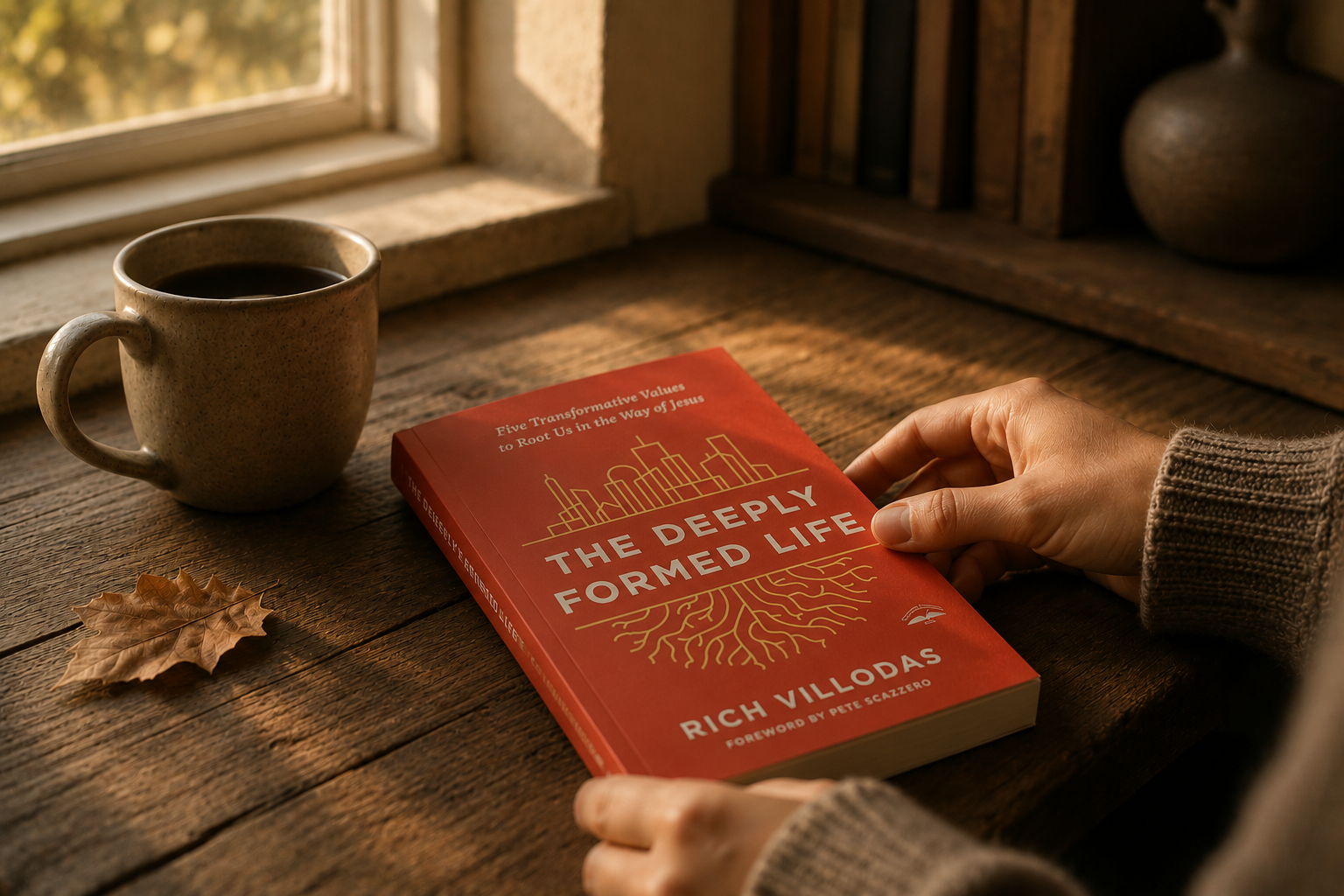
If you'd like to read it: The Deeply Formed Life — Amazon (Affiliate Link)
📚You Might Also Like
The Paradox of Love: Why a "No" is the Kindest "Yes" — Boundaries
The Spear You Don’t Throw Back: A Masterclass in Radical Silence — A Tale of Three Kings
You're Not Too Busy. You're Just Hurrying — The Ruthless Elimination of Hurry