The People’s Club: How a Methodist Sunday School Birthed Everton FC; Part 2: Breaking the Holy Huddle and the Theology of the Open Door
By the autumn of 1879, the experiment at St. Domingo Methodist New Connexion Church had become a runaway success. What started as a simple winter distraction for a few Sunday School boys had transformed into a formidable footballing force. The “St. Domingo boys” were playing with such a ferocious, disciplined joy that the entire district was beginning to notice.
But with success came a profound crisis of identity. It is a crisis that every growing organization—and every healthy church—eventually faces: The Dilemma of the Outsider.
1. The Queen’s Head Hotel: A Theological Crossroads
The problem was simple: people who had never stepped foot inside St. Domingo Church wanted to play for the team. Local workers, boys from other denominations, and secular neighbors were knocking on the door.
The church leadership was at a crossroads. Do they keep the team exclusive to protect their “Holy Huddle”? Do they use the team as a rigid recruitment tool, forcing everyone to attend their specific services first? Or do they throw the doors open and risk losing their specific “Christian” label?
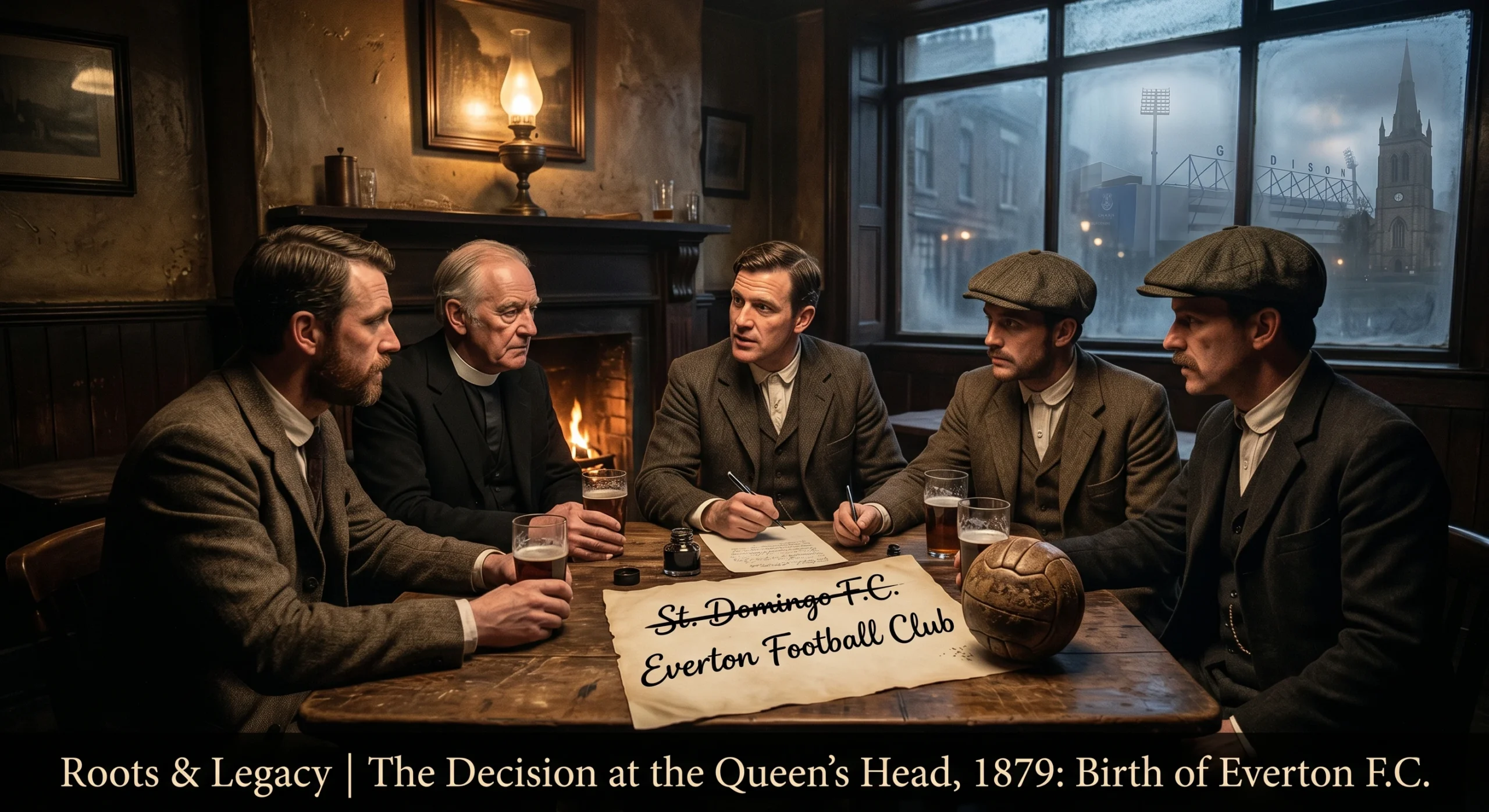
In November 1879, the club’s members met in the Queen’s Head Hotel on Village Street. It was here that the most important decision in the club’s history was made. As recorded in Everton’s official historical archives regarding their formation, they chose Inclusion.
To ensure that the club belonged to the entire community and not just one congregation, they made the ultimate sacrifice: they stripped the church’s name from the club. They renamed it after the local district so that everyone, regardless of their background, could feel a sense of ownership.
St. Domingo FC died that night. Everton Football Club was born.
2. The Spiritual Reflection: Salt and Light
This decision at the Queen’s Head Hotel is a breathtaking real-world application of the “Salt and Light” theology found in Matthew 5:13-16.
Jesus famously told His followers that they were the “salt of the earth.” But salt is utterly useless as long as it stays inside the saltshaker. It only fulfills its purpose when it is poured out and rubbed into the meat to preserve and flavor it.
By dropping the name “St. Domingo,” the church was essentially pouring the salt out of the shaker. They recognized that for their influence to truly “flavor” the city of Liverpool, they had to stop worrying about their own branding and start worrying about the people. True ministry is often about losing your name so that others can find theirs. When a church is willing to let go of its control, it often gains a legacy that changes the world.
3. The Legacy: St. Luke’s and the “People’s Club”
The spirit of those Methodist founders never truly left the club. Even today, Everton is famously known as “The People’s Club”—a nickname popularized by David Moyes, but rooted in 1879.
Perhaps the most visible sign of this legacy is St. Luke’s Church, which stands literally inches away from the corner of Goodison Park. It is one of the most unique sights in world football—a Premier League stadium and a house of God sharing a fence. On match days, the church opens its doors to fans, providing tea, a place to gather, and a reminder of where it all began.
The Final Whistle Everton FC wasn’t just a football team that happened to start in a church. It was a theological experiment that proved that when a group of believers decides to fiercely love and practically serve their neighborhood, the result can be something immortal.
The next time you see the “Toffees” take the pitch, remember the boys from the Sunday School and the men in the Queen’s Head Hotel. They taught us that the greatest way to honor the “St. Domingo” within us is to be willing to give up the name for the sake of the people.