What Is the Armor of God? A Plain-English Explanation
If you have heard people talk about "putting on the armor of God" and quietly wondered what they actually mean, you are in good company.
It sounds dramatic. A little intense, maybe. The phrase shows up in sermons and song lyrics and bumper stickers, usually without anyone stopping to explain it. So let's slow down and answer the plain question directly. What is the armor of God, really — and why did the Bible reach for a soldier's gear to describe the inner life of a believer?
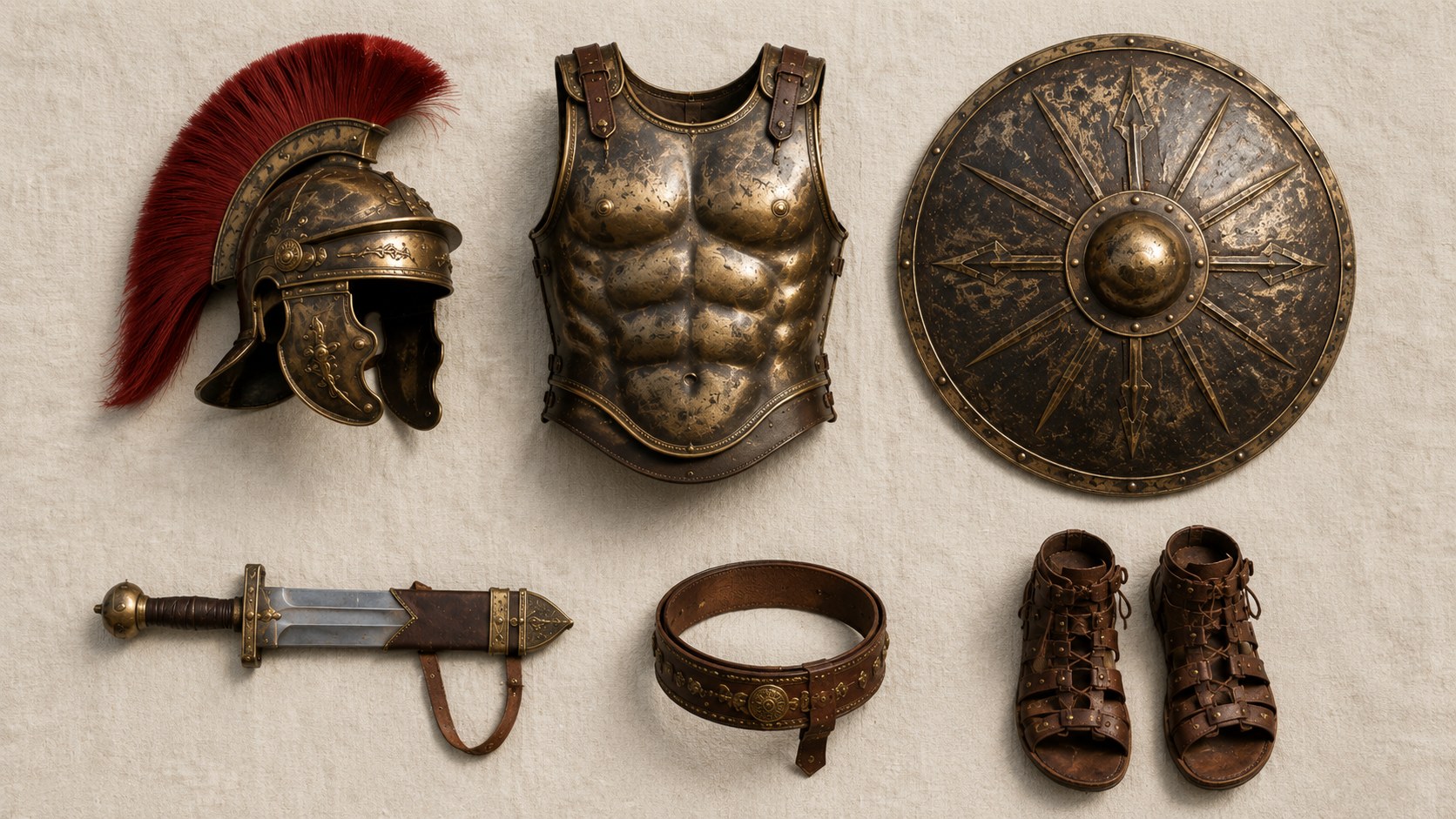
No jargon. No assumptions. Just the picture, where it came from, and what it is for.
So what is the armor of God?
What is the armor of God in one sentence? It is a metaphor — a comparison — that the apostle Paul uses to describe the spiritual protection God gives Christians, by picturing it as the equipment of a soldier dressed for battle.
That word, metaphor, matters. Paul is not describing literal armor you can buy or forge. He is taking something his readers saw every day — a Roman soldier in full kit — and using it to make an invisible reality easier to picture. The protection is real. The breastplate is a comparison.
The whole idea sits in one passage:
"Put on the full armor of God, so that you can take your stand against the devil's schemes." (Ephesians 6:11)
If you want the deep dive after this — every piece, the original-language details, the history — there is the complete guide to the armor of God. This page is the on-ramp.
Why a soldier? The story behind the image
Here is a detail that makes the whole thing click. Paul wrote the letter to the Ephesians from prison, most likely under house arrest in Rome, where he was guarded by Roman soldiers around the clock.
Picture him dictating this letter with a legionary standing right there — belt, breastplate, shield, the works. Scholars have long suggested that the soldier in front of him became the living illustration. The very thing chaining him became the picture of freedom and protection in Christ. There is a quiet irony in that, and Paul would have felt it.
So the image was not invented in the abstract. It was sitting in the room.
The six pieces, in plain terms
Paul lists six items in Ephesians 6:14-17. Here is what each one stands for, stripped down to the essentials.
The belt of truth. Living honestly, anchored in what is real about God and yourself. It is the piece that holds the others in place.
The breastplate of righteousness. Being made right with God, and choosing to do right. It guards the heart.
Shoes of peace. The steady footing that comes from knowing you are at peace with God.
The shield of faith. Trust in God that absorbs the doubts and accusations thrown at you.
The helmet of salvation. The assurance of being saved, protecting your mind from despair.
The sword of the Spirit. The word of God — the one piece you use to push back, not just block.
That is the whole set. Six pieces, each a different way God protects and equips a person who belongs to him.
The most common misunderstanding
A lot of people hear "armor of God" and imagine a kind of spiritual force field — say a prayer, snap on the armor, and nothing bad can touch you. That is not what Paul means, and reading it that way leads to real disappointment.
The armor is not a guarantee that life will be easy. It is what keeps you standing through the hard parts. Paul assumes you will face "flaming arrows" (Ephesians 6:16). The shield does not mean the arrows stop coming. It means they do not have to land.

Is this the only place in the Bible that talks like this?
No — and that is encouraging, because it means Paul was not making it up on the spot. The clothing-and-armor language runs through Scripture.
Paul tells the Romans to "put on the armor of light" (Romans 13:12) and a few verses later to "clothe yourselves with the Lord Jesus Christ" (Romans 13:14). He gives a shorter version of the same picture to the Thessalonians, with faith, love, and the hope of salvation as armor (1 Thessalonians 5:8). And the original source is the prophet Isaiah, who pictured God himself wearing the breastplate and helmet (Isaiah 59:17).
That last point is the key to the whole idea. The armor is God's first. We are only ever borrowing it.
What "putting it on" looks like on a normal day
Theory is easy. The harder question is what any of this means on a Wednesday when nothing dramatic is happening and you are mostly just tired.
Try following one piece through an ordinary day. You wake up and the first lie arrives before your feet hit the floor — today is going to be awful, you are behind, you are not enough. That is the moment for the belt of truth: you name what is actually true instead of believing the feeling. Mid-morning a coworker takes credit for your work and your chest goes hot with resentment; the breastplate of righteousness is choosing the right response instead of the satisfying one. In the afternoon an old shame resurfaces out of nowhere — a flaming arrow — and the shield of faith is trusting that you are forgiven even when you do not feel it. At night, when your mind spins and sleep will not come, the helmet of salvation is the quiet certainty of who you belong to.
None of that is mystical. It is just a day, met with what God has given instead of with your bare hands. That is the whole exercise. You will not do it perfectly. You are not meant to. You are meant to keep reaching for the pieces until reaching becomes a reflex.
Does this mean the Christian life is one long fight?
Reading about armor and enemies and flaming arrows, a beginner can come away thinking faith is exhausting — a constant state of high alert. That is not the picture Paul paints.
The fight is real, but so is the rest. Remember that the armor is defensive and the strength is borrowed. You are not the one holding the line by sheer effort; you are sheltering behind protection that is far stronger than you. There is a strange peace in that. Soldiers who trust their armor are not frantic. They can stand calmly because they know what is between them and the danger. The Christian life has hard seasons, but it is lived from a settled place, not a panicked one.
If anything, the armor is good news for the beginner. It says: you are not on your own, you are not expected to be impressive, and the equipment you need has already been issued.
For the bigger picture and the full history of each piece, work through the complete guide to the armor of God when you are ready.
What the armor of God teaches a beginner
1. You were never meant to face it bare
The simple fact that God issues armor tells you he does not expect you to walk through life unprotected. If you have felt exposed and overwhelmed, the right response is not to toughen up. It is to put on what has already been provided.
2. It is something you do, not just something you have
Paul says "put on." Armor on the shelf protects no one. The pieces become real in the choices of an ordinary day — telling the truth, trusting God when you are afraid, reaching for Scripture instead of your phone at 2 a.m.
3. The point is to stand, not to conquer
For a beginner this is a relief. You are not being asked to win some cosmic war by yourself. You are being asked to stay on your feet, with God's strength holding you up.
A prayer for getting started
God, I am still learning what all of this means, and that is okay. Thank you that you do not leave your people defenseless. Help me put on what you have given — your truth, your righteousness, your peace, faith and salvation and your word — one ordinary day at a time. Teach me to stand. I am trusting your strength and not my own. In Jesus' name, Amen.
Frequently asked questions
What is the armor of God, briefly?
It is Paul's word picture in Ephesians 6 for the spiritual protection God gives believers, described as the gear of a soldier: truth, righteousness, peace, faith, salvation, and the word of God.
Is the armor of God literal or symbolic?
Symbolic. Paul is using the image of a Roman soldier to describe invisible spiritual realities. The protection is genuine, but the belt, breastplate, and sword are comparisons, not physical objects.
Who wrote about the armor of God?
The apostle Paul, in his letter to the Ephesians, written while he was a prisoner. He likely drew the picture from the Roman soldiers guarding him, and from the prophet Isaiah's earlier image in Isaiah 59:17.
Do I have to "put on" the armor every day?
The language of Ephesians suggests an ongoing, daily posture rather than a one-time event. Each piece is a way of leaning on something God has given, renewed through everyday choices and prayer.
Where can I read the passage myself?
You can read the full text at Bible Hub or at Bible Gateway, which also lets you compare translations.