Why are you so tired? The quiet question your body might be asking
On midlife fatigue, Vitamin B6, and what it means to care for the body God gave you
There's a particular kind of tired that settles in somewhere in your forties. Not the tired that follows a hard day's work — the kind you sleep off and wake from restored. This is something else. A heaviness that's still there in the morning. An irritability that surfaces over things that never used to bother you. A sense that your energy is somehow leaking out faster than you can replenish it.
Most people in their forties and fifties eventually arrive at the same quiet resignation: "I suppose this is just what getting older feels like." And that may be partly true. But it is not the whole truth — and accepting it uncritically means missing something worth paying attention to.
Scripture takes a notably practical view of the body. Paul's instruction to the church at Corinth was not merely theological. It was physical and immediate:
"What? know ye not that your body is the temple of the Holy Ghost which is in you, which ye have of God, and ye are not your own? For ye are bought with a price: therefore glorify God in your body, and in your spirit, which are God's."
1 Corinthians 6:19–20, KJV
The body is not incidental to faith. It is the dwelling place of the Spirit, and caring for it is a form of worship. Which means that persistent, unexplained fatigue — the kind that quietly erodes your patience, your focus, and your capacity to be present for the people who need you — is worth taking seriously, not just enduring.
One of the more commonly overlooked factors in midlife exhaustion is something quite small: a deficiency in Vitamin B6. It's not dramatic. It doesn't announce itself with obvious symptoms. But its absence quietly affects more of your daily functioning than most people realize.
 In a sunlit morning kitchen, a middle-aged woman quietly holds a warm mug while looking out the window. A calm and reflective moment before the pace of the day begins.
What Vitamin B6 actually does
Vitamin B6 — pyridoxine — is involved in over 100 enzyme reactions in the body. It is one of those nutrients whose job is invisible until it isn't being done. Its primary role is in converting the food you eat into usable energy, which is why a deficiency shows up first and most persistently as fatigue that doesn't respond to rest.
Beyond energy metabolism, B6 is involved in the production of neurotransmitters — including serotonin and dopamine — which regulate mood and emotional stability. It supports immune function, plays a role in red blood cell formation, and helps process amino acids from protein. In short, it is a quiet participant in nearly every system that determines how you feel on an ordinary day.
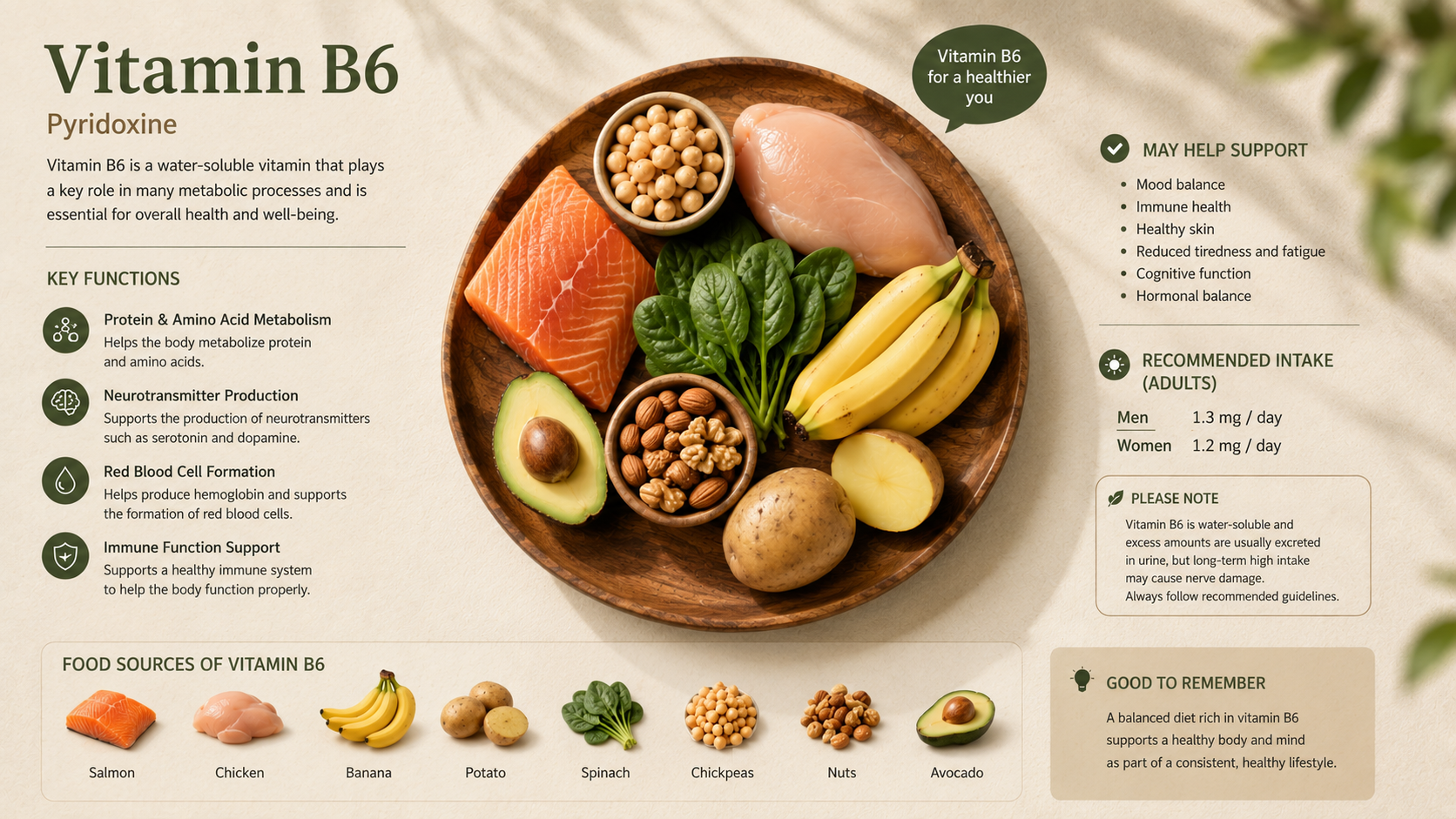 A clean educational infographic highlighting the key functions and food sources of Vitamin B6. Featuring salmon, chicken, bananas, potatoes, nuts, and leafy greens, the design emphasizes the importance of balanced nutrition for everyday health and energy.
Signs worth noticing
Fatigue that persists despite adequate sleep. Difficulty sustaining focus. Irritability or low mood without a clear cause. Cracked skin at the corners of the mouth, or a persistently rough skin texture. A general sense that your body is running below its usual capacity. None of these alone confirms a B6 deficiency — but together, and recurring, they are worth a conversation with your doctor.
Why midlife is when the gap tends to open
Vitamin B6 is not rare in food. It appears in chicken, pork, fish like mackerel and tuna, potatoes, bananas, and nuts. The issue is rarely that people don't know what to eat. The issue is the gap between what people know and what their actual days look like.
The forties and fifties are often the most demanding season of adult life. Careers are at their most complex. Children are navigating adolescence. Aging parents are entering a phase where they need more. The church has its own needs. And somewhere in the management of all of it, the quality of your own meals slides down the priority list — meals skipped, replaced by whatever is quick, eroded by frequent social obligations that involve alcohol, which actively depletes B vitamin absorption.
The same patterns that a younger body absorbed without obvious consequence begin, in midlife, to register as fatigue, brain fog, and emotional fragility. The body is not failing. It is giving honest feedback. And that feedback is worth hearing.
The body does not malfunction silently. It asks for what it needs — often quietly at first, and then more insistently. Learning to hear those signals is part of faithful stewardship.
Food first — the wisdom in ordinary things
There is something deeply fitting about the fact that most of what the body needs to function well is not exotic or expensive — it is available in the ordinary provisions of a well-tended table. Chicken. Fish. Eggs. Potatoes. Bananas. Nuts and seeds. The foods that show up in almost every culture's cooking tradition, that generations before us ate without giving it a second thought.
The wisdom literature of Scripture has always connected bodily nourishment with gratitude and attentiveness. Proverbs is full of observations about how the diligent tend their households, including the care they take with what they eat and how they live. The body was not designed to run on whatever is nearest and fastest. It was designed to be fed.
"She riseth also while it is yet night, and giveth meat to her household, and a portion to her maidens."
Proverbs 31:15, KJV
The woman of Proverbs 31 is praised, among other things, for the intentionality with which she tends to her household's provision. There is nothing spiritually elevated about neglecting to feed yourself well. There is something quietly faithful about doing it consistently — about treating the fuel of your body with the same care you would give any other resource God has entrusted to you.
The practical goal is not elaborate meal preparation. It is regularity and balance: protein at most meals, vegetables of varied kinds, fruit where it fits, foods processed as little as possible. These are not complicated principles. They are the unglamorous backbone of sustained energy and a stable interior life.
 A simple, wholesome meal arranged on a wooden table under natural daylight. Grilled fish, roasted potatoes, banana slices, nuts, and a glass of water come together in a quiet reflection of balanced everyday nutrition.
On supplements — what they can and cannot do
If meals are consistently irregular, or if fatigue has been persistent for some time, a B-complex supplement is something many people in midlife find helpful. These are widely available and generally safe at standard doses. The caution worth noting is about excess rather than deficiency: Vitamin B6 at very high doses over extended periods can cause nerve-related symptoms, so more is not better. Standard supplemental doses are effective and appropriate; the goal is filling a gap, not overloading a system.
Those already taking multiple supplements should check for overlap — B6 often appears in multivitamins, B-complex formulas, and standalone supplements simultaneously. And for anyone with ongoing, unexplained fatigue, the right first step is a conversation with a physician, not a self-directed supplement program.
The stewardship of a midlife body
There is a version of Christian life that treats the body as something to push through — to exhaust in service, to ignore in discomfort, to manage just enough to keep functioning. That version has always had a certain appeal, particularly for people who genuinely want to give their lives to something larger than themselves.
But the Scripture does not support it. The body is described as a temple — a place where God's presence dwells. Temples are maintained. They are tended to. Their care is taken seriously, not because the building matters more than what happens inside it, but because the building is where what matters most takes place.
"Whether therefore ye eat, or drink, or whatsoever ye do, do all to the glory of God."
1 Corinthians 10:31, KJV
Even eating can be an act of worship. Not in a labored, over-spiritualized way — but in the simple recognition that how we tend to this body affects our capacity to love, to serve, to think clearly, to be fully present. The person who is chronically exhausted and nutritionally depleted is not more spiritual. They are simply less available — to the people around them, to the work they are called to, and to the quiet attentiveness that a life of faith requires.
If you have been telling yourself for months that the fatigue will pass, that you'll address it when things slow down, that it's probably just stress — take one concrete step this week. Eat a proper breakfast. Sleep by a reasonable time. Make an appointment with your doctor if something has been persistent. These are not dramatic gestures. They are the ordinary, faithful maintenance of a life God placed in your care.
 Under warm afternoon light, a pair of hands gently presses soil around a young plant. A quiet moment of patience, care, and tending something living.
A prayer
Lord, You made this body and declared it good. Forgive me for the ways I have neglected it — treating it as expendable rather than as a gift entrusted to me. Help me to see the care of my physical self not as selfishness, but as faithfulness. Give me wisdom to pay attention to what my body is telling me, the discipline to respond to it well, and the grace to do all of it — even eating, even resting — to Your glory. Amen.