Every Good Endeavor by Timothy Keller — What If Monday Morning Is Where Your Faith Actually Lives?
You got the promotion. You sat in the parking garage for twenty minutes afterward, engine off, not sure why you weren't ready to go home yet. You had wanted this. You had worked for it. And now here it was, and something underneath it felt exactly the same as before.
You're not someone who abandoned their faith. You tithe, you serve, you show up. But somewhere along the way, the categories got sorted into two separate drawers — the sacred things, and everything else. And work landed in the everything-else drawer, where it has mostly stayed. You perform well. You're responsible. You just can't shake the sense that what you do from nine to five is spiritually inert — that God is present on Sunday mornings and largely uninvolved the rest of the week. So you do your job. You do it well, even. And you wait for the weekend. The question doesn't announce itself. It just sits there, under everything you do.
In 1957, John Coltrane hit the floor.
Drugs and alcohol had taken everything — his clarity, his discipline, finally his place in Miles Davis's band. The work he loved most, the only thing that had ever made sense of his life, was slipping out of reach. He went into a room alone and stayed there for days.
When he came out, he was different. Not fixed — but reoriented. He picked up the saxophone again, and this time something underneath the playing had changed. The music was still his. But it was no longer just his.
A few months later, he recorded what many consider the greatest jazz album ever made. On the liner notes, he wrote simply: "This album is a humble offering to Him. An attempt to say THANK YOU GOD through our work, even as we do in our hearts and with our tongues."
A Love Supreme. One of the most transcendent pieces of art in the twentieth century was born the moment a man discovered that his work could be an act of worship — that the thing he did with his hands and breath could be offered, and received. Timothy Keller opens his book with this story. Because what Coltrane stumbled into in that room, Scripture had been saying from the very first page.
 What Coltrane found in that room, Scripture had been saying from the beginning.
Paul doesn't say: change your job, or pray more at your desk, or find work that feels meaningful. He says: be transformed by the renewing of your mind. Which means the problem was never the work itself. It was the lens you were looking through.
Keller puts it this way — work is not, primarily, a thing one does to live, but the thing one lives to do. It is the medium in which we offer ourselves to God.
The email didn't change. The meeting didn't change. The spreadsheet didn't change. The commute, the difficult colleague, the project that never seems to end — none of it changed. What changed was the person looking at them. That's what renewal actually looks like. Not a new job. A new set of eyes for the one you already have.
And that, it turns out, is harder than finding a new job. And more worth it.
I didn't expect this book to reach into something I'd stopped questioning. The divided life — sacred here, ordinary there — had just become the water I swam in. I didn't know it was a division I'd made, not one I'd been given.
About the Book
How it's put together The book moves in three parts. The first establishes why work is a gift — tracing it all the way back to Genesis, before the Fall, before anything went wrong. The second is honest about how work breaks down, how it becomes either meaningless or an idol. The third shows how the Gospel reshapes work from the inside out. It's 288 pages, but each chapter is short and opens with a story, so it reads faster than it looks.
What it keeps coming back to The book is built around a tension most of us have quietly accepted: that our faith and our work run on separate tracks, and that's just the way it is. Keller pushes back on that from the first chapter. Work, he argues, was woven into creation before sin entered — which means the frustration we feel at our desks isn't evidence that work is meaningless. It's evidence that something good got damaged. From there the book moves through three movements that mirror the shape of the Gospel itself. First, dignity — your work carries more weight than you've been told, because you are doing it in the image of a God who works. Second, brokenness — the futility, the politics, the sense that nothing quite adds up — and Keller doesn't rush past this or spiritualize it away. Third, redemption — not that your work becomes easier, but that it gains a new purpose. You are no longer working to justify yourself. You are working as someone who has already been justified, and that changes everything about how you can show up.
What the author draws from The practical center of the book is this: loving your neighbor at work starts with doing your work excellently. Keller is direct about it — a Christian engineer who builds a safer bridge has served people more concretely than one who corners colleagues for gospel conversations but cuts corners on the specs. Competence is its own form of love. He draws on Genesis and Ecclesiastes to set the terms, and leans on J.R.R. Tolkien's idea of the sub-creator — that when human beings make things, they reflect the image of a God who makes things. Co-author Katherine Leary Alsdorf, who spent decades working in New York's tech sector, keeps the ideas grounded in the texture of actual working life.
Who tends to find this at the right time The person who has been a faithful Christian for years but has never once thought about their job as an act of worship. The one who is quietly burning out because work has become the thing they live for without quite realizing it. Or the one sitting at a desk that feels entirely pointless, just enduring until something more meaningful comes along. Both of those people are in this book, and both are spoken to directly.
If the divided life has started to feel like something you're tired of carrying, Timothy Keller's Every Good Endeavor might be exactly what finds you next.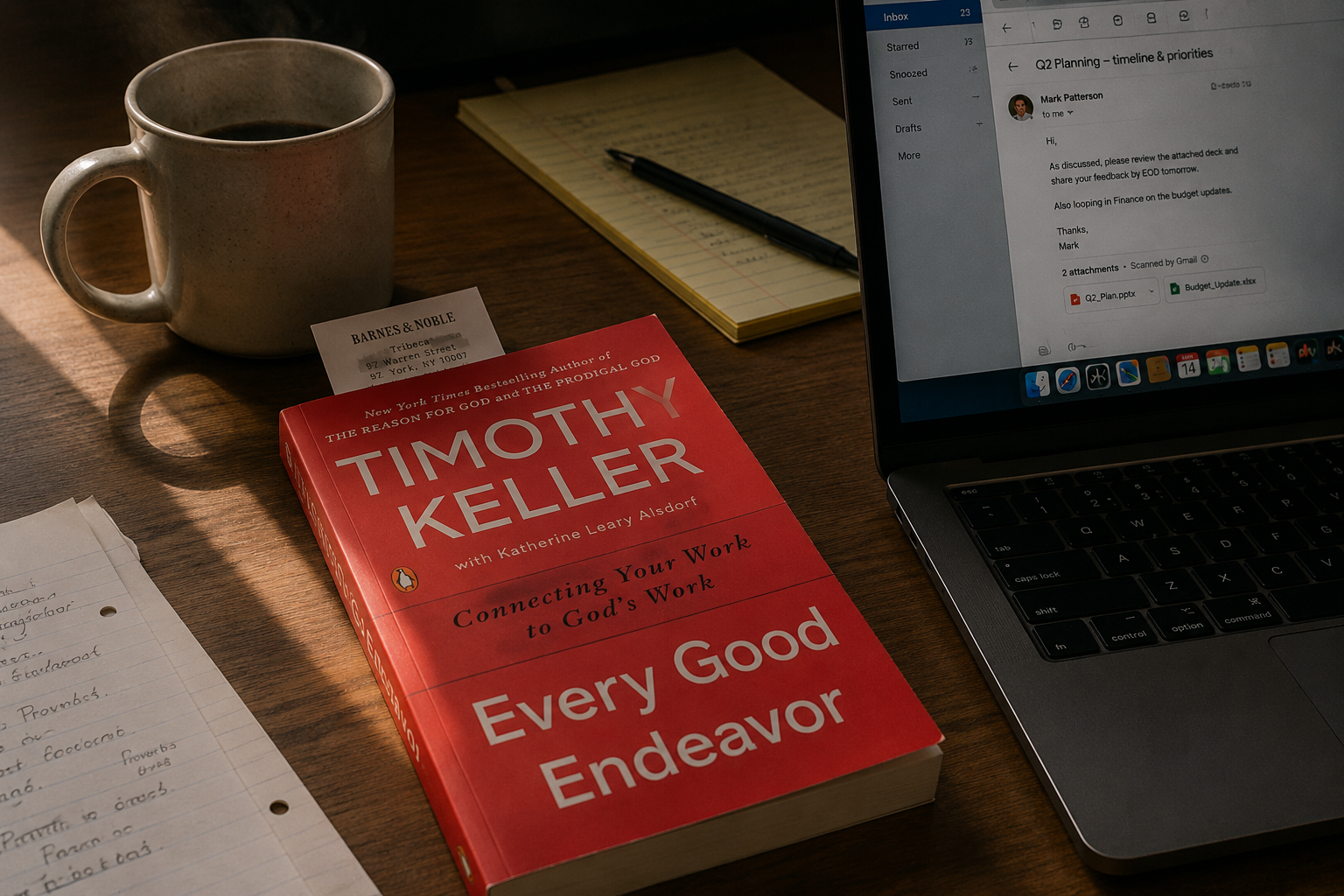 Set down between meetings. Picked back up before the day ends.
If you've ever sat with the quiet suspicion that your work should mean more than it does — and weren't sure where to take that — this is the book I'd hand you.
Read Every Good Endeavor (Affiliate Link)
📚You Might Also Like
Have You Ever Wanted to Believe But Just… Couldn't? — The Reason for God
Why So Many Christians Feel Stuck in Prayer — Prayer: Experiencing Awe and Intimacy with God